Writing

The GDC 2026 Notebook

The [Save Game] newsletter is back! After TinyLetter shut down I took a hiatus, but people keep asking me to bring it back, so here is an extra meaty one. If you are new to this series, please consider subscribing! It’s free, and in this age of social media atomization I have been finding more joy than ever in the circle of newsletters that brighten my emails.

Last week I went to the 2026 Game Developer’s Conference (GDC) and filled my notebook up with interesting lessons from all sorts of developers. I have pretty complicated thoughts about this year’s conference as a whole compared to the previous years, but I’d like to keep things focused on the juicy substance of game development talks. 

Please keep in mind that all of my notes are, at best, paraphrases of the original author’s words, and many of them have lots of editorializing by me based on my interpretations and connections to my own experiences.

Without further ado, here are my favorite insights from a random scattering of talks:


Flavors of Challenge: The 8 Flavors of Difficulty and How They Can Be Combined to Make Better Difficult Games

By Brett Moody

Moody proposed a taxonomy of different kinds of challenges that games can contain, in order to better understand why some games motivate people to overcome adversity while others don’t. This talk was very exciting to me, because I had been assembling my own chart of “flavors of fun,” so I wanted to see where our observations aligned and differed. 

He identified eight flavors of challenges:

  1. Reasoning
    • Critical thinking (Pentiment)
    • Deductive reasoning (Return of Obra Dinn)
    • Pattern recognition (Chess)
  2. Physicality
    • Hand-eye coordination
    • Strength
    • Balance
    • Accuracy
    • Agility
  3. Randomness
    • Input randomness (starting seeds, like Balatro or Spelunky)
    • Output randomness (differences in outcome, maybe like an attack dealing random amounts of damage within a range?)
      • I didn’t understand this split very well, but for research I picked up Uncertainty in Games by Greg Costikyan at the GDC gift shop, hoping it will have some insights.
  4. Endurance
    • This was one I hadn’t considered at all! Moody defined endurance challenges as the ability to “sustain concentration or focus”
    • Guitar Hero’s 8+ minute long level based on Dragon Force’s “Through the Fire and Flames” is not the most complicated song, but is an endurance test
    • Celeste and Super Meat Boy are a series of individual sprints, so the game is lower on the endurance flavor, while Getting Over It With Bennett Foddy is pure endurance
  5. Out-of-game resources
    • Time (very prevalent in board games, but all games weigh these facets differently)
      • Setup (waiting for player input, can build anticipation)
      • Play (taking your turn, doing an action)
      • Tedium (time it takes for actions to complete)
      • Waiting (time before you can input again)
    • Money (Poker, coin-op beat ‘em ups)
    • Knowledge (trivia games)
  6. Representation
    • Engaging with deeper themes can be difficult (Molleindustria games used as example)
    • Obscenity (Kane and Lynch 2: Dog Days)
  7. Interpersonal Skills
    • Reading Non-verbal cues
    • He gave a bunch of other examples, but sadly I didn’t have time to write them down
  8. In-game resources
    • Scarcity (Survival games)

With those eight flavors in mind, Moody offered various strategies for keeping players from feeling hopeless when faced with difficult challenges:

  • Pair skill growth with virtual growth
    • Consistently award stronger equipment, or stat growths
    • Common in RPGs or Dark Souls
  • Parallel Challenges
    • If you get stuck on something, have somewhere else to go
    • Look at Baba is You
  • Vary the flavor of challenges
    • It can keep up excitement to know that once you overcome one challenge there will be a reprieve with a different kind of challenge
  • Rewards should provide momentum and direction
    • Defeating one Megaman boss helps push you through another
  • Reward all efforts, not just victory
    • If effort doesn’t feel worth it, players burn out
    • Modern RPGs let players keep the experience points earned even if they die
  • Foreshadow big challenges early
    • Keeps motivation up
    • Breath of the Wild’s omnipresent castle creates excitement
  • Make retrying easier than quitting
    • If it takes more effort to quit out of a game than to try again, players are less likely to ragequit
    • This was the key innovation in Super Meat Boy
  • Avoid “time-taxes”
    • Redoing challenges you have mastered creates boredom
    • Moody offered criticism of Bloodborne’s run-backs, which some people might disagree with, but that just goes to show the subjective nature of people having different tastes for different flavors of challenge.
  • Never restart from zero
    • Rogue-lites cool features where players start their next run with a random bonus item/ability
    • Maintains momentum between runs, creates variety
  • Give suffering meaning
    • A game’s story can make frustration part of the thematic arc. Players will persevere if they feel something deeper than fun. 
  • Give players a common enemy
    • Being part of a larger movement can be motivating, making the struggle feel less lonely and more meaningful
  • Establish narrative stakes
    • If players get attached to characters then they will move mountains to get narrative satisfaction

I think these strategies are wonderful. Moody is spot on that every player will be interested in different mixtures of challenges, and some people will be more engaged in a game than others. If someone isn’t on the same wavelength with the game, they might drop out from frustration. These techniques could keep that person from giving up, and that could lead to them discovering a flavor they didn’t appreciate before. Growing players’ palettes deepens the culture of play, so I am keen to keep this list handy. Thanks for the great talk, Moody!


Game Designer’s Notebook: Five Obstacles to Successful Gen AI Games

By Jesse Schell

I’ll be a little rude and say that I thought the majority of this talk was delusional. Schell asserted that silent movies were not considered worthwhile art until the invention of talkies, and that the theoretical addition of conversational AI characters will be what finally liberates game-making from trash culture to the vaunted cultural status as filmmaking. Personally, I think LLMs and Gen-AI are like fracking – sure, they can give you energy, but they poison their own well with runoff, depend on temporary subsidization, cause incalculable collateral damage, and suck up any research or investment into sustainable technologies. But while it wasn’t the intention of this talk, Schell did a good job of vocalizing even more reasons why AI technology is a poor fit for games as we understand them.

“AI technology has been around for almost a decade, so where are all the games? I can’t even name flops. Isn’t it weird that there is nothing? Why is that?”

Here are my favorite new reasons:

  • Non-deterministic
    • The same input given twice to an AI will not yield the same output each time.
    • Inconsistency is the primary feature of AI. It is what makes it seem natural, as opposed to algorithmic code, which is consistent and obviously machine-like.
    • Games are systems of inputs and outputs, and need to be deterministic for a player to be able to understand the rules and dependably step towards goals.
  • Agents resist limitations
    • LLMs mimic patterns but do not have any understanding of meaning, so they are incapable of maintaining a “magic circle”
    • One of the generalized differences between videogames and physical games is that for IRL games the rules define what the player CAN’T do (“your hands can’t touch the ball”) while videogame code defines what the player CAN do. If you do something you aren’t intended to do in a videogame, it risks null pointer references which can create glitches or crashes.
    • LLM agents mimic patterns absorbed from the physical world, but exist in a virtual world of code, so agents will try to do things that aren’t programmatically possible.
    • Examples: Reference items that don’t exist, hallucinate characters, prompt player actions that aren’t available
    • Hypothetically defining everything an agent “can’t do” in a prompt would take more effort than just programming a traditional “can do” deterministic program
  • Players don’t want to be creative
    • The magic trick of LLMs is that a player could say anything and get a response. However, that wide open field has the “blank piece of paper” problem where players have to put in substantial effort to creatively think of the best thing to input.
    • The more open ended a scenario is, the less directed the experience is. Players become more responsible for how sucky their play experience is.
    • Deterministic models are better for curating directions for players. If games are about “a series of interesting decisions” then it is the game designer’s job to make those decisions interesting, not the player’s job!

Schell had a fun analogy: “You wouldn’t put a live bird in a cuckoo clock and expect it to come out and chirp three times at 3pm”

I don’t think AI birds are alive like that, but I do agree that the output of AI is fundamentally mismatched with the last 8,000 years of game design as it has been understood. Perhaps new forms of play are possible with the technology, but I don’t see any reason why they would be better or deeper than what creators have been practicing during our current golden-age of game development and study. Why anyone would explicitly want the end or replacement of that is beyond me. It breaks my heart to see someone with a deep structural understanding of games turn to hating them.


Constructive Destruction: Fusing Voxel Tech and 3D Action Platforming in ‘Donkey Kong Bananza’

Kenta Motokura and Tatsuya Kurihara

This has been one of the more quoted and reported-on talks from the conference, so I want to focus on some general design ethos observations I came away with from this talk:

  1. The games started from a crystal clear genre and technology concept
    1. 3D Action Platformer + Voxel Technology = Destruction = Donkey Kong
  2. Nintendo’s gameplay spirit is to focus on interactions between game elements
    1. They identified that the core feature of voxels is the ability for reactions to exist across surfaces rather than points
    2. For example, a non-voxel object taking damage is applied to the whole object because it can only tell that there was an interaction between the damaging object and the hit object, but a voxel object can apply damage to just the surface areas that were hit, creating a hole the size of the damaging object
    3. Surface reactions allow for chains of destruction, which can unveil points of interest and incentivize exploration.
  3. Nintendo’s traditional elements of a 3D action platformer are:
    1. Terrain
    2. Gimmicks (gameplay objects)
    3. Enemies
    4. NPCs
    5. Minigames
  4. What we may call a “game loop” Nintendo calls a “game cycle”
    1. For platformers their loop alternates between the player’s normal state and a “powered up” state, though they clarified that does not necessarily mean a Fire Flower or other clearly labelled item.
    2. In Bananza, to keep with the spirit of centralizing voxels, they asked themselves how to achieve DK = [normal] and DK+Voxel = [powered up]
    3. When DK is holding a voxel, he gains the ability to:
      1. Swing for extra damage
      2. Throw for a ranged attack
      3. Double jump
      4. Enhanced speed while riding
    4. Bananza has a “small, high frequency game cycle” as players are grabbing and losing their voxel pickups
  5. Voxels were not very fun to destroy until the levels were beautiful.
    1. Nintendo coated the levels in non-voxel game objects, but disguised this by making them all destructible. They usually fly away when hit, and cause impacts on voxel surfaces to ensure that the “chain of destruction” loop continues
  6. The level tools appeared to be very simple
    1. In-engine level designers could create box volumes of different materials, and carve through them with subtractive boolean cylinders. Collectibles would be placed within the subtracted space.
    2. Unique voxel shapes would be created through a Maya -> Houdini -> Voxel export process.

‘Silent Hill f’: The Challenges of Creating a Melee-Only Horror Game

AL Yang

This talk astonished me. The Hong Kong developer Neobards had one week to put together the pitch for this game, and only a month to prototype it. I’ve been in a similar situation before but I landed on my face, so it was amazing to hear how their focus on practicality let them deliver an efficiently produced title that punched above its modest budget. They thoroughly documented the experience before starting, and identified “Danger Points” early on for features that they knew would be difficult, so they could budget x2 or x3 the usual time for those parts. Many cuts were made early on based on cost efficiency, but that let them focus on delivering a higher quality experience than they could have otherwise.

The biggest cost saving choice they made was to avoid developing ranged combat systems. This saved them from having to create a wide range of animations that would have been required to compete with the brand’s main competition. However, this meant that they had to design replacements for the various risk/reward systems that ranged combat provides. Some examples:

  • When shooting zombies, the danger rises as the enemy gets closer, but at the same time they become easier to shoot
    • Replacement: They reversed this! All enemies were given ranged attacks so they were more dangerous the further away they are, forcing players into hiding behind cover
  • The tension between needing to conserve bullets vs wanting to unload into an enemy feels great
    • Replacement: Melee weapons were given durability, so they functioned like ammo
  • Distance is tough to read in over-the-shoulder perspectives, but gun reticles conveniently flatten aiming into a digestible 2D screenspace
    • Replacement: They simplified distances by having melee attacks snap combatants into fixed places, and use long exaggerated animations to make the risk/reward about timing light vs heavy attacks. Heavier attacks leave you vulnerable, but the reward is that they deal substantially more damage and while maintaining weapon durability.

Each of these redesigns flowed from an argument Yang made that all action games lean either toward RPG or fighting game systems. He observed that sports games have dropped their fighting game traits and shifted to more strategic RPG-like systems over the last few years, because that is better for casual audiences. How much will a player learn about the game system after ten hours with an RPG, versus ten hours with a fighting game? Yang posited that after ten hours a developer can accurately predict a player’s growth in an RPG using experience points and stat growths, and the player will understand the mechanics of the system pretty completely. But in a fighting game, players will vary wildly in ability after ten hours depending on the player’s introspection: players become better at fighting games if they can reflect on their own play. Because this is an uncontrollable factor, it is better suited for hardcore games than casual ones. 

For Silent Hill f, they knew they would have a large audience of casual players because the story’s script was penned by a popular author, so it needed to be playable for people who were only invested in the story. They leaned away from fighting game mechanics and towards strategic resource management: stamina meters, weapon durabilities, and time. Fighting games prioritize reflexes by requiring players to hit the correct button within tight timing windows, but Silent Hill f rewards patience and waiting for the right moment to execute a generous counter.

A final memorable note: Because horror games are all about high tension, but there is no way for a developer to anticipate when a challenge will be too frustrating for an individual player, many horror-action games will often give the player what Yang calls a “master key” that can be used a limited number of times to bypass break one of the game’s systems. The most obvious example is Resident Evil’s rocket launcher, which has become available earlier and earlier in their games. If a player is stuck in a fight and no longer having fun they can blow past it using the rocket launcher, but the ammunition is very limited so they have to make that choice carefully. This lets the player choose when they need it without feeling bad. It doesn’t just need to be for combat, though. A master key can be created to break any game system. In Silent Hill f they introduced a weapon with unlimited durability during a memorable part of the game.

I thought this talk was interesting because my impression from reviews was that Silent Hill f’s combat was divisive. The developers didn’t shy away from regrets they have with aspects of it, but it was clear how much thought went into their decisions, and that the tradeoffs are what allowed them to make a game that, at the end of the day, had players comparing it sincerely with titles of much higher budgets. I think there is much more to learn from those circumstances than from anywhere else.


Misc:

  • From a panel discussion on the State of Level Design, Absurd Ventures level designer Cameron Williams described open-world level design as an “additive process” compared to linear level design.
    • Many factors of the environment are fixed, such as landmarks, distances, systems, and adjacent gameplay.
    • Most often, designers have to add gameplay on top of the existing environment with only limited ability to reshape the space.
    • Often it is easier to cut content than to add it. Space can be carved or obstructed, but more space can’t usually be added without large repercussions on the surrounding spaces.
  • From a talk on Despelote, Julian Cordero noted that fantasy is easier to create in games than reality.
    • This harmonized with a recently translated 1989 interview with Shigeru Miyamoto and Shigesato Itoi where the two explain that the earliest videogames involved piloting spaceships because sci-fi physics can be anything, but replicating familiar physics is difficult and it feels bad when it is off.
    • Despite the difficulty, we have more tools and knowledge for creating “neo-realism” in games than by pushing for graphical fidelity. Despelote uses recordings from improvised conversations to give a uniquely warm feeling of real performances.
  • The .Hack and Fuga developers CyberConnect2 gave a candid business talk about their initial struggles to switch to self-publishing and had a good explanation for regional pricing.
    • If a game was sold in the US for $30 in 2018 the conversion rate at the time would price the game at 3,000 yen in Japan.
    • If a $30 USD game was sold in Japan using the 2026 conversion rate, it would cost 4,500 yen.
    • Pricing the game at 4,500 yen might be the most accurate exchange for the currency, but Japan’s comparable domestically made games will still be priced at 3,000 yen, and consumers will consider the imported game too expensive compared to everything else they see on the shelf.
    • While $30 might be worth 4,500 yen, a $30 game is worth what a $30 game is sold for in the region.

It was a good GDC, full of interesting lessons, greater student access, and good company. But it was also a year where the conference was trying a rebrand, and inserted itself in the organic culture that emerged around the conference itself. Large gatherings at Yerba Buena were disrupted by a village of tents, and all the evening parties were wrapped into a sanctioned list that drove the smaller parties further underground. Even though attendance on the whole has continued to decline, everything was stuffed with too many attendees as everyone was driven into a smaller selection of talks and activities. I had to be at least half an hour early to each of the talks in order to get in line early enough, even for talks that would have only filled half the room in previous years. It was a strange contrast to the rebranding, which tried to present GDC as a “festival” open to more than just developers. 

More than once I heard people compare this year’s conference to the identity crisis in the waning years of E3. But for all its problems, I hope GDC doesn’t fall apart. The amount of infrastructure required to create such a large gathering can’t be easily replaced. As Los Angeles game developers above a certain age know, behind the cameras Summer Games Fest is a virtual charade of what E3 was. A host of factors are playing into California fumbling as the global hub for game development, but its loss doesn’t mean something better will rise elsewhere in this decade or the next. Instead, please elect me as the next president of the ESA! (Who even is it that votes on that anyways?)
Subscribe to the [Save Game] newsletter!

Next Era

After the unfortunate closing of TinyLetter this newsletter has been on pause until I find a suitable replacement service. I’m very grateful for the readers who have reached out with recommendations, and those who have encouraged me to keep writing more. A great deal has happened since I wrote the last letter! So if you will indulge me, how about a quick life update?

In 2024 I was able to celebrate the release of Penny’s Big Breakaway — Evening Star’s debut title. I was Evening Star’s first employee over five years ago, and it has been a long road to get the game out the door. The team built our own 3D engine, created a unique technical pipeline for iterative level creation, and experimented with gameplay conventions to make a truly fresh entry in one of the oldest genres in videogames. I am unbelievably proud of our accomplishments, and any trials we faced were peanuts compared to the gratification of seeing people dig into the game on Twitch, YouTube, and elsewhere. I’ve worked on many titles that never saw the light of day, so having the opportunity to be part of a game all the way through production was very special.

I also had the opportunity to come up with new original titles and pitch them at DICE and GDC in 2023 and 2024. This was a ton of work to juggle while also finishing the studio’s Big Breakaway title, but it was a blast. It gave me a new perspective on the business end of game development, and really transformed the way I think about design. I’ve always tried to keep a material labor focus on my design analyses here, but my understanding of the economics were more abstract before, and now I have a better sense of scale and numbers. I’ve had to do more than a couple breakdowns of other games in an attempt to reverse-engineer their productions, which I can’t share here but in the future I might do some for fun and share those.

We built some incredible prototypes, but unfortunately couldn’t land a publisher either year. I might spend the rest of my life thinking about what I could have done differently, but I know it wasn’t for lack of thoughtfulness or effort. The climate for mid-sized indie titles is dire right now. Many people have offered different perspectives of why this crisis is happening, and I definitely have my own, but I don’t think there is a single fundamental cause. Everyone’s takes are probably right, to some degree, which means that there isn’t a single change that can fix broken parts of the game industry.

I have no clue what the future is going to look like. New modes and models will emerge somehow, someday, and the people who adapt to them will be the ones that stick around. What I know is this: play is older than mankind, and color television is younger than the president. There will always be games, but the technology and business around them cannot be taken for granted.

Until the next time, keep on having fun <3

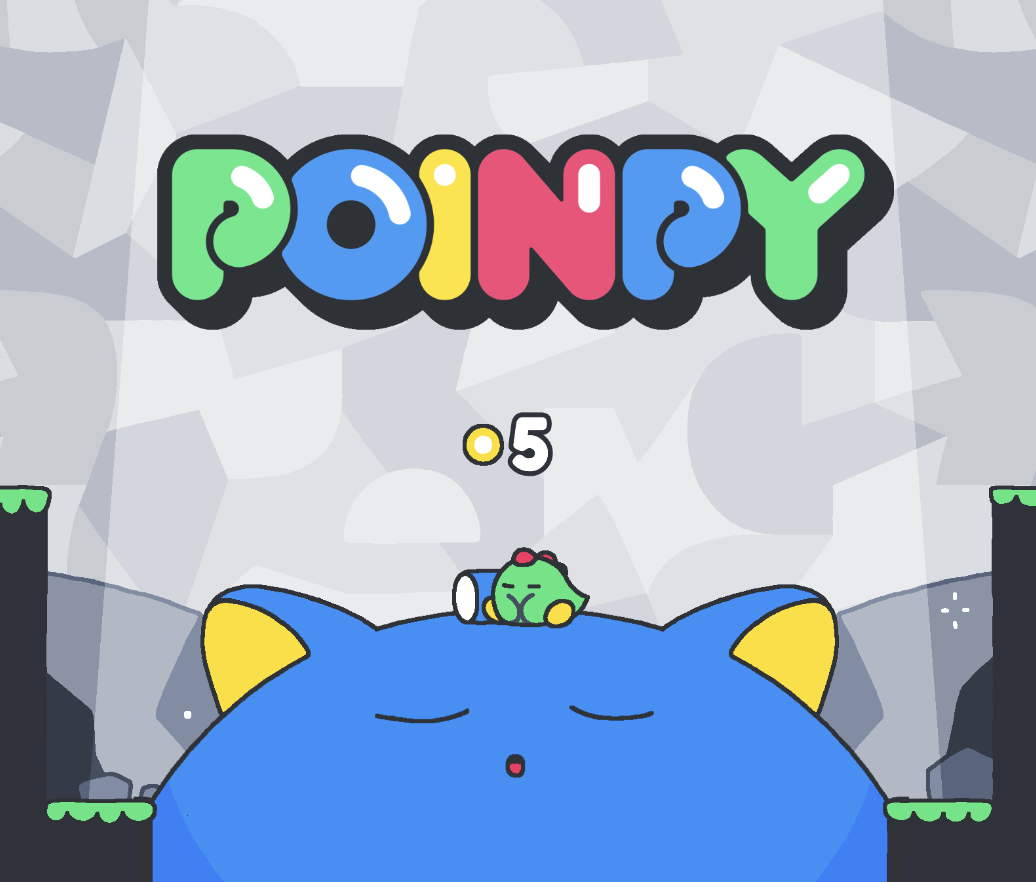
Poinpy GOTY 2022

[Let’s pretend this came out in December of 2022]

Poinpy is my 2022 Game Of The Year. As a mobile game available to anyone with a Netflix login, most people could be playing Poinpy within a minute, no matter where they are or what they are doing. Yet I’ve never talked to someone else who’s played Poinpy! No one has even heard of it! Maybe it’s because the name is too hard to pronounce, even though it is so much fun to say. Poinpy! Try it! ˈPoin(p)ē!

Poinpy Trailer

Poinpy is a platformer for your phone developed by Ojiro Fumoto with art by @2nd_Error403.* It’s Fumoto’s return to the indie scene after a brief stint at Nintendo where he worked on Ring Fit (Nintendo’s best new IP since Splatoon). Poinpy is a mirror image of Fumoto’s first hit, Downwell. In Downwell you descend down a well, and in Poinpy you climb up one. In Downwell you seek ground, and in Poinpy you avoid it as much as you can. In both, your key actions reload when you land. And while both Downwell and Poinpy’s procedurally generated tunnels give the appearance of infinitely scrolling arcade games, they both have definite endings.

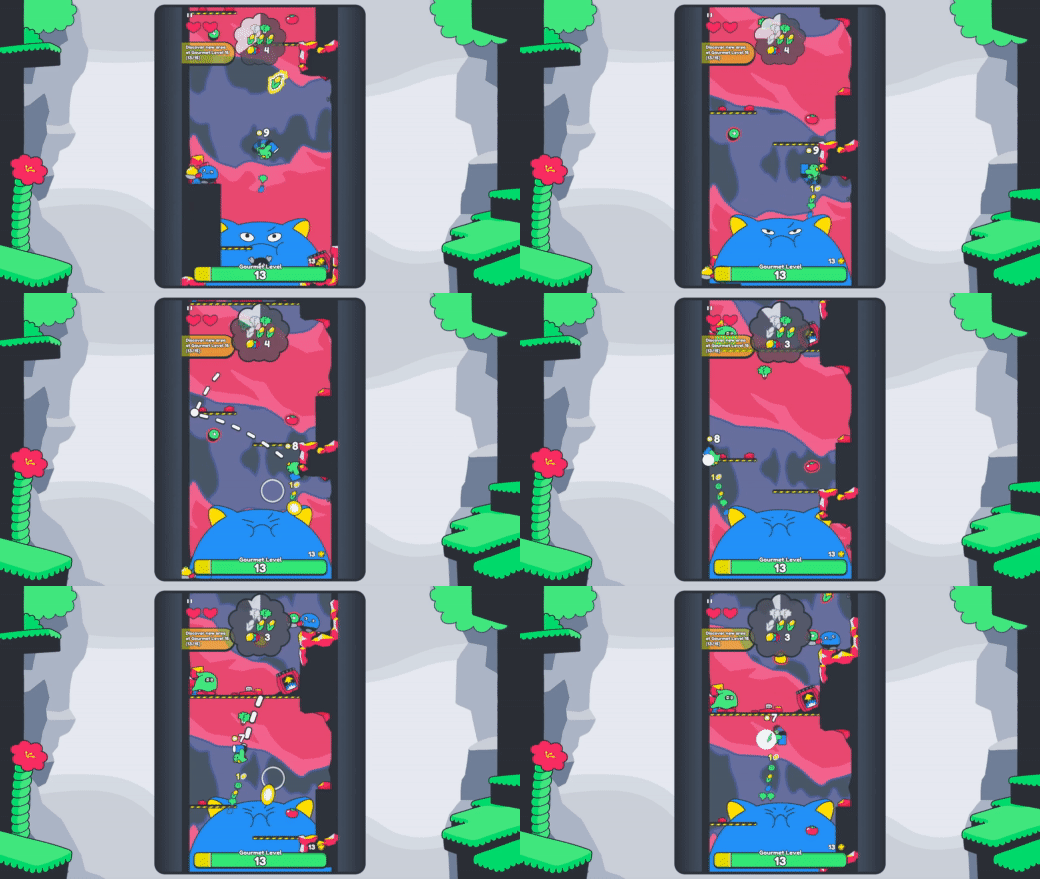
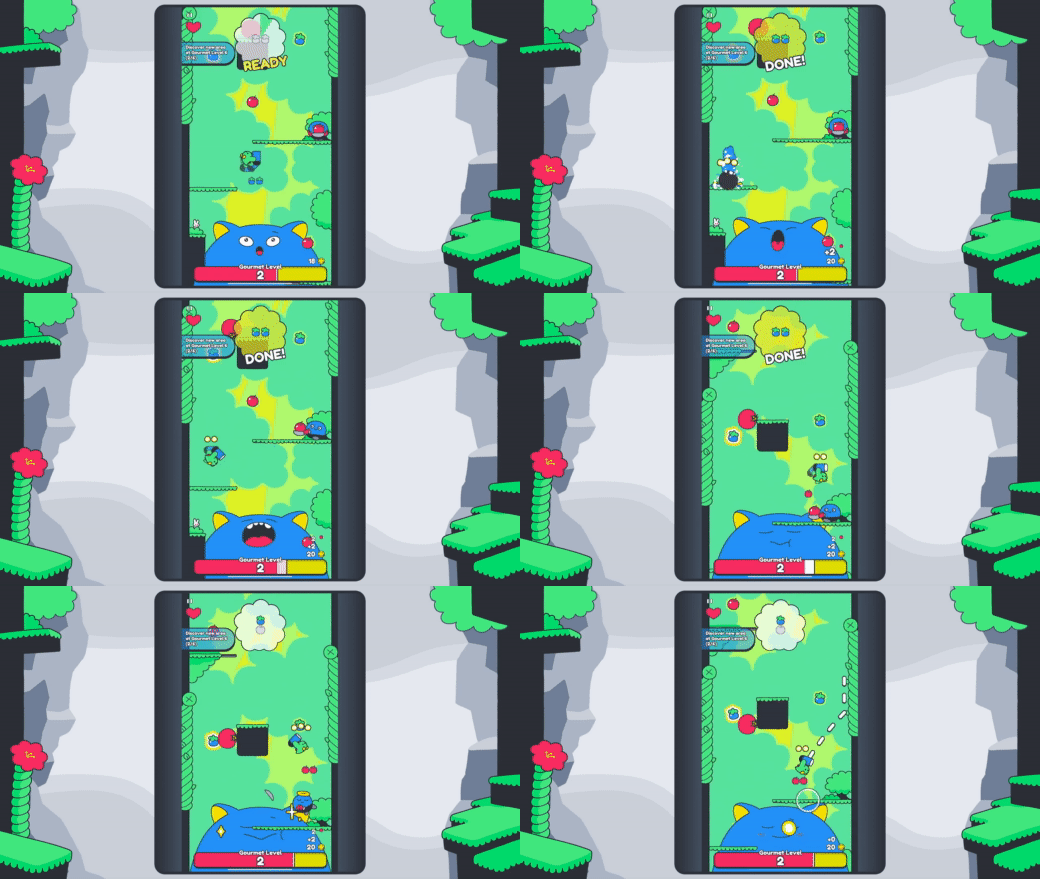
In Poinpy you play as a cute dinosaur with a fruit blending bucket. A hungry beast demands smoothies, and it will incinerate you if you touch the ground without the specific ingredients. So you must ascend a well using careful wall bounces to collect the fruits. Additionally, you gain a jump whenever you land on an enemy or a pot, allowing you to chain together jumps and perform dazzling mid-air acrobatics to collect the floating fruit. As you feed the beast its demands grow more complicated, but the better you play the more permanent upgrades you unlock. This gives it a wonderful arc; in the beginning Poinpy is a puzzle-like challenge to carefully use your slim abilities to collect all the ingredients, but before long your familiarity and tools let you play it as an action game where you blast through enemies instinctively.

Of all the games I have played this year, Poinpy holds the highest esteem from me because it achieves the pinnacle of a genre on its platform without any superfluous waste detracting from its achievement. Poinpy presents players with a challenge that is interesting and that evolves over its runtime. It overflows with comfortable cuteness in its art, music, and game feel. All of this combines to make an experience that is deeply satisfying, and which I will remember fondly into the new year and beyond.

Touch the ground to blend fruit, bounce on enemies to gain jumps

The platformer genre originated in arcades with Donkey Kong and Mario Bros, but flourished on home consoles during that period in the 80s and 90s when the sensibilities of the arcade experience still carried over to the living room. Arcade games have simple controls, short play sessions, and demanding difficulty. In the same way the first television shows were just people reading radio dramas, the first home console games carried these arcade traits. In time, developers would recognize that home consoles had their own set of virtues: longer play sessions, bespoke set pieces, and complex, standardized controls. But that shift would come after the platformer genre found its home. So while our sensibilities have changed as long as platformers are about slipping and falling the arcade will be in its blood. The arcade would return, however, in a new device that quickly gained ubiquity.

Mobile phones are the new arcade. A physical room of loud strangers has traded with a virtual one. Notifications from dozens of chat apps claw for your attention. You don’t wait in line to play, but you do play while in line. As a result, games with brief bursts of play thrive on the platform. A phone’s limited interface means that controls must be kept as simple as possible. These make mobile games resemble arcade games so closely that Apple even named their subscription service “Apple Arcade.” However, mobile phones have an important feature that arcades did not: the singular player profile. An arcade machine is shared by many players, but a phone has one owner. This allows for phone games to have persistent progression just like a home console.

The reason platformer games thrived on early home consoles more than in arcades was because consoles let you advance through a globe-trotting adventure bit-by-bit. The first Donkey Kong cabinet had only four levels, but on a home console Super Mario Bros. could have 32 levels. It wasn’t technical freedom that allowed for this, but a different reason: the game no longer needed to be shared among a crowd. Save systems soon allowed even more levels to be strung together. This made every victory in a play session another step along a grand journey. The lingering arcade sensibilities of precision and difficulty created engaging challenges, while the affordances of home consoles provided an arc that makes those challenges rewarding. Relatively speaking it was only a short blip of time when home console games had this overlap of styles that birthed the platformer genre. With mobile phones sharing that same mixture of both arcade brevity and console persistence, it seems like platformer titles should have seen a renaissance there; however, that has not been the case.

Platformers have languished on mobile phones because they lack the one trait that is most important to the genre: precision. Touchscreens struggle to offer tight controls. Buttons let you know their properties physically: the resistance of the spring, the click of the confirmation, and the shape of the button itself. All of these elements communicate the state of input, and let you control a character with 0.0167th a second of accuracy. Your finger can slide across a touchscreen frictionlessly, but that input is floaty and imprecise without any bounds. This is trouble for platformers because they are fundamentally games about intuitive physics. We understand how gravity works, so platformers ask us to react quickly and precisely to navigate up and around obstacles. The more precise that navigation can be the more possibilities there are for fun and varied challenges.

Consequently, the platform games that have found success on phones reduce their physics from two dimensions down to one. Temple Run, Flappy Bird, Mario Run, and Canabalt all push you forward automatically. You are not controlling left and right and up and down, just one or the other, usually with just a tap or swipe. This is not a dig at those games – they maximize a single input with enviable depth – but all of them have controls that are even more minimal than the arcade games that they are based on. Games that go in the opposite direction and try to emulate buttons on the touchscreen always suffer from input mistakes, like moving left when you meant to go right or missing the jump button. Even the platformer games that have exceptionally good virtual buttons, like the classic Sonic ports or Fumoto’s own Downwell, still suffer from the momentary second guessing that each input brings. Without clearly defined ridges around the buttons I always ask myself “Are my fingers in the right place?” before taking an action.

Drag to fling

Here is Poinpy’s first step above its predecessors. Unlike Downwell, Poinpy’s controls are native to the touchscreen format and are elegantly designed to be played with a single hand (or finger!). Jumping is handled through a slingshot style drag that will be familiar to anyone who has played Angry Birds or Desert Golf. Press and hold down anywhere on the screen, pull back to set the jump direction, and then release to launch. The cross-cultural success of Angry Birds showed how intuitive this input is. You can start the drag anywhere, which keeps your eyes on the game and away from your thumbs. The fling can go in 360 degrees, allowing you to take full advantage of the 2D space. Poinpy enters slow-motion while you aim, which gives you enough time to be precise within that wide possibility space while maintaining a delicious time pressure. You can tell exactly where your character will launch before you commit to it thanks to a projected trajectory, but it will only show some of the route. The rest has to be imagined, and that is where the depth comes in.

One of the pleasures of the platformer genre is that with practice, your jump trajectory becomes internalized. Poinpy offers the same pleasure in the distance beyond the projected path. Because you want to stay in the air as long as possible, the further you can bounce your character around with each jump the better you will score. The fling is finely tuned between what it shows and what it does not, and how quickly you can act. Your score suffers if you stay within the handicaps of the projected path and the slow motion. These niceties make it easy to play competently, but Poinpy always pushes you to play better through complex motions and faster actions. Learn the physics to bounce off more enemies and walls with each jump, and turn those calculations into second nature so you can release your fling before wasting a millimeter of falling.

Tap to slam

There is one other action Poinpy has – the ground slam. Tap on the screen and the character will pause for a tiny fraction of a second before slamming straight down. If you slam onto a pot or an enemy you’ll bounce back up to just below where you started the slam. This action is easy to do, but you have to remember what is directly below you to avoid breaking your jump combo. This includes remembering things that are off-screen, which are the most rewarding things to slam onto because it bounces you back to your original height as well as awarding you an additional jump. The speed of the slam contrasts with the arc of the fling, which rises and falls with gravity. The fling is full of grace, strategy, and anticipation, while the slam is punchy and determined. The contrast creates incredible pacing. Whiiiip foooooo BLAM bwoooing fwoop pwaaaaaang BLAM!

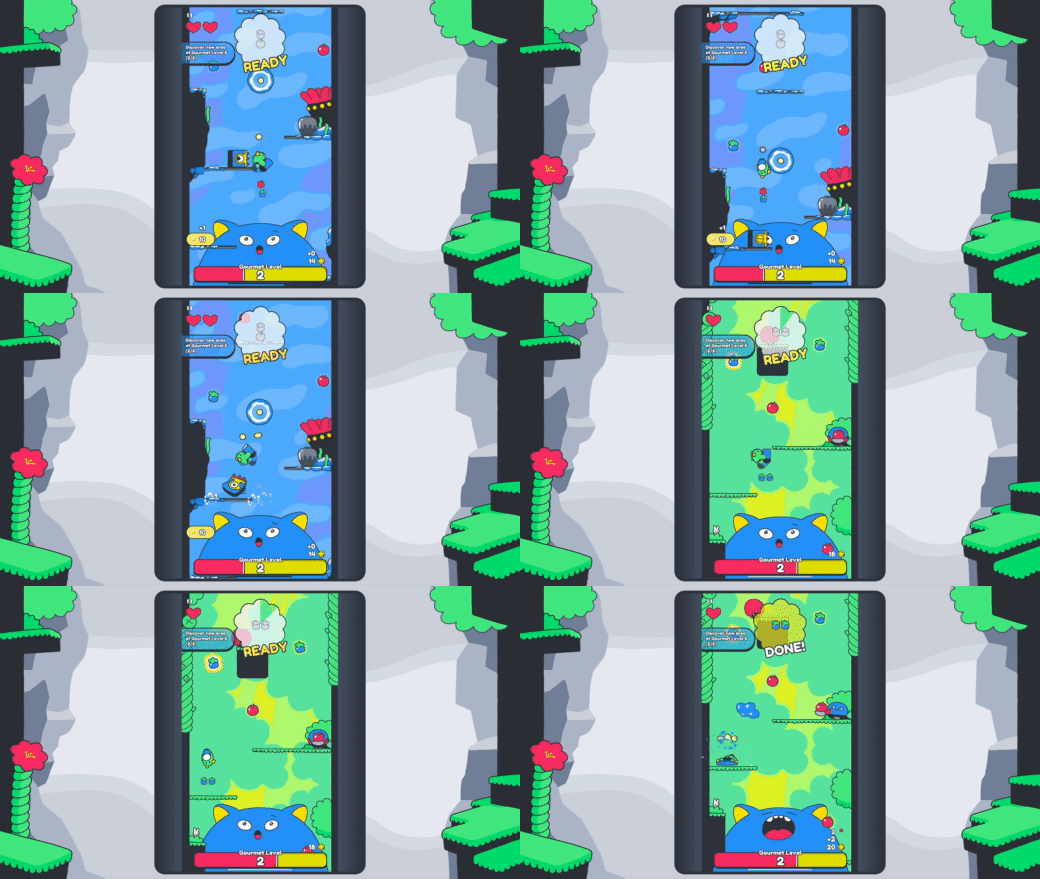
As you grow in proficiency with the flings and slams the targets you aim for increase in complexity. First they are stationary, then they are moving from left to right, then moving in mid-air, hopping in an arc, and so on. This evolution emerges naturally, as do all the other elements of the game’s various progression systems.

Level up to unlock more abilities

The overall goal in Poinpy is to feed the monster enough smoothies to unlock new areas. The more fruit in a smoothie the more points it doles, and once you have enough points then the level transitions into a new setting. Poinpy is run based; whenever you die you restart from the beginning with the score at zero. If you manage to unlock an area, though, it enters into the random rotation of areas on subsequent runs. Each area challenges specific play styles; the water level is about timing jumps, the fire level is about introducing a fireball state, and the palace is about using wall bouncing to get around overhangs. When a new area is unlocked, a set of puzzle challenges unlock as well. These puzzles use hand crafted scenarios to teach advanced techniques and are elegantly stashed to the side of the title screen, where you return after each run. The room is empty to begin with, but as you level up you gain the ability to climb the empty room to reach a secret throne hidden above and out of sight. This setup masterfully makes you feel smart for discovering it without actually being hidden at all. It makes you say “Ah-ha!” and then it rewards with more opportunities to feel clever in the puzzles themselves. 

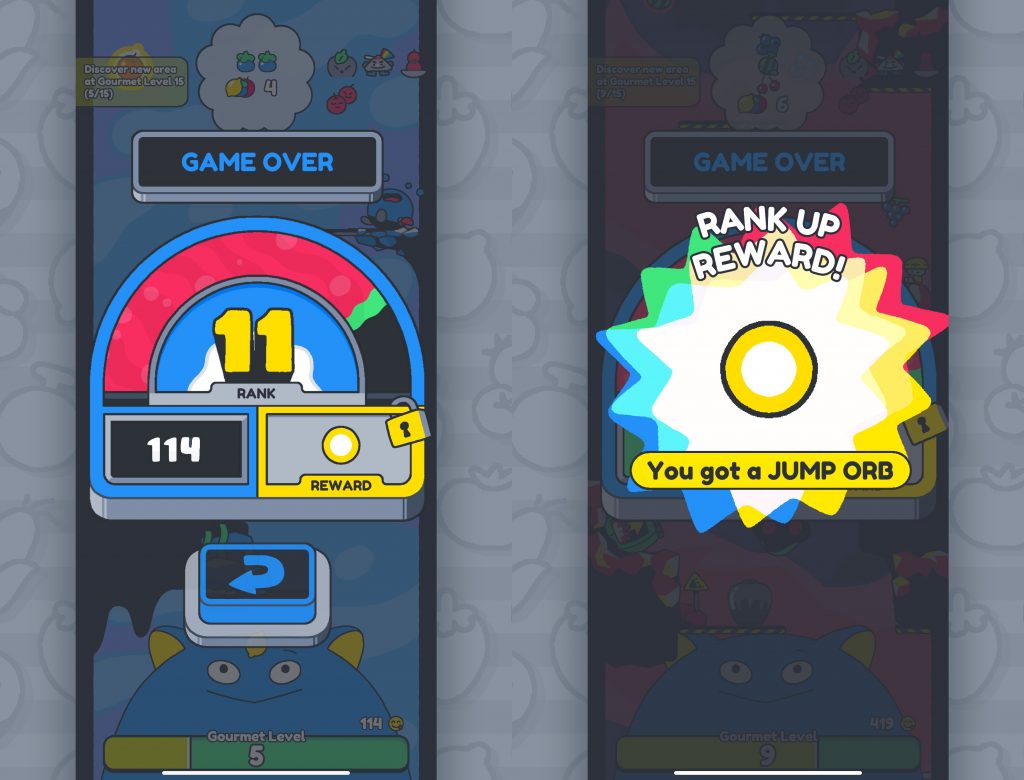
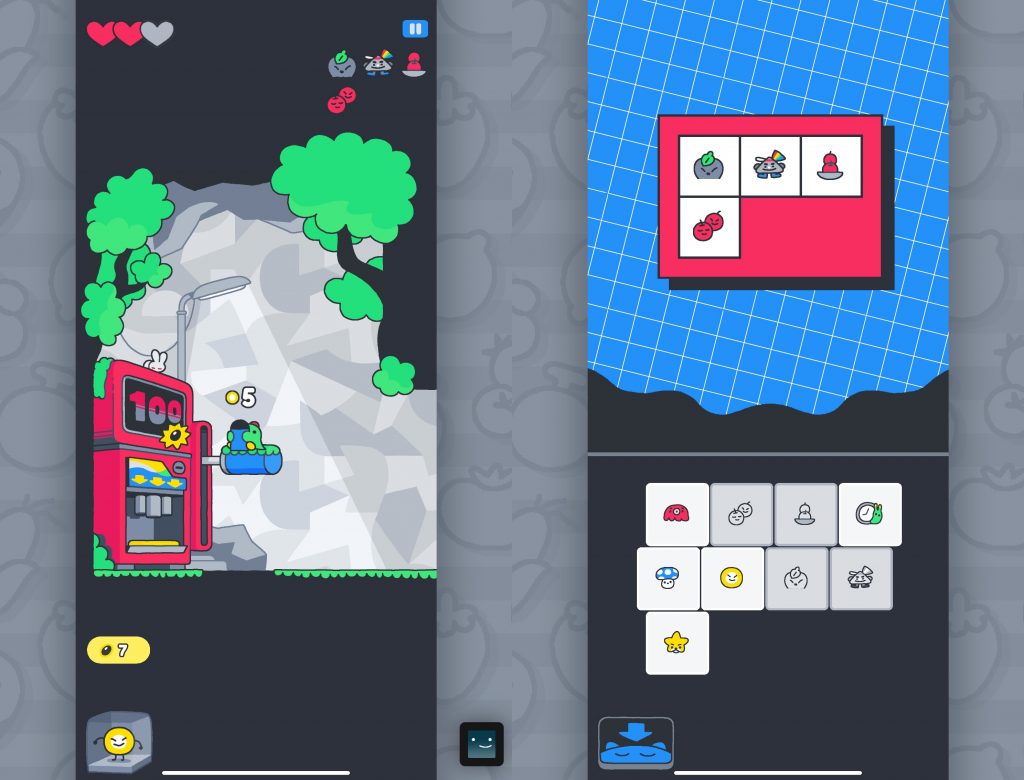
Reaching a new area is exciting and motivating, but the primary gameplay evolution occurs through a pair of parallel progression systems: the player level and ‘seeds,’ the in-game currency. After each run, your smoothie score is pumped through a leveling meter. When you reach a new level, you unlock either a permanent upgrade to your number of jumps or equipment slots, or a big bag of seeds. The additional jumps allow you to travel through the air for longer without hitting the ground, making it easier to collect fruits and reach higher scores. The equipment slot allows you to apply a modifier that changes your character or the level. These modifiers are purchased using seeds. A cheeky gachapon machine dispenses three random modifiers, of which you can only keep one. This provides the thrill of randomness without the dissatisfaction of a bad roll. You don’t know what you will get, or even what is possible, but you get to keep your favorite! This leveling system is another part of Poinpy that is mobile native: recognizing the best pleasure of gacha without the predatory aspects.

The gachapon dispenses powerful modifiers

These modifiers provide the greatest source of evolution over Poinpy’s playthrough. Because they are unlocked semi-randomly they push you to explore different playstyles. Eventually you have the experience and tools to define your personalized kit. Good at slams? Increase the number of pots! Narrowly missing fruit? Have them suck in at the start of a slam! Many modifiers synergize with others, and figuring out the combos is a rewarding puzzle that feels like sneaky cheating. By the end of the game I had constructed an invincible dinosaur that blasted through areas like superman. Working up to it, each run felt like a step forward thanks to the leveling meter. The steady stream of new modifiers provided novelty around each corner, and clicking them together gave me a sense of clever ownership over the game. This novelty may have worn out, though, if the game didn’t have an ending to work towards.

Poinpy can be played infinitely, but if it was only an infinite game then it would have lost my interest. Unlocking new things only feels satisfying if those new things are pushing you towards something tangible. Progress needs a destination, and without spoiling it, Poinpy delivers with a final area to reach and surpass. Games without end states inevitably leave a taste of guilt, no matter how good they are. Any Animal Crossing player knows this bitterness well – our time with the game can be full of happy, worthwhile memories, but once you move on with your life to something new it feels bad to leave a game world ‘undone.’ This happens even for multiplayer games, like this year’s fantastic Splatoon 3. I can say a million good things about that game, but when I think about Splatoon 3 I would be lying if I didn’t mention the guilt I feel for not playing it literally right now. I know in my gut I didn’t finish my time with Splatoon 3, but no one ever can. I have no such reservation with Poinpy. I may have had more fun in moments playing Splatoon 3 than I have with any other game this year, but when I reflect on the totality of a game’s experience Poinpy’s ending lets me sit then and forever in perfect satisfaction.

Except, Poinpy’s ending plays a subtle trick. I began to sense it as I approached the final area. I had slipped and died just short of my ultimate goal, and as I watched the leveling meter fill up with my spoils and tick to level 18, I felt a sense of dread. I unlocked the last equipment slot, and realized I could have reached the ending before hitting this level. I didn’t need the equipment slot. I could have beaten the game earlier, without all the powers that were bending the game in my favor. I didn’t need them, I was a better player now. But you can’t unwind a level. That number only goes up. Whatever level I am when I beat the game, that will be how good I am. I couldn’t unrealize the fantastic and horrible truth. I don’t want that number high, I want it low. Poinpy isn’t basketball. It’s golf.

I knew with certainty then that after the credits rolled Poinpy would show me my level. It would say nothing about it. Poinpy would make no judgment. No suggestion. It would never have to. Like the hidden puzzle room or the modifier combos, it trusted me to make my own discovery and push myself to take a new challenge. We hate someone telling us we could do better, but it’s beautiful to say to ourselves “I know I can do better.” I’ve beaten Poinpy now, after slipping and falling and hitting the level cap. It was thrilling – when I started the game each failure felt like a gentle step forward, but when I was finishing it I could see each failure stacked side by side on that level bar. The drama amplified. When I finished, I knew I could have done so much better. I was ready to restart the game as soon as I finished it. Poinpy is a game that can be played infinitely, but it has a definite ending. That definite ending, as the deft combination of all its systems, produces the best of all feelings: total satisfaction for what I have done, and welcome arms to come back and try again. The rewarding journey of a home console experience, and the daring depth of the arcade.

That rewarding journey exemplifies the home console experience, and that daring promise of a worthwhile return epitomizes the arcade style. With this ending Poinpy succeeds in taking the platformer back to its roots in the overlap between arcades and home consoles. Reflecting on the games I played this year, I could have called out the ones that gave me the greatest instants of excitement or the ones that pushed and experimented the most, but in my opinion Game of the Year is for the whole game. I didn’t have the space to touch on the art, music, or haptics of Poinpy, but everything is harmonious with the core mission of crafting a comfortable and satisfying experience. Through the controls and progression systems it represents a maturation of Fumoto’s style of design, and exemplifies the genre on its platform like nothing else. I feel very glad to have played it, and I hope it continues to get the recognition it deserves! 

Footnotes:

*Poinpy is so neglected online that there isn’t even any record of the game’s credits anywhere. I had to open the game to double check that I wrote artist @2nd_Error403’s name correctly! 

Special thanks to Milena Correa and Kevin Wong for their input in editing this piece!

If you have enjoyed reading this, consider signing up for the Saving Game newsletter! I will always post these on my website, but with the newsletter all future essays can go straight to your inbox, sometimes with extra goodies.

Changing Frame of Mind

Long time no see! When spring rolled around I got caught up in wedding season (so many BEAUTIFUL grooms and brides finally tied the knot this year <3 <3 <3 !!!!) and now that everyone has escaped the danger zone I’ve been relaxing this week with our old arch nemesis: COVID. It has been the best case scenario for an unfortunate situation; vectors were immediately identified and notified, I knew I had it and was isolated days before my tests detected it, my fridge was stocked, and my symptoms have been more mild than flus of previous years. So I’m feeling very lucky and doing not too bad!

There’s no full essay from me this time, but instead one from my colleague Hunter Bridges! We’ve been sparring for years over whether our game’s time based variables should be in units of seconds or frames, and this tiny clash has challenged and remolded our game design philosophies. I do not know if I have settled into a concrete final stance, but my current liquidity is a testament to how persuasive Hunter’s argument is. I am glad that he has published this perspective, which I know he has been refining carefully for quite a while. This lesson has made me a better game developer, and I am sure it will make others better game developers as well!

Make sure to give it a read before going any further — my own short response will make no sense otherwise!


So my counter-point to using frames as the base metric is two-fold:

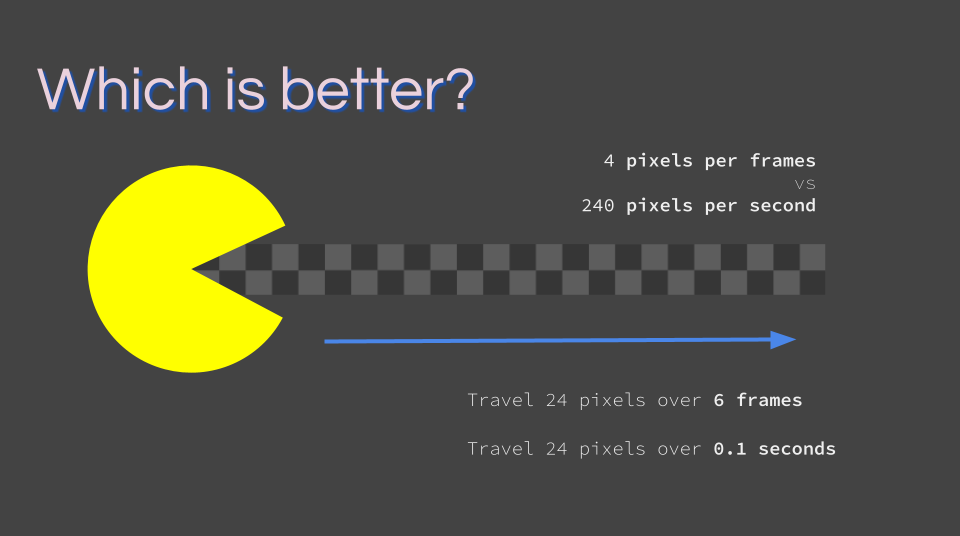
Firstly, we experience all other aspects in life using seconds, so using frames makes me have to multiply and divide things by 60 constantly. I am not good at multiplying and dividing things by 60, but a computer is extremely good at that. In fact, it was born to do it! So is the computer working for me, or am I working for the computer?

This is the line of thinking I first came into our discussions with, flabbergasted that any other approach even existed. But it was a deeply immature understanding of the value of frames. Learning to speak the language of the computer, not just in terms of code and logic, but phenomenologically reframing my own senses to those of the computer can unlock a far greater potentiality of nuance in game design. Hunter nailed the crux of it. When you are designing the physics of a universe (as every game must do) you must do so at an infinitesimal scale. Action and reaction connect and spread through literal lightning. Humans are not rocks, they do not experience life at geologic scale; nor are they computers, experiencing life in electric cycles. But as many an animator could tell you, with a little bit of training and focus you can see and count in “1s” and “2s”. It is crucial for an animator to break down an action into the standard metrics of animation so the action can be translated into one drawing every 1/24th of a second. Game designers must be able to do this as well, though with more than twice as small a gradation. The job of a game designer is to bridge the computer experience and the human experience, and so yes that means doing the multiplying and dividing by 60 frames, until you can see a game on the screen and accurately guess how many frames an animation lasts for. 

My second argument is more complicated, and not one I surrender so easily. When a game measures time as the distance between frames rather than the distance between seconds, it locks the game to a specific frame-rate. This demands a consistent technical quality, which can be a good thing, but it might lose out on future-proofing. If we make games for the machine, what happens if the machine changes? A second will always be a second, will a frame always be 1/60th of a second?

My friend Alec has a 120Hz monitor which he uses to play Stepmania. He is very good at Stepmania. However, it turns out he is twice as good at Stepmania as his scores were suggesting, because the copy of Stepmania he was using counts accuracy by frames, and consequently his window for “Flawless” hits was half the size as the vast majority of other players. Truly Flawless! If an experienced developer can see in 60 frames per second, then Alec has pushed to the next level and can now see in 120. 

This is a technical bug, and one Alec quickly discovered was fixed in a later build of the game, but it still represents the type of issue that can easily slip by when building for machine time. There are old, defunct browser games that I have downloaded but have become unplayable because they assumed the refresh rate of world wide web would never improve beyond what was possible in 2002. This happens with all old games, though the work emulators do hides that this could even be an issue. Developers in the 1980’s weren’t thinking about how their game would run on system architecture four decades later. Perhaps neither should we! But as games become exponentially more complex pieces of technology, they will become much harder to build emulation sandboxes for. Building fundamental gameplay code on top of system defined frame rate seems really sandy to me. Less than 1% of people are playing games with 120Hz displays, but will that always be the case?

There is a theory that our human senses are influenced in some degree by the technology around us. A professor of aural studies once told me that as soon as there were ways to record sound, musicians and singers were being caught in lip-sync scandals. What was interesting about the records, though, is that the low quality scratchiness of phonographs and gramophones which are so obvious to us now didn’t give away the deception. The majority of people simply didn’t hear it as low quality until higher fidelity technology incrementally transformed standards, and that prolonged mediated exposure changed our brain’s digestion of our senses.

I bring up that tangent because it relates to the concession in my first argument, that we can augment our senses to a higher fidelity and improving our own senses is one of the duties of a game developer, but it also breeds a warning for this second argument. In fifteen years, computer monitor companies will have capitalized on all the profit to be had when they persuade us that our many 60Hz monitors look unbearably worse than the 120Hz ones, and could our games of today be experienced not just under a technical difference but an aesthetically different one? Will the eyes of our audience see our games running meaningfully choppier on their screens, compared to the notification animation playing on their second monitor at twice the frame rate?

I’ll admit, that is perhaps too heady of a line of thinking. But that is what I love about this discussion — working in frames isn’t about methodology, it is about philosophy. Evening Star‘s policy is to use frames as the basic metric, because that is how the best games have been made. The games developed for the consoles of our childhoods were counting on the dependable specifications of their fixed platforms, and sometimes couldn’t even technically spare the calculations needed to compare the distance in time between frames. Ain’t no way an SNES game is querying a clock whenever it’s calculating a movement speed — pretty sure that thing didn’t even have a clock! And if Harvest Moon can count down to its sunsets one frame at a time, why can’t people today?

The biggest difference with games today is that they have to exist agnostic of their platforms. Independent games must be easily portable to as many systems as possible, or they will never find a big enough audience to survive. Even the largest platform owners like Sony are going multi-platform and having to port their console selling hits to PC. The direction of games today, like all media, is towards abstracted “content” whose utility is measured by how much it can be repackaged. So for all my headiness and worries about future-proofing, games are hitting portability issues around frame rates today. Dark Souls 2 had weapons degrade twice as fast on the 60FPS PC port, because the game was developed around the PS3’s hardware, and assumed a 30FPS lock. (Thanks again to Alec for telling me about this as I was writing!) 

As with Stepmania, this was eventually patched, though it took a shockingly long time. I’m sure the delay was a result of bureaucratic rather than technical reasons, but while frame rate dependency issues are usually easy to fix, they are also very easy to miss. Among thousands of lines of code on a perfectly functioning object, it is easy to glance over durability -= 2.0; and not realize it needs * deltaTime appended for it to scale properly with time. This has to be caught regardless of whether frames or seconds are being used as the scale, and it is the job of a programmer to catch this, but it is so much easier to slip up when the equation is missing a “multiply by 0.01666” (the fraction of a second between frames aka deltaSeconds) rather than missing a “multiply by 1” (the deviation from intended frame rate aka deltaFrames). Materially, that is what the difference between centering a game’s code around seconds vs frames looks like. Assuming a fixed frame rate makes gameplay math much cleaner for programmers, because 1 is a much nicer number than 0.01666! It also means unnoticed mistakes can easily slip by in games of all sizes.

That said, the industry’s unmooring from fixed frame rates has had some clear negative consequences. Because the games of today can run at any which frame rate, they often do. But rather than run better, faster, this has instead manifested in more games with frame rate dips all over the place. A game can drop to half or a third of the intended frame rate, and it will still technically “work.” The player will still move at a consistent speed, the camera will rotate without slowing down, and the player experience can continue. The game will look worse, but it doesn’t stop the show. This is good, but as a developer I can’t help but feel like standards have gotten sloppier. Older games ran at consistent clocked speeds because they had to — if the frame rate dropped in F-ZEROthen all the cars would move slower too. In many ways, it is a blessing to not be tied to frame rate dependency like that. But my friends, we have abused our power. When the gods of videogames come down to look at us and ask to see what we have done with our power to query a clock, whenever we desire, for the time between frames, will we be proud? I am sure they will high five Animal Crossing, but maybe the rest of us will be forced to share Promethus’ fate.

So what do you think? Are you team deltaFrames or team deltaSeconds! Please leave a comment on Hunter’s blog or send either of us a message — let’s continue the discussion! I’m sure many a developer has lived through the shift from console “locked frames” assumption to the PC native “frame independent” assumption. What were the code standards like? What are the sneakiest frame-rate dependent bugs that slipped by? I want to hear stories!


Wow can’t believe I said I only had a short response instead of an essay, now we’re 1,900 words later. Sorry Hunter, you worked way harder on editing your piece to perfection while I have vomited a massive first draft, this is why your code runs at 60FPS B^) EVERYONE GO SHARE HUNTER’S COOL BLOG AND MAKE HIM WRITE MORE! Also everybody else write more, so that I have more to write about.

Alright enough about all that. Gotta end my monthly wrap up. It’s June now, which is my birthday month, so once I recover from COVID somebody better come see my favorite movie Macross Frontier: The Wings of Farewell making its international debut on the big screen on my birthdayyyyy!!!!!

Games I’ve played this month (and the last three months oops):

  • Stranger of Paradise (PS4)
    • I wrote half an essay about how bad my taste is and how no one should ever ask me for recommendations because I told my coworker The Batman is good but I like Batman & Robin more, and I un-ironically adore Star Wars Episode III, Pirates of the Caribbean 3, Spider-Man 3, and all gratuitous threequels. It was about learning that to other people, “good movie” meant “good to take people on a date to” and that means it is less about engaging with a film than it is about representing oneself through a film. This is why Marvel films excel with cool powers, glib humor, and little moments of vulnerability (that have been focus tested to not be too vulnerable). The characters in those films are very dateable, and that makes them good date movies! Anyways Strangers of Paradise is not cool nor dateable but I love it. I sincerely have had a good time playing it, but it is condescending flavor of love. That made me think about how there is other popular media that is also built on the audience being condescending. I was watching Succession at the same time, and that is a show that is not full of cool dateable characters but ones that the audience is supposed to condescendingly root for their downfalls. So why does that work as mass media when Strangers of Paradise doesn’t? Well it seems to be all about intent! Succession makes it clear that it is in on the joke, and it is asking you to laugh with it. Strangers of Paradise I don’t think anyone alive can tell you where the line is between the things that are intentionally funny and accidentally funny. That lack of clarity is a big problem for dates! When sharing media with another person, you want to laugh at the same things, and if anyone is ever thinking “Do they think that I think…” then that’s a showstopper for enjoying anything! So when making stuff for a big audience make sure your intentions are clear and your characters are really hot.
  • Franken (PC)
    • ​this game is good and all the characters are really hot.
  • I don’t remember any other games I played in the last three months
  • i wrote down “DK King of Swing (GBA) is better than DKC” so I guess I played that sometime and that is my opinion and I guess i;ll fight you to the death over it!!!!!!!!


    love y’all wishing you good health!
    – esteban

If you have enjoyed reading this, consider signing up for the Saving Game newsletter! I will always post these on my website, but with the newsletter all future essays can go straight to your inbox.

Wandering Above a Sea of Fog (February 2022)

Another month is here! The world sure does keep on spinning, doesn’t it? In addition to everything going on, you know, out there in the world, I have been extremely busy making things big and small. They are either private or NDA projects, so not well suited to a public blog. It has been very fun, but has left only the time to dabble a little in this month’s massive releases. But that dabbling, and especially the conversations around those releases, have got me feeling a lil’ Martin Scorsese about the state of the industry.


We are living in the thick of the open-world era. The conventions of the Ubisoft model have been spreading through AAA games for over a decade now and show no signs of stopping. In fact, I do not believe it is possible for it to stop. The overwhelming anticipation and celebration of open-world reimaginings of game franchises feels to me like an extension of the undaunted centuries of domination of perspective drawing in art history. It is the logical ramification of a trend that was set long before our grandfathers’ grandfathers’ were born, and it may easily outlive videogames. To explain this, I will need to summarize some history. It will unfortunately be a bit crude and reductionist, so I hope the experts among you will forgive my quick and dirty attempt and please correct me with details.

Raphael’s The School of Athens

Western culture, as part of its colonialism, has championed the superiority of perspective techniques in art since the 15th century. Drawing in perspective is a technology that was developed as a science and deployed as proof of providence against “lesser” peoples. The artists in Europe were the best in the world, the argument goes, because they could render scenes that warped and bended in ways that mimicked human bifocal sight. Deviance from this paradigm in other parts of the world was dismissed as savagery, even as techniques from African and Eastern art were appropriated as Cubism and other expressions of the reactive Modernism movement. Rendering in perspective thus became a global default mode of image making as all artists had to engage with the expectations carried by imperialism.

I bring this up not to say that perspective drawing itself is problematic or bad, but to contextualize our present moment. We live in a global culture that has been trained for generations to prioritize the horizon line and the reproduction of bifocal sight. Our tastes are informed by art history. Those tastes are well known to marketers and developers, who have a commercial interest in satisfying mass market expectations for visual beauty.

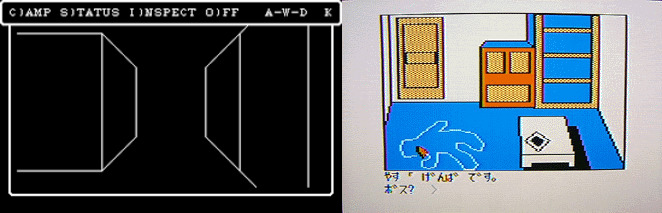
Wizardry (1981) and The Portopia Serial Murder Case (1983)

In videogames, the race to develop 3D graphics was part of this hegemony of perspective visuals. Even before the technology was capable of rendering real-time polygons, games tried to emulate a “3-D perspective” using static images, vector lines, and crude sprites. Early dungeon crawlers like Wizardry attracted audiences with its crude vector based first-person perspective, and adventure games like King’s Quest and Myst would leverage static background images to give scenes the illusion of perspective. Even on underpowered machines like the Famicom, Yuji Hori’s Portopia squeezed clever sprite allocation to achieve a perspective effect. When the Super Famicom released in 1990, its shiniest new feature was “Mode 7” which scaled a single texture in pseudo-3D space. This technology formed the basis for its graphical showcase launch title, F-Zero. In all of these examples, the novel presence of perspective gave weight and legitimacy to the visual art, which were celebrated at the time as exceptional graphical achievements.

The early attempts at perspective suggested a potential for videogames to come. Players had been imaging and anticipating Virtual Reality decades before it could be realized. When Doom and Mario 64 arrived, they were impactful not because they created entirely new visions for games, but because they fulfilled the promise that games would have real-time, embodied perspective spaces. Why did this matter to people? Because with a perspective view, videogames could join and surpass the cultural standard of Good Art. Our subconscious values for what looks better than something else, which were formed as part of an ancient political machine, compelled us to race for 3D graphics as quickly as possible.

Of course, even today perspective is not the only rendering style used in videogames. The counterpoint to perspective is orthographic. Orthographic refers to a camera view that flattens 3D space so that parallel lines do not warp ocularly. We often see is used in overhead views for games like SimCity or side-view games like Castlevania. Orthographic renders grids without ambiguity, so it is better at communicating planar relationships in space. This makes distances and hitboxes easier to read — important stuff for many genres! Perspective, meanwhile, is better at communicating how objects relate to a single subject: the eyes of the camera. Essentially, orthographic views can be more “objective” while perspective cameras are more “subjective.”

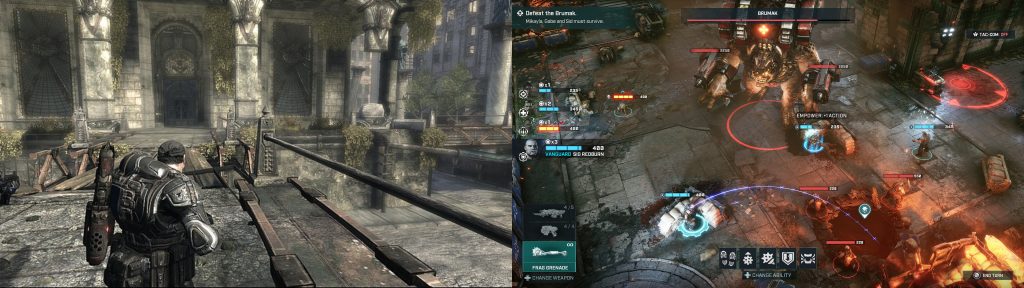
Gear of War and Gears of War Tactics

Despite their individual strengths, in the mass market we can witness a palpable preference for game graphics that utilize a perspective horizon. While I would not say that orthographic projection is unpopular (SimCity was one of the most popular games of its time, after all), what I do feel confident saying is that when a franchise converts from orthographic to perspective the audience grows, and when a franchise loses the perspective horizon line then the audience shrinks. We can see this in the receptions to Gears of War Tactics and Hitman/Tomb Raider Go, all games that moved away from their eye-level cameras towards a more orthographic projection. These spin-offs are all critically acclaimed, but they are considered amusing diversions. They have never maintained the full audience of the horizon-line originals, nor even given the chance to entertain such ambitions. On the other side, when Grand Theft Auto and Final Fantasy and Fallout and dozens of other franchises jumped from orthographic roots to over the shoulder 3D the shift definitively established their new defaults. Because art history and technology are perceived as linear, the “jump to 3D” is assumed as a matter of fact, and overhead orthographic projection is treated as a regression.

The effect of this art history does not end there, I believe. As a mass culture we prefer images where the camera mimics our sight by warping in perspective and resting at eye-level. We want our images to look like we are there, to transport us to a virtual reality. That is why open world game design has become ubiquitous as soon as technology allowed it. “Open world” is an extension of the values pushed by perspective art. Our culture has told us for generations that the superior art is one which feels like a habitat, viewed by a subjective individual, that could stretch infinitely beyond our of sight.

The subconscious narrative goes that Europeans were advanced because their science and training could turn a flat image into a three-dimensional space. Photography then dethroned painting, as it captured that subjective reality perfectly. Cinema then became the dominant force in culture because it added motion to photography. Since then cinema has remained the sun that all other mass market culture rotates around; even if more money passes through the games market our visual imagination remains in conversation with film. But, the linear technofetishist narrative says, if games have a perspective camera at the accepted angle, and have photoreal textures, and the horizon stretches forever in an open world, then games will surpass film and become the Most Art.

People love this trajectory more than they love games. We love games, sure, but we crave virtual realities more. Games are activities, they are things that we do. But visual art history does not consider the doing of things. The hegemony will not validate activities, but what it will validate is the creation an infinite subjective reality. Centuries of art history tell us that what we, an audience, see is more important than what we do. Games are just an excuse to sit in a vast virtual habitat, and we love that.

Or we think that we will. No Man’s Sky attracted out of control fervor in the build up to its release because people were convinced that the dream of an infinite horizon would give them apotheosis. Some were convinced that No Man’s Sky would be the last game they would ever need — the fabled Forever Game that could surpass art and reality. Of course, when it actually came out people were struck by reality. No Man’s Sky is infinitely large thanks to its sophisticated and brilliant procedural generation system, but the activities within the game were simple and quickly became uninteresting to the vast majority of players. Those activities have steadily improved over the course of many updates and are celebrated by the dedicated few who have continued playing, but it still pales in comparison to the dream that so many people deluded themselves into imagining before the game became a tangible reality.

This has happened with many games before it, and will continue to happen with many games after. With very little evidence people are eager to believe that some time soon they will have a digital world that they can live in. If any attention was paid to the activities within, then there would be more questions as to how these open world formats serve a game’s play. Unfortunately it seems to take many people dozens or hundreds of hours before they ask themselves whether walking across vast, empty spaces is meaningful at all.

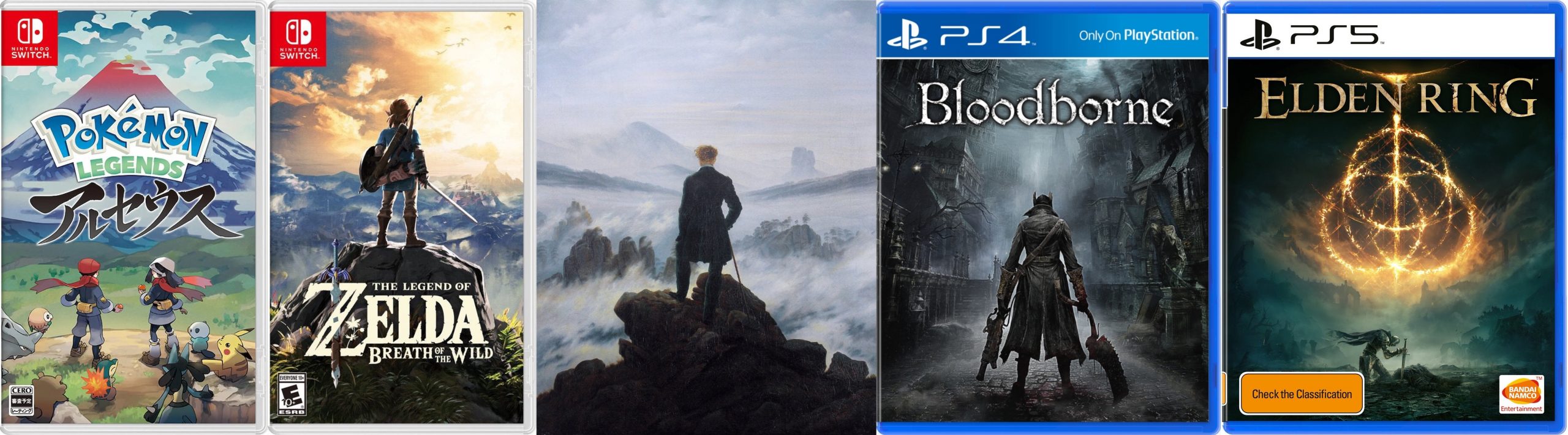
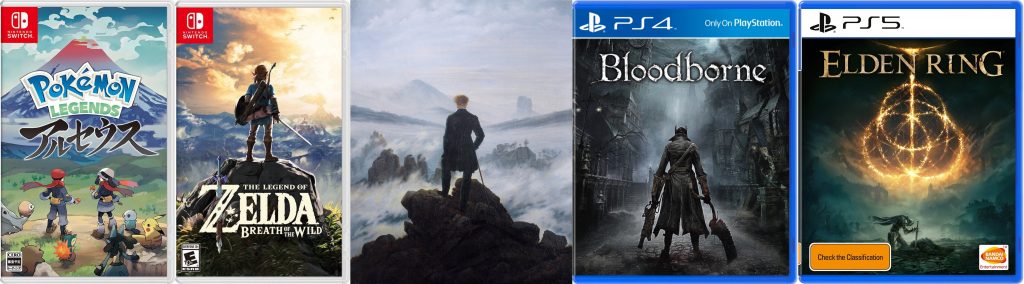
The foggy horizon promising a mysterious yet conquerable world in Caspar David Friedrich’s Wanderer Above the Sea of Fog has been reproduced ad infinitum by game marketing

This has been a very long way around to say that I have been playing a little Pokémon Legends: Arceus and Elden Ring. I have not spent nearly enough time with either to dig into them deeply, but the reception to both crystalized my feelings on this topic. Both games have been hailed as a sort of “coming of age” for the two mega franchises. Though they come from different backgrounds (Pokémon as a top-down pixel game and Dark Souls as a 3D action game) these latest entries are the first time they adopt contemporary open world design. The shift for Pokémon appears more radical, since it is not just a structural shift for gameplay progression but also a camera change, while Elden Ring‘s change is more subtle. No matter the scale of the change, the narrative around the two has been the same: These games are finally realized visions.

Witnessing this consensus emerge for Pokémon Legends has been eye opening. Pokémon has come of age by offering expansive vistas and a shoulder level camera. All other elements of the game experience can deteriorate, and it scarcely matters. The visual fidelity can plummet, the programming can run unoptimized, the gameplay systems can be made tedious, the art directions can clash, the writing can strike out, the sound design can falter, the animations stiffen, and none of that keeps this game from being a “step forward” for the franchise. For my money, the only crafts that have not suffered in the transition have been the music and the UI design, but neither of those are what I would consider best in the series, and certainly not strong enough to carry critical reception of a game. This is now heralded as the hopeful new default for Pokémon games going forward, on the adoption of its culturally validated camera alone.

I have heard the argument that the game has resonated because the gameplay is better, and that its success signals a victory of good game design triumphing over poor visual art. However, I do not believe it. The improvements that have been described are a streamlined UX, tedious battle menus cut out, the gym structure being discarded, and how nice it is to quickly catch Pokémon without having to always battle them. These changes are all subtraction. This is, perhaps, a cruel conclusion, but these are improvements only to people who do not like playing Pokémon games. Not to say they are not for fans of Pokémon! Many a Pokémon superfan has expressed their love for this game. But I think generally people like the idea of Pokémon more than they like Pokémon games, and that is why they like Legends: it is the idea of a Pokémon game. One that is validated by tastes formed from hundreds of years of reinforcement as to what art should be.

There is a chance I will spend more time with Pokémon Legends and get hooked on the gameplay of sneaking up on large monsters and dodge rolling away from attacks. But in the hours I have given it, it has not given me satisfaction or made any of my efforts feel well spent. The long term playability of the game is almost irrelevant — like with No Man’s Sky what brings people to purchase a game is a dream. The dream promised by Pokémon Legends is that now you can inhabit the world of Pokémon. The horizon is the limit, go out and explore. We are attracted to that dream of a virtual reality, and what better reality to live in than Pokémon’s? That dream is all people need, the game is just an excuse. A dream medium.

I have less to say about Elden Ring, but I believe the trend is the same. The changes are more subtle, and I am much less experienced with FromSoftware’s repertoire than many of the other people discussing this game. I also have to disclose that I know people who work at Bandai Namco, so I am limiting the scope of my opinion to avoid my biases. Elden Ring‘s mandate is obvious, though. It seeks to expand the series beyond its relatively niche roots to compete against the likes of Horizon: Zero Dawn and Assassin’s Creed, which have been at a higher mass market weight class despite Dark Souls‘ popularity and influence. To do so it has adopted their open world conventions. This, coupled with the billing of world famous fantasy author George R.R. Martin, have made Elden Ring the most anticipated game of this year. It was not Martin’s involvement that has made it an instant critical success, though. The open world design is what has captivated players and had them celebrating a new evolution that they hope will become the default going forward.

As with Pokémon, I am skeptical about this uncritical celebration. There is not the same broad deterioration of craft as there is in Legends, but the new format is not a universal improvement. Its biggest benefit is that the open world design is more accessible to a broader player base, because a difficult section can be abandoned and beneficial experience or gear can be attained elsewhere so the player will be better equipped when they return. This is like how a puzzle game can be ground to a halt if the player is stumped on one puzzle, so contemporary puzzle design offers puzzles in batches so that there is always possible activity. This is a very valuable change to the Dark Souls series, which is notoriously difficult and has many players dropping off early. However, the open world solution is an imperfect implementation. What challenges are there, where the player should go, and how long it takes to reach there are all obscured. Typically, this series tightly curates these questions. It is by design. By going open world, Elden Ring does the opposite of design. Players now assume the burden of getting lost, finding their way, choosing what they need and when, and crossing large distances without any certainty that the effort is meaningful. Dark Souls is known for asking a lot from its players, so I don’t mean to disparage the existence of friction. The issue is that the activity is not meaningful. In one of the few pieces I saw take a critical eye to open world design, Renata Price described Elden Ring‘s traversal as frictionless. It is made to be as easy as possible because it is a band-aid to the fact that it must exist at all. Traversing in Elden Ring is a lost opportunity. It is a new problem introduced by the open world conventions that are still in want of a solution. Those of us who hoped that FromSoftware’s designers, who are among the best in the world, could have matched their brilliance in combat design with a revolution in open world design are left a little disappointed.

FromSoftware changed the course of contemporary game design by respecting the player. The Dark Souls games are demanding, but they trust the player to develop their abilities and reward them with satisfying experiences for that effort. The people who climb their mountain are all happy they have done so. Even though FromSoftware’s games drop cruel traps and force players to repeat arduous challenges, they never waste the players’ time. It is all valuable. This is why it stings to sacrifice the tightly designed gauntlets on the alter of open world conventions. It is now much easier to waste time. Elden Ring doesn’t disrespect the player, but it does stumble and apologize and concede. We have a big game now. It is vast, you can explore all over, a new virtual reality. I hope that dream is worth it. We can’t go back. Our values, imbedded in imperialism almost as old as Elden Ring‘s ruins, can’t imagine it.


This essay owes a debt to this paper from Dominic Arsenault, Pierre-Marc Côté, and Audrey Larochelle from the University of Montreal. I first encountered the ideas in Super Power, Spoony Bards, and Silverware, where the Super Famicom’s Mode 7 was given a similar art history context.


What other stuff have I played this month?

  • Fire Emblem Heroes (iPhone)
    • The 5th anniversary celebration was this month, and it got me to give this game a proper go now that I have completely poisoned my brain with Fire Emblem games.
    • For those unfamiliar, this game takes the horny chess tactics game and micronizes it to a miniature gatcha version.
    • Only four units can be brought into battle, and the field is a 6×8 grid. Tinier than a chess board!
    • As with most gatchas, characters are unlocked through a lottery system that is paid with a resources that slowly becomes harder to acquire without paying money for. Fire Emblem has a 700+ character roster, so it is good fodder for this system!
    • I have barely touched my orb stockpile, though, because I quickly stumbled into an unbeatable team.
      • Edelgard is a tank who can absorb serious damage and has a guaranteed counter attack to nearly every blow she receives, including magic attacks (which would normally be a tank’s weakness). Crucially, she heals back half the damage she deals out. I buffed her attack so she deals a looooooot of damage, letting me drop her straight in the action and usually seeing her health still capped out after being dogpiled.
      • I use Yuri to chuck Edelgard into enemy lines. He has special abilities that allow him to swap places with someone after moving, and then to move again after taking an action. So I run into battle with him, swap him for Edelgard who can still move and attack, then move him back up to meet her. He has ranged attacks, so I can keep him behind her wall.
      • Eldigan is a dragon riding dancer, meaning he can fly over terrain other units cannot and then give an adjacent unit an extra turn. I usually use him to give Yuri and extra turn and a chance to attack after chucking Edelgard.
      • Lastly, I have Evelyn for healing. She is a horse rider, so she can travel farther than normal healers. She also has a Physic staff, which lets her heal at a distance and occasionally heals my entire party at once. I have no trouble keeping her out of harm’s way and healing the squad if anyone falls into trouble.
    • Astonishingly, these characters are also among my favorites from the entire franchise roster. So I really don’t have any motivation to collect more!
    • Usually gatcha games hold onto player’s long term motivations by dangling desirable characters at nearly unreachable distances, but I have so far been completely happy to just have little chess puzzles to tap away at during breakfast.
    • After a month I am sweeping all the asynchronous multiplayer matches I have been in, but I am certain that will change as it sorts me into higher tiers. Eventually the game’s challenges will scale and it will force me to hunt for new characters to form new strategic teams, but so far not!
    • Despite this being the game I have had the best time with all month I do not recommend it to anybody. This is my hell pit to live in.
  • Hunt: Showdown (PS4)
    • Last month I wrote about a hunting game so I thought it was be funny to write about a completely different hunting game with a similar name for this month. I changed plans, though, because there is almost nothing I can say that this video by Super Bunnyhop doesn’t say better. Everyone I know who has played this game has done so because of that video, and he’s not wrong about any of it; the game is good!
    • You got squads of players racing to find a lovecraftian monster lurking in one of several dilapidated buildings surrounded by fields of zombies. Whoever kills the beast gets a token that must be carried out of one of the map’s exits to win. Players can kill each other and claim the token, which naturally transforms the experience partway through from player vs environment to player vs player.
    • I described this game to my parents by saying it was like Predator, but make it Frankenstein. That’s not a good description at all, but they said they got it?
    • I played a handful of rounds with my brother and it was so much fun. The zombies lumbering around made for engaging combat challenges that filled the gulf of time between battling other human players. It made the pacing feel more flush than a battle royale game, which are always very staccato.
    • I can’t get into this for NDA reasons, but a lifetime ago I worked on a game that had a very similar mandate to Hunt: Showdown. That project transformed so completely that it is unrecognizable now, but it was very surreal and humbling for me to play this game and see it accomplish design challenges that I thought were impossible. There is a lot of invisible work that is handled masterfully, and it could have collapsed very easily.
    • Okay you know what, forget what I said earlier this was the most fun game I played this month. Get it on PS4 and play with me.

POST-POST SCRIPT: Are you kidding me they already announced another open world Pokémon game coming out this year??? Here I was feeling like you’d have to pay me to spend more time with Arceus, those cute new monsters are about to get me into paying for another one, aren’t they.

If you have enjoyed reading this, consider signing up for the Saving Game newsletter! I will always post these on my website, but with the newsletter all future essays can go straight to your inbox.

Loving the Obtuse (January 2022)

I pay my rent by mailing a check every month. Being the first month of a new year, January is a risky time; I almost always write the wrong year out of habit. This year was an exception! I have naturalized seamlessly into 2022, and saved myself a check. Could this be like the groundhog and his shadow? I did not look back, and spared myself an extra month of 2021. At the very least, this checkbook will now last me an additional month. Remember this and rejoice, myself several years in the future!

I took an extended vacation in December, but now that I’m back at work the tires are hitting the road. Every day is busy, but fortunately I have established a good routine. My meals are prepped, my shelves are dusted, my crops are watered. I have even been regularly programming in my free time again, after a months-long freeze. I’m embarrassed to admit it, but I think that part of my ability to make games on my own has been broken, and it has been broken for a long time. So I am reteaching myself, almost from scratch, using a new set of tools. PICO-8, a “fantasy console” with a strict (but thoughtful!) set of constraints and fully embedded code/art/sound editor has made me love digital doodling anew. Most helpfully, almost every game made in this engine can have the hood opened up and assets observed or remixed. One of the things that makes learning game development so hard is that there are very few opportunities to play something and then transparently see how it was accomplished. Anyone can find bits and pieces in tutorials or forums, but PICO-8 is so small and so open that I can read a whole projects’ source very quickly. In fact, the code caps out at 8192 words (or “tokens”) which would be exceeded by just putting together a couple of these newsletters. I do have to take care not to develop some bad habits (the code has to be typed out entirely in lowercase!! capital letters are not allowed!!!) but I am still working with “real” code at my day job so I think I will be okay.

Surfing test

How about the games I have been playing? I engaged with two games this month: one that I have never heard of someone playing, and another that everyone has arguably been hearing too much from. You can probably guess that the latter is Wordle, a simple world game that blew up thanks to an engenius game result receipt. Many people are annoyed by the flood of pictographic cyphers, but if you play the game once you know how to read it and can commiserate in a digestible drama that communicates an entire story in an instant, and is made relatable since every player tackles the same challenge every day. It’s like how an entire baseball game can be understood from the scoreboard, but more intimate. I love seeing people’s Wordles. I have gasped, I have shaken my head, I have pitied, I have cheered. A stranger’s Wordle means nothing to me, but my friends and family are my home team and I root for them at every game. It is not cooperative, nor is it competitive. Wordle occupies this strange middle space that I have not seen defined in games scholarship before. It is simply togetherness. What a romantic game, no?

The other game is called theHunter: Call of the Wild, a five year old hunting simulator by Swedish developer Expansive Studios. I saw a completely random screenshot of the game on Twitter which piqued my curiosity and led to me looking it up. What I found were several negative reviews disparaging how boring it was to wander the woods for hours without killing any animals. The consensus was united: pretty graphics but gameplay too obtuse to actually engage with. Perfect. I ordered a copy right away.

The Hunter: Call of the Wild review | PC Gamer

theHunter is a hiking game. That’s not how it sells itself nor thinks of itself, but it’s there to be that if you’d like. Give it a willing curiosity, and the depth of the scene can take your breath away. The nature reserves are massive, lush with endless shrubs and rolling fog, with volumetric lighting casting through the trees. Despite being digital, there is a good approximation of the visual joys of taking a hike. The game is lovely at just being “a place to walk.” There are even cheeky “lore drops” where bits of poetry and history dot landmarks. Someone could happily play this game for dozens of hours by just walking around and looking. Whether you are the kind of person who would enjoy that or not, you probably already know.

Sooner or later everyone will reach a threshold where, without any mechanical complications for walking, there is no meaning to what you are looking at or exploring. Fortunately, there is an entire hunting videogame designed to augment exactly that. Through the eyes of a hunter, this pretty scenery transforms into a complex maze filled with subtle ambiguities. Searching for prey within the dense foliage demands an attentive eye – and is a significantly more difficult task than you could possibly imagine – but the true key that unlocks the game is noticing that animals trample grass underfoot. Recognizing that, the overwhelming foliage isn’t just something to look through, but to look at. Really, truly, closely look at. Every blade of grass can be interrogated. Did an animal pass through here? Is this clump bent because it was pushed, or because the ground has a lump? Did this trail swerve left, or did it twist right? Seeking evidence of agency in the chaos of nature, every vista becomes a potential tale of a deer or moose or bear. One just has to learn how to read it, then, like a Wordle scoreboard, the drama unlocks. 

Now I have to concede, while theHunter is derided as an obtuse game, it actually does hold your hand more than I am describing. By default loud UI elements highlight clues to animal whereabouts. The design of these hints are clever and elegant, but the blinking lights ran so counter to the calm hike I was initially taking that I shut them all off. I am glad that I did, because it forced me to look at the game closer and swim in the ambiguities of my prey’s subtle influences on the environment. The UI is more reliable, but in sharing so much inarguable information it actually makes the world feel emptier. “Is there an animal nearby?” is a better thought to have than “No, there is not” even when you have spent half an hour asking the former, rather than abandoning a location as soon as you reach the latter. Uncertainty creates mystery, and mystery creates curiosity, and that curiosity led me to look even closer at the marvelous artificial world around me. So what I am saying is, the reviews online were wrong. theHunter is not obtuse enough.

All the downtime is perfect for multiplayer sessions. First Person Shooter games are frequently loud, intense affairs that drown all opportunity for catching up. I love them, but they provide a connection very different from taking a hike with someone. theHunter is perfect for hanging out. The world is saturated in ambiguous possibility space, which means there is usually something to talk about or engage with, but it is fluid. You can talk, or you can walk, you can seek, or you can wander. It is possible to split up and broaden a survey of the land, or stand in a single spot and debate which direction a trail twists. And all the while there is room to complain about your week or ask about how pets are doing. What makes it better than a phone call is that there are nice sights to share and talk over, but also that there is the addicting thrill that at any moment the conversation will have to be put on pause and the subject turned to tactics as an animal is spotted.

Stumbling across a living creature is rare. Often half an hour will pass without one – but the moment when one does appear is always special. Whatever the circumstance, the overwhelming emotion of each encounter is one of “sudden opportunity.” Here is a creature, alive, fickle, unpredictable, and it is your goal at long last. The effort of all that searching, culminating in a decisive climax! But before you pull the trigger, you have to be ready. You may only have one shot, after all. 

If the creature is far away then an exciting race begins. The starting guns are terrible, so you must get closer before it wanders away. There is no time to waste; an animal can disappear out of sight within seconds, even in the most open areas. You can’t run carelessly, though, because it will flee if you are detected. The best parts of a stealth game come to the surface here. The target must be closely observed, sightlines have to be considered, terrain must be negotiated, loud risks must be taken. There are no clear answers for what your prey can see, where you should step, or how close you should get. It takes hunches and the slow build up of experience and superstition to improve. 

It is no less impactful when you bump into an animal that is closer than you expected. Once I turned the corner and came face to face with a moose. I was so startled that I fumbled the controls and fired a full clip into empty air as the moose ran off. While I was reloading, the animal turned around and charged straight into me. A health bar, which I had not even noticed before, took a considerable hit. I would later learn that this health bar is no joke – after falling from a firewatch tower and dying I was respawned over fifteen minutes away. Moments like these trained me to keep on edge. On another occasion, when a nearby bear flitted in and out of my sight I felt genuine fear and ran away. I had barely managed to kill some small game, there was no way I was going to take down a bear.

Finding and shooting an animal is seldom the end of the story. It’s actually the easy part – the hard part is following wounded prey. The initial weapons are not powerful nor accurate enough to dependably kill in a single blow, so you have to give chase in the hopes of taking another shot or exhausting the animal until it bleeds to death. I had not expected this part of the game, but it is the core challenge. Every animal in the game can easily outrun a human, so like in real life our only advantage is endurance. A wounded animal will sprint away, and then you have to carefully and quickly trace the tracks so you can spook it again until it expires, exhausted. 

I have no love of hunting in real life. I think the hobby is repulsive. A digital simulacrum, though, I’m all good with. One of the beauties of play is that we can explore experiences without real harm. So I didn’t expect this part of the game to still leave me feeling so guilty. I have shot dozens of creatures at this point, tried to chase them when they fled, and then promptly lost sight of them. The challenges of tracking through the grass that I described before turn into a time sensitive imperative, and one that I regularly fail at. This persistent, believable digital nature preserve must be littered with unclaimed corpses. I would feel different if I had found them and harvested them for XP, then the act would have been worth something. The game actually quantifies pain; the less painful the death the more points you get. There’s a mechanical drawback too: when I fail a hunt I lose ammunition. Restocking ammunition costs money, and I am such a poor hunter that I risk never climbing out of virtual poverty. Better equipment means easier kills, but better equipment is expensive. As a result, I will probably never see 80% of this game’s systems. Yet I’m okay with that!

My time with theHunter has been about the journey. I have dissolved in full immersion for three hours, only to get a single kill and lose more money on bullets than I earned back. That doesn’t matter. Every minute was pleasurable and well spent. Hunting demands full attention to lush, ambiguous detail. Finally finding a creature is frequently dramatic. Preparing a shot encompasses the best elements of stealth and sniper games. Tracking a wounded animal forced me to do stuff I’ve never done before, and created poignant new emotions. It’s a game I would gladly spend dozens of more hours accomplishing nothing in.

Honorable Mentions

Skip-Bo

  • Great card game. Played with family.
  • Like Solitaire it walks a razor’s edge line of player agency where the choices feel very consequential, even though most of the process of playing can be very automated. The consequence makes the luck feel dramatic, and the automation makes the second-to-second routine feel productive and pleasurable.

Windjammers 2

  • I haven’t been online much this month so I don’t know if people are talking about Windjammers 2 but it’s so gooooooooooooooooooooooood

If you have enjoyed reading this, consider signing up for the Saving Game newsletter! I will always post these on my website, but with the newsletter all future essays can go straight to your inbox.

New Year Recap (December 2021)

Happy New Year! I am typing this from chilly Colorado, where I have been staying with my family for the holidays. The air is apocalyptically dry, and a burst of wind tore through with such force that a car alarm started. Our Christmas tree, naked and discarded in the lawn until the recycling service starts up, has been bouncing around like a tumbleweed.

Hard to believe, but it’s been a whole year since I started these posts. Writing them was my New Year’s resolution last year, and I’m so glad that I kept it up. It forced me to think through my feelings more thoroughly, and provided a perfect set of milestone goals across the year. Not to mention it leaves a wonderful record of what I was playing and how I felt, that I can now look back upon during this reflective time. Will I keep it up in 2022? I think I will. It’s not a resolution this time, though, but a habit. I think that’s the best way to treat a New Year’s resolution – not as a single goal to reach, but a practice to begin and develop, that can last a long time.

That said, there might be some changes to how I do this going forward. I am content with my small, intimate audience (thank you to all who read this, I love you) and I’m not really interested in spending effort to deliberately grow it. However, I do want the quality of my writing to be better. My editing could be improved – the organization could be clearer, the tangents cut, the word flow smoothed, and my voice could stand to be less dry. Acting solo, I worry I might be reaching the limits of my growth. The complications of collaborating with an editor or anyone else frightens me, but that’s what I have been thinking about lately.

On a similar line, I think it would be wonderful to share more writing through this channel. Many people have told me that this series has inspired them to write about the games they are playing, or about their own expertise in game development. To all you readers out there – if you want something cross posted through this newsletter don’t hesitate to reach out and ask! Perhaps this may one day become a magazine of various voices. I try to fill in the hole in game design writing that I seldom see elsewhere, but it is only a sliver of potential perspectives.

That’s enough dreaming of the future, though. Let’s look backwards!

All the things I wrote this year

December 2020 – Rapid fire thoughts on every game I played over the year.

January 2021 – How game-systems in Tony Hawk, Floor Kids, and Hitman approach free-form play.

February 2021 – Observing the evolving coin economy in Mario games.

March 2021 – Breaking down how Gnosia creates a single-player deduction game.

April 2021 – A collection of several lessons gleaned from doing a close reading of the credits of Link’s Awakening, with various related tangents in different mediums. Some people have told me this is their favorite one, and I think it was my favorite one to research.

May 2021 – Disconnected, rapid fire thoughts on New Pokemon Snap, Dicey Dungeons, FFVI, Bugsnax, and Rez Infinite.

June 2021 – Working through an existential crisis as I confront a cool game that totally omits my game design values in Trip World.

July 2021 – Various spicy takes on the systems in games and the systems for making them.

August 2021 – A love letter to what may be my favorite release of 2021. How did a visual novel without any deep game systems blow me away??

September 2021 – I take a break from writing about games to look at the evolution of Evangelion, and explore the complex relationship between business and art. Despite the change in subject, I spent much longer putting this one together than any other — it haunted me.

October 2021 – I try to define the change in priorities in the new Metroid and how that affects the taste of the game, for better or worse.

November 2021 – A thorough investigation into the creation and purpose of the humble Goomba, who I believe is an expression of game design brilliance. So many people told me they liked this one — I hope I can meet it and exceed it as a standard for next year’s posts!

December 2021 – … Oh right, I still gotta go over what I played this month!

What I played this month:

Chibi-Robo (GameCube)

  • I have wanted to play this game for almost as long as I have had a GameCube, but it wasn’t until I was off work this month that I finally got to give myself over to it. And give myself over, I did. I marathoned the game in the hopes of finishing it before my flight to Colorado, though I only made it halfway.
  • I expected the gameplay to have some third-party jank or Moon: Remix RPG tedium, and was delighted to discover that it has Nintendo-quality gamefeel. The dangling powercord behind the titular character has fun, consequential physics, and has a satisfying POP when it comes out of electrical outlets. A random note plays with every step the character takes, and changes depending on the surface material. It is fun to exist in the world.
  • The story is affecting, and the characters are lovable. The intimate nature of the gameplay makes the dramatic stakes personal and riveting.
  • I had always believed this game could be one of the best things I ever played, and so far I have not been let down! It will always be limited to a cult darling, but even among that class I feel like the love and celebration for this title deserves to be louder.
  • The development studio, Skip Ltd. seems to have closed its doors within the last couple of years. Very sad.
  • Chibi-Robo amiibos were available nearby, to my disbelief, and my dad grabbed me one 🙂

Need for Speed: Underground 2 (GameCube)

  • Out of all racing games out there, this is the one I have consistently popped in and out of for the past decade.
  • Adaptive triggers are a big selling point for the PS5’s new controllers, and after spending a couple hours with one at a friend’s place I couldn’t play racing games with the flaccid triggers of the PS4. Fortunately, the GameCube has powerful spring-loaded triggers that provide crucial resistance and granularity for a throttle. Such triggers are not well suited to all genres, especially First-Person Shooters, so the adaptive trigger technology is a good step forward for future consoles. Absent that technology, I was glad I could drive around for a bit with a GameCube controller.
  • The art direction, which probably had aspirations for photorealism during development, paints a striking impressionism compared to modern crisp graphics. The textures are muddy and reflective, like everything has just been coated in rain, and the dynamic lights from the cars bloom in neon-tinged reflections. 
  • There is a Cingular branded SMS logo perpetually in the upper left corner of the screen, and I love it. Timelessness is overrated.
  • I switched from Automatic to Manual controls for the first time and it was like discovering a whole new game. Manual transmission is so much more fun and engaging.

Chess (board game)

  • My cousins and I played chess matches every night we were together. It ruled. Chess is a good game at all skill levels, imo.

Alright now it wouldn’t be an end of the year post if I didn’t highlight some favorites.

Best game I played this year: 

Donkey Kong ‘94 (GameBoy)

  • So good I played it twice in a row.
  • This iteration of Mario has the most expressive set of movement in a jump button of any 2D game I have played. It is rivaled in 3D only by Mario 64, which adapted the movements wholesale from this game.
  • The mix of action and puzzle hit in the perfect proportion for my tastes. Like Portal it makes you feel totally embodied with the character, while still demanding thoughtfulness over pure reflex.
  • The love this game has for the arcade game roots made me appreciate the original Donkey Kong much more, and consequently it made me appreciate the arcade Mario Bros., and all the Mario games after. Platformers really are elegant and beautiful playthings, aren’t they?

Best game I played this year that came out this year: 

ummmmmmm The Great Ace Attorney Chronicles (Switch) ??

  • Even that game originally came out over five years ago. Not a lot of new games came out this year, and I barely played the ones that did. Sorry, 2021… 
  • I hear Inscryption is super good! I never play games on the computer but I probably should have made an exception here.
  • But I really like Great Ace Attorney!!!!!!!! I wrote an entire article dedicated to why I like this game so much, so I’m not going to rehash it here.
  • I will add though: A not insubstantial part of my joy playing this game is that it operates so totally in a different playing field than the kind of stuff I work on, so I am less critical while playing it. My job is to design systems and spaces where actions have emergent consequences, and this is a linear visual novel with a rigidly authored set of interactions. That I am so captivated by something that is so wholly outside of my aspirations makes playing Great Ace Attorney the most relaxing time I have had with a game this year.

Other Favorite Discoveries:

Dear Brother (anime)

  • Still haven’t finished it, but the direction is off the charts. Every part of the production compliments the whole. It is mature, not in subject matter or tone but in creators who are at the top of their game confidently geling perfectly.

Streets of Fire (movie)

  • Gimme cheesy music, gimme action, gimme ill fated romance. This movie is the kind of popcorn that was made just for me.

Super Mario Bros. 3 (NES)

  • So many people told me that this is the best Mario game but I didn’t listen until this year. 
  • Giving this my honest attention was eye-opening. Now I recognize all the ways the subsequent Mario games have been chasing this one. It is truly the finest example of the genre.
  • I still like Donkey Kong ‘94 better tho.

I Am Error by Nathan Altice (book)

  • This deep dive on the technical architecture of the Famicom/NES and how it shaped the next phase of game culture has stepped up my professional understanding more than any other book this year.

If you have enjoyed reading this, consider signing up for the Saving Game newsletter! I will always post these on my website, but with the newsletter all future essays can go straight to your inbox.

Good Goomba (November 2021)

If I could ask Shigeru Miyamoto, Takashi Tezuka, Toshihiko Nakago, or Kazuaki Morita about any one single thing, it would be: Goomba.

I do not know if these four original developers of Super Mario Bros. have thought about the Goomba’s origin much in these last 35 years, but it has been consuming me over the last month. I believe that the Goomba is an unappreciated piece of genius. Beneath that ugly mug is a perfect germ of game design, one that takes Mario’s core act of jumping and gives it playful purpose. Most of us are so accustomed to having Goomba around that we take for granted how rare it is that a game element elegantly and completely satisfies its mechanical premise. This adversary did not come from the sky like water, it was created by human hands. The pixels were drawn on graph paper, the behavior was coded in 6502 Assembly, and the planning for those elements was probably argued over late dinners surrounded by cigarette smoke. There were jumping games before Super Mario Bros., but jumping over pits can only provide so much satisfaction. When the first Goomba was squashed, that was when the “platformer” genre became immortal.

How is Goomba

The Goomba is a simple creature. It is a squishy triangle with boots that walks back and forth, turning when it hits a wall and falling if there is no floor beneath. If Mario jumps on it, it is destroyed. If it touches Mario from the side, then Mario is damaged. That’s it! But from that simple recipe, a thousand gameplay scenarios can be created. A Goomba walking straight towards you, a pair of Goombas walking together, a Goomba blocking an entrance, a Goomba walking down a stairway, one Goomba coming from the left and one from the right, and on and on. 

Each of these scenarios are dependably fun because the simplest set-up with the Goomba still encapsulates the best core gameplay loop of a platformer: Jump and land on something, or risk damage.

Consider the player’s actions. You hit the jump button, launching Mario into the air. This is exciting, but meaningless unless there are consequences. Gravity begins pulling Mario down. In a second, you’ll return to the ground. Within this time, there is a natural challenge. You can maneuver airborne Mario left and right. With a target, there is something to aim for before Mario hits the ground. If there is a pit, you could try to move beyond it. This is exciting for a time, but a pit is static, and once the motion is learned it demands no variation. A moving target is more exciting. Some target that is not in the same place when you land as it was when you began the jump. But that movement should be predictable, otherwise the challenge is unfair. Landing on this target should be rewarding — increasing a score is good, but it can be more consequential. Missing this target should bring the risk of getting hurt, but not absolutely. And landing on it should eliminate it, removing that risk and solidly impacting the game world. Like a bullseye in darts, the best result should also risk the most fallout. Here is the Goomba’s perfection. Jump and land on a moving target to destroy it, and if you miss, it might walk into you and hurt you. Play it safe and jump over and away from it, or take the risk and try to land atop it. On an empty screen, just Mario and Goomba, this single challenge is fun. Watch out, this little guy is coming at you! Try to land on him and squish it, but be careful not to miss, or it might hurt you! This gives the jump purpose, and therefore gives Mario life.

Everyone is Goomba

The other enemies in Mario expand this basic premise. Koopa is a Goomba, except that it is taller and therefore harder to land on and easier to touch from the side. Jumping on it also produces a new object (the shell) which has its own heightened risk/reward behaviors. Paratroopa is a Koopa that jumps, making it a much more complicated target to predict and land on. Bullet Bills are Goombas who move very quickly and disrespect gravity. Thanks to decompiled source code, we know that Goomba is not the first enemy on the data table (his binary address is %000110, since I know you are all curious). For that and other reasons I am certain Goomba was not the first enemy created for Super Mario Bros., but there is a reason it is the first enemy the player encounters. At its mechanical core, Super Mario Bros. is about Mario vs Goomba, and everything else just supports and expands upon that.

In the 35+ years since it was released, no side-scrolling platformer has had an adversary that bests Super Mario Bros.’ Goomba. There are many phenomenal enemies in Mega Man and Castlevania who challenge the specific novelties of those game characters, but the gun and the whip are additions which build atop Mario’s base. All other platformers feature jumping, but they are not about jumping. That is because jumping is solved. The Goomba perfected the challenge, and made “jump on enemy to eliminate” so common it has become water. To surpass Goomba would be to invent a new state of matter.

We Live After Goomba

Goomba does not fare as well in 3D. It is harder to judge Mario’s movement through the air across three axes, making it much more challenging to precisely land on as small a surface as in 2D. Consequently, almost every single 3D Mario game has given Mario a punch or kick to knock back enemies from the side. In Super Mario Galaxy shaking the Wiimote makes Mario spin around and knock Goombas upside-down. The spin ensures that the direction Mario is facing is unimportant, and the upside-down Goomba makes it temporarily harmless so the player can try to jump on it without taking damage if they miss. These are new ways to dispose of Goomba, since the original way cannot be the most fun way when the camera is even slightly overhead.

The 3D games more heavily feature new basic enemies which challenge whatever the unique novelty of the game is. My favorite is Mario Sunshine’s Swoopin’ Stus, which will spawn from ink splatters and slowly crawl towards Mario before making a tiny leap which, upon landing, pops the Stu and spreads more ink. They incentivize the player to quickly blast away ink with water so that they stop spawning, and their slow encroachment pressures the player to not take too long when they lock in place to aim the water sprayer. They also provide a satisfying target to hit with water, and the ink they leave behind becomes a dynamic target as well. Is Swoopin’ Stu better than Goomba though? Not a chance. (Sorry to this youtube channel). Goombas are able to provide different, increasingly complex challenges based on the level layout. Swoopin’ Stus unfortunately are the same no matter where they are placed. Mario Galaxy has to resort to creating dozens of different enemies to provide variety. Super Mario Bros. just has a bunch of Goombas and things pretending not to be variations of Goombas.

Since I realized Goomba can’t be beat, I became obsessed with figuring out how it came to be. There were several platforming games before Super Mario Bros., after all, and a few of them even starred Mario. How did the iterations by Miyamoto and others eventually coalesce?

We Lived Before Goomba

Donkey Kong (1981)

The Donkey Kong arcade game is widely credited as the first game to involve jumping over gaps and obstacles. Donkey Kong rolls barrels and other impediments down stages, and Jump Man has to leap over them while making his way up. The player is jumping over things, establishing the basic precedent of not wanting to touch dynamic objects, though not yet requiring the player to land on top of things aside from a handful of moving platforms. It did introduce the world to the thrill of perfectly timing a jump to dodge something, but without air control the jump is too rigid to challenge airborne precision.

Pitfall! (1982)

Pitfall! released on the Atari 2600 the next year, and brought with it the introduction of sequential lateral screens, but more importantly it featured enemy hazards that the player needed to land on precisely. Alligator mouths open and close on a timer, demanding that the player wait until there is a chance to land on top of their shut snouts. However, the objects that need to be landed on top of are all fixed in place, and the moving objects need to be universally avoided.

Mario Bros. (1983)

Another year ahead, Mario Bros. came to arcades, and established a prototypical Koopa. The enemies in Mario Bros. cannot be jumped on top of, but by jumping and hitting the floor beneath them they are temporarily flipped over, and then can be eliminated by touching them. This demands precise jumping, but it is for hitting them from beneath rather than above. The player is jumping at enemies, but the process for eliminating them is convoluted for the sake of fun. (And I still think it is mega fun, especially with two players!) 

Remakes of this game from after Super Mario Bros. release had to change the enemies to Spinies — turtles with spikes on their shells — to signal to new players that the now expected system of jumping on top of them will not work in this game. This is evidence of just how natural the elegant design of the Goomba has become in retrospect.

This game is also why I am confident that Koopa was designed before Goomba. In fact, in an interview with Eurogamer for the 30th anniversary of Super Mario Bros., Miyamoto revealed that a Koopa originally appeared at the beginning of 1-1, but it was too complicated for the first enemy. “That’s why we created the Goomba,” Miyamoto explains, “If it was a turtle, we couldn’t really just jump on it and defeat it.” They had found a system they liked with flipping the Koopa and kicking it, but it took more time to hone the gameplay discovery down into its purest form.

Pac-Land (1984)

Pac-Land came out in the year between Mario Bros. and Super Mario Bros. and has been explicitly acknowledged by Miyamoto as an inspiration for Mario’s first side-scrolling adventure. Pac-Land is a platformer that brings some of the features of Pac-Man to the emerging platformer genre. Specifically, enemies must be avoided until a power pellet is grabbed, and then Pac-Man is able to touch enemies to eliminate them. This combines several of the elements seen in the earlier titles: Moving enemies must be avoided, they have a state change where the player does want to touch them, and the enemies continue moving around even when the player wants to touch them. This demands more dynamic precision than the previous titles, which is afforded by it’s biggest innovation: the player can control Pac-Man a bit while in the air. This allows for a common scenario where the player, after grabbing a power pellet that turns the enemies into vulnerable ghosts, jumps at an enemy with the intent to touch it and eliminate it, but misses and is then touched by the enemy a moment later when its vulnerable state ends. A player, wishing that they had successfully landed on the enemy to hit them in that chance moment, is just a step away from Mario’s gameplay experience of enemies that are hazardous to touch unless they are jumped atop.

All these steps taken together, it is easy to see how the gameplay for Koopa and then Goomba entered the imagination of the Super Mario Bros. team. But it is also worth seeing how this evolution took four years of multiple unrelated teams exploring the genre.

Unbeatable Goomba

The Goomba’s design has persisted beyond its predecessors, despite a truly weird visual, because the functional foundation is so solid. Taken as just a visual devoid of gameplay context, the Goomba is a bizarre sight. Why would a mushroom have feet? Why does it have a face? Nothing about it seems sensible. But because the form follows the function, each element supports the gameplay. It is a mushroom because mushrooms are triangular and squishy, making them perfect targets for something to try and stomp on with a boot. It has feet because it moves around. It has a face so that you can see an unfriendly disposition, helping create the expectation that it will hurt you. While the gameplay design is elegant, this visual design is anything but. Each element is a disconnected solution to a different problem, resulting in something visually ugly and weird. Yet there is Goomba, printed on Uniqlo.

I can occasionally be glib about my profession because art direction and music seem to leave stronger impressions on people than game design. When ranking the priorities of game elements, I try to humble myself with reminders that the department I work in reasonably comes in at third on a list of priorities. Goombas make me feel differently though. If people care about art direction most of all then I have no idea why Mario is so popular. Certainly more people must like Zelda games, with their mysterious lore, cool visual designs, and unforgettable music, yet reality tells us that Mario outsells every single other franchise on Nintendo’s platforms. The only explanation I have is that Goombas work. The relationship between the player and an interesting challenge can create a bond that elevates everything else. Perhaps no one will ever best the Goomba, but to all the game designers out there, it is worth trying!

If you have enjoyed reading this, consider signing up for the Saving Game newsletter! I will always post these on my website, but with the newsletter all future essays can go straight to your inbox.

What Does Metroid Taste Like? (October 2021)

Whoa, it’s the end of October. I started this as a New Years resolution back in January, and I guess there are only two more of these left before the end of the year! I haven’t decided yet whether I will continue this in 2022, so let me know what, if anything, you’d like to see from me. Every one of these has been longer than the last, so maybe next year’s resolution should be to have less thoughts??

When I think back on this month I remember a couple of weeks ago there was wind so strong that I was unsure whether I could manage the brief walk between my office and home. For myself and many others this October has felt like an escalation of stakes. The year exiting its second act, and the foreboding of an impending climax. Even in Los Angeles, a place where time does not move, the weather is different. Subliminally, we all know the beach is now off limits. We weren’t going to the beach anyways, but the closure of that possibility still dampens my mood.

In games, COVID related delays have meant there have been blissfully few new releases this year that have captured my immediate attention. This month provided one exception: Metroid: Dread, the first totally new Metroid game since 2010’s lambasted Metroid: Other M. The initial announcement made me skeptical, but curious. Here is a 2D game, coming out while everyone is waiting for the in-development 3D Metroid Prime 4. It is developed by MercurySteam, who could be considered the most qualified people in the world to make “Metroidvania” games; they are the only people in the world who have spent the last decade developing both Castlevania games and Metroid games. However, that pedigree is tempered by the consensus that their games so far have been uneven at best. Nevertheless, this studio was given the enviable opportunity to realize not only a canonical mainline entry in a hallowed Nintendo franchise, but it was the infamous “Dread” project! This game was originally planned for the DS system two hardware generations ago, but languished in development hell for unknown reasons. In marketing Nintendo touted it as the final entry in the “Metroid saga.” There is a great deal to be curious about!

Yet gameplay footage had me very concerned. “Free aiming” and countering features were returning, after first appearing in the studio’s remake of Metroid II: Samus Returns. These two abilities utterly sabotage the classic style of Metroid’s level design, and signaled to me and other designers a critical misunderstanding of how Metroid’s game design functions. Fortunately, it exceeded my expectations. The parts of the experience that are lost are truly lost, but the replacements are well developed. Dread is not a weak Metroid, but a new flavor of one. 

Even before playing it, the mandate for Metroid: Dread was clear. “Return to a classic style, but update it for modern sensibilities.” The question then is what needs updating, how did they tackle it, and what are the ramifications? If we are feeling ambitious we can also ask: What do these changes say about the culture of players in 2021? I’m excited to dig into it!

Criticism 1: “Metroid is clunky”

Many players quickly turned away from older Metroid games because they found the character of Samus cumbersome to maneuver. The armour she wears is heavy, and the physics of the games communicate that by giving the character slow momentum. From a standing position, it takes a couple moments before she can move at full speed (even though that full speed is very high). This offers a lot of fine control, but it makes it painful for some to frequently start and stop.

Addressing this was clearly a high priority for MercurySteam. The first thing many reviews for Dread will say is that the game feels silky smooth to move around in. More so than any new gimmick or feature, this is what gives Dread its character. Samus runs at 100 mph with the slightest tilt of the stick. Like an Assassin’s Creed character she will automatically vault over low barriers, and can pull herself up from ledges right from the start. She is a cursor, instantly sprinting towards whichever direction you want her to. This fluidity is supplemented with dozens of small character animations that flow seamlessly across movement states. The player character looks comfortable in her environment, and it makes the player feel comfortable and in control as well.

The biggest new traversal ability in Dread is the slide action. Samus can use the slide to get under narrow passageways, which previously would be locked off until the player gets a “Morph Ball” ability. Unlike the ball form, sliding is a natural movement that easily maintains the players momentum and allows them to keep running. The ball form is still required to access narrow passageways that are off the ground, which is a fantastic way to expand the subtle gating system in the level design. Sliding allows for levels to have plentify one-way passages, which can compartmentalize the map. (Whether this is a good or bad thing is up to taste, and GMTK has a great video explaining how it affects Dread’s level design.) Because of how many narrow tubes are used in Metroid, the Morph Ball is usually unlocked early on. Expanding the core movement set allows Dread to keep the ball locked until very late in the game, which makes its discovery a very tantalizing and cathartic moment. Beyond just being a meta-joke, withholding the Morph Ball gets the players very familiar with the slide action, which is crucial for Dread’s combat goals. I’ll get into that more later, but suffice to say that the slide is an efficient addition that hits several birds with one stone. 

All these movement adjustments and additions seem to have accomplished their goal. Players have responded overwhelmingly with praise for how good it feels to traverse through the world of Dread. How does this change affect the experience though? If game design is the careful control of friction, then losing so much movement friction separates the player from the environment. 

Because the player moves so quickly, it is too difficult for a level designer to construct platforming challenges that require a great deal of precision from the player. The character moves wildly and abruptly with any slight input. This makes the game feel responsive, and the character powerful. It also means that the character cannot make small adjustments to move tightly. It’s a tradeoff. The older games feel “clunky,” but they allowed for the player to make micro adjustments to movement. Platforming challenges could frequently ask the player to land on a platform no wider than Samus’ own sprite. By contrast, Dread has very few platforming challenges, and the ones that do exist have wide platforms around four times Samus’ width. Isn’t it weird that you never have to jump across platforms over a lava pit? They have lava — it is not an accident that you never have to jump over it. The game is not about controlling Samus’ “placement” beyond the broadest strokes. This will have spillover consequences to every other aspect of the game.

Even in an abstract sense, the player is unable to connect with the environment. While the background art is phenomenal, there is no way for a player to slowly walk through and linger in it. Walking is impossible, there is only running. Each room is briskly passed — the suggestions and contemplations of each space passing by in blinks. More primitive graphics did not stop players from attaching to the spaces in older Metroid games; being forced to carefully consider each room imprinted those areas in players’ imaginations, even when the background art was a pitch black void.

Criticism 2: “Aiming is so complicated”

I definitely shared this criticism the first time I tried to play Super Metroid, as a child. I know what I want to do, the bad guy is right up there, why is it so hard to shoot where I want? I would stumble over the buttons constantly, mashing the controller when I wanted to fire a missile, until I would accidentally jump into a lava pit. There is fun friction, but stumbling over complicated controls is not one of them. I wanted to be able to aim wherever I wanted to.

“360 degree free-aiming” is a monkey paw wish fulfillment. By holding down the L-bumper, Samus locks in place and the movement stick is instead used to point her gun in any direction. MercurySteam first implemented it in their remake of Metroid II, but the consequences of that feature sabotage the careful level design of the original. In the original Metroid games, Samus could fire in eight directions, with a bumper being used to aim in 45 degree diagonals. These locked angles forced the player to move in precise locations, where other enemies or hazards could pressure them, and create the unique challenges of each combat setup.

To give an example: Say there is an enemy on the ceiling. You could stand beneath it and shoot up, but maybe this enemy would drop straight down and damage you. Maybe you can jump up some platforms and be high enough to hit it from the side, but this depends on those platforms being present. Most likely, the only way to hit it is by firing diagonally. Since the diagonal firing angle is locked to 45 degrees, there is only one place you could comfortably stand and shoot. The level designer knows this, and can add an additional enemy that threatens that specific location. Perhaps there is a projectile that fires at that spot in regular intervals, and you must take your shots at the ceiling before dodging the incoming fire. Perhaps there is a swarm of bees which must be cleared out first. Perhaps there is a wall, forcing you to only hit it underneath, and risk taking damage if you aren’t fast enough.

These modular possibilities are the essence of level design. Free-aiming ruptures this setup by allowing the player to stand wherever and easily circumvent any traps. This is a disastrous outcome for a remake of an older game, but Dread has the benefit of being built specifically for this new aiming scheme. It depends on it too — because of the changes in mobility, it is impossible to maneuver precisely and stand in tight locations. Even without the changes in aiming, the example above is nearly impossible with Dread’s movement. How, then, can Dread replace the game’s core combat loop?

Dread takes the disadvantages of free-aiming and builds a new “action”-centric combat loop around it. While holding the aim button, Samus is locked into place. She can shoot anything with an unobstructed sightline, but so long as she is aiming she is vulnerable to being hit. If there is an incoming attack, the player must let go of the aim button and dodge the attack. This would be trivial, except that aiming is much harder to do when there are 360 degrees of possibility. The further a target is, the more precise the aim with the joystick needs to be. (This is, in fact, so difficult that the game gives the player a “Wide Shot” power-up early on). It takes more time, focus, and dexterity to aim than with the previous movement scheme. This would be a disadvantage, except that the game turns it into the primary challenge. The new combat loop is thus: 

  1. Player locks into place
  2. Player aims at a target
  3. Player must fire before the enemy responds
  4. Player must disengage the aim and deal with incoming attacks

This new combat loop primarily challenges reaction time. We would call this more action-based, since action genres primarily challenge reflex. The older Metroid games were more platforming-based, because they challenge character placement. This adjustment is harmonious with the change in player movement abilities, which also dropped platforming challenges in favor of instantaneous responsiveness. It is also more in vogue with the generation defining Dark Souls style of combat. Yes, “____ is the Dark Souls of ____” is a meme, but that is because it genuinely recalibrated everything to its gravity. Metroid: Dread follows the Dark Souls style of combat — pellet the enemy, watch the attack pattern, then roll (well, slide) away. Placement doesn’t matter too much in Dark Souls, it is all about reaction.

The downside to this loop is that it risks making Metroid’s combat encounters very monotonous. To their credit, I think MercurySteam is aware of this and does a thorough job of introducing as much variation as possible. At the most basic, Dread introduces multiple enemies with varying attack patterns. By combining them in combat encounters, the player has to buckle down and aim at one, while watching the others. The way these attacks have to be dodged also grows increasingly complicated over the course of the game. Do you have to jump over, slide under, phase shift to the side, or hit the counter button? It is, essentially, a natural quick-time event. Aim, spam fire, then hit the right button or you will take damage.

This approach is not perfect, though. The combat only grows more complex by introducing more actions that the player can do, and it overburdens the controller with too many inputs. Boss encounters, in particular, feel like a battle with muscle memory rather than a battle with a boss. The combat actions are almost only used in combat situations, so I would die to each boss a half dozen times just because I had to relearn the controls each time. 

This is made most egregious with the counter mechanic. Samus Returns was criticized for letting the player counter almost every single enemy, which reduced the game to a far too simple loop of “run at enemy, wait for them to attack, then counter.” That has thankfully been changed in Dread, and only a slim selection of enemies can be countered. However, the bosses have each been balanced around the counter mechanic. Missiles do considerably less damage than countering a boss, encouraging the player to wait and focus on dodging attacks until there is a move that can be countered. The reason for this direction is because the counter leads into a lavish animation where the player can actively fire missiles while Samus performs some cool acrobatics. These sequences are cool, expensive, and not to be missed, which is why the fights are designed so that you must not miss them. The canned acrobatic animations are needed, because those acrobatics are much less possible with the combat loop.

Older Metroid games used platforming as the basis of combat, and that brought certain boons which Dread lacks. For one, because battles were affected by level design the same enemies would require different strategies in different layouts. For another, acquiring new mobility abilities would offer new vantage points and naturally change combat. Lastly, the player would use nearly the same mental muscle memory for combat as they would for platforming. Dread’s boss battles feel like difficult swerves because they are mode shifts.

To compensate for all this, Dread challenges player reactions, but complicating those challenges over the course of the game requires them to add more and more abilities that are only useful in combat. The result is a bloated control scheme, which backfires on the original complaint. It is more natural to aim, perhaps, but it is not less complicated. In Super Metroid, I complained about firing a missile because I had to hold down a bumper to aim diagonally, but in Dread I have to hold down that same bumper, and also press the joystick in the exact direction, and I cannot move until I release. It is in these complications, however, that Dread finds its friction to replace the effortlessness of movement. It is fun friction, in the way an action game like Dark Souls is. It does not fit the model Metroid was first built for, but it perhaps better fits the model of today’s games.

Complaint #3: “Pixel art is cheap looking”

While I sympathize with the previous complaint of old Metroid games, I definitely do not feel any kinship with this one. The pixel art of the old games is masterfully evocative and eerie. It takes a great deal of skill to accomplish, but because it can be produced cheaper, many people in the broader consumer base do not believe a pixel art game can be worth the price of a AAA title today. Alas. So while Metroid: Dread has 2D gameplay, MercurySteam constructed lavish bespoke 3D models for each environment. Each room has unique assets, carefully lit and arranged by a hundred artists. For some people it seems like even that is not enough, I saw people online saying a side-scrolling game could never be worth a full price tag. Alas.

The art is gorgeous though. I particularly like the decision to flip the negative space from typical Metroid games. The original Metroid had a stark black background, with illustrated foreground sprites. Dread has lush backgrounds, while its platforms are silhouetted in black shadow. This gives Samus a nice backlight, allowing her neon glowy details to really shine. Consequently it also makes Samus feel more divorced from the world, since she is literally on a separate plane from most of the visible environment. This is not a particularly good thing, but it is at least harmonious with how the mobility changes in Dread changed the relationship between player and space.

(The only thing that doesn’t look great are the E.M.M.I. chase sequences. The game heaps multiple shaders at once, and blows out the lighting contrast in a way that makes the textures look muddy. It smells to me like a quick attempt to make these sequences scarier, and it might be pushing past the technical art assumptions that had been set, and which everything had previously been built on. That’s just a guess on my part though, I don’t know much about technical art, it just looks notably inconsistent to me and I wonder if there is a story there.)

I’m bringing up the art because it does have an interesting design consequence. Since the collidable terrain is mostly in shadow and made up of large assets, they can’t really hide secrets in the same way the pixel ones did. Metroid games were infamous for hiding secret routes behind innocuous looking tiles, but Dread’s art direction does not afford that same approach. The level is still mapped to a tile grid, but the large assets do not have obvious seams. A player could not shoot at every tile, because the bounds of each tile are invisible. Now, a player would not need to shoot at every tile in a pixel game, because the Metroid series subtly teaches a consistent shape language that clues players in to where secrets might be hidden. This technique has been so effective that it established the same language across a genre, and while watching Austin Walker stream Super Metroid I was amazed at how he could instantly intuit where every hidden object was despite never playing a game in the series before, just because he knew the grammar from other games. It is an unfortunate impossibility in Dread. If the collision is all in silhouette, then any object which is not obviously stands out. MercurySteam leans into this, and makes every critical “shoot this tile” a pulsing, glowing brain.

Metroid is all about finding hidden objects, though, and they cannot discard that critical feature, so how do they disguise the secrets? Rather than be hidden, many of the bonus items are locked behind “shinespark” challenges which require a bit of cleverness and a lot of dexterity. This is, again, harmonious with the pattern of other gameplay changes. Dread replaces obfuscation with action. It is not always immediately clear what you need to do, but it is clear that there is something that can be done. Figuring it out lets you feel smart, but it is only half of the battle. Reaching these hidden objects requires using a complex series of moves which challenge timing — not exploration. There is no more shooting at every tile in case something is hiding beneath, and this is as much a good thing as a bad thing. For my part, I never bothered to double back and collect any of the secrets I missed. I fought the final boss with half the number of missiles as my friends, because it seemed like the more fun way to go about this particular game.

Conclusions

Metroid: Dread has silky movement, tough action, and lavish backgrounds. It is not a bad flavor, but it is a new one for Metroid. I have been very critical of the consequences of these directions because I miss the old taste, but I respect the dedication to developing each of these changes to complement each other. In isolation, any of these changes would have broken the game design completely. Together, they are a harmonious vision for what 2D Metroid needs to be for today’s audience. Dread declares, with its design, that to be modern, laborious platforming is out, and instant action is in.

These modernizations, though, are not a linear advancement of progress — they are born from a living culture that responds to taste-making hits. Would Dread be this way if Dark Souls hadn’t come out? Was Dark Souls popular because there was a craving for tight action, or is there a craving for tight action because of Dark Souls? Is there Dark Souls without Castlevania, and is there Castlevania without Metroid? The mainstream success of Dread shows that Metroid is not destined to be a dinosaur, but it is not, this time, the taste maker. Looking at this game, I wonder how tastes will continue to change, and how Metroid could continue to adapt in the future.

Bonus!

I can’t write about Metroid: Dread without also talking about the outcry from former developers at MercurySteam over their exclusion from the credits. MercurySteam says their policy is to only credit people who have worked on the project for at least 25% of the development time, ostensibly to encourage retention, but there are many holes with that motive. For one, it is not transparently communicated to the people who work there, but also MercurySteam are the ones who choose how long a contractor is employed, and Spanish media has reported that they cycle through contractors just barely within the bounds of Spanish labor law. Developers who weren’t credited also say that some people they worked alongside for the same period of time did get credits, so I wouldn’t be surprised if the policy is baloney and the crediting situation is a mix of negligence and pettiness.

The crediting stuff is just the tip of the iceberg though, compared to what the Spanish press has reported. MercurySteam’s management allegedly kept everyone working in-person through the entire pandemic, while only implementing superficial precautions. (This would explain why it is the only major Nintendo release this season — they might have been the only ones trying to operate at full capacity during the pandemic). The scope of the game sounds like it could have also been out of control, with one person claiming there were supposed to be twice as many boss fights — which the final game shows some evidence of but certainly would not be improved with. The people who speak about the game say they are proud for contributing to the most prestigious game Spain has ever released, but the road to its release sounds messy. Management bullied people around, and even forbade the use of any microwaves for some reason or another. 

All the stories tell me is that the pressure of delivering a good game led to some intense paranoia from the management. They put people in danger by working through a deadly time, they pinched pennies by cycling through a load of contractors without benefits, and they acted out on the staff when the output wasn’t up to snuff. A team that is confident in their abilities doesn’t have to cycle through a hundred artists to stitch together something. People who are only brought in to do work on the spot produce spotty work, it ain’t their fault. I have no doubt that excellent results could have been achieved with less strenuous circumstances if the production was better. I can only hope that MercurySteam uses the success of Dread to invest in stabilizing itself rather than taking the opportunity to expand and reach for the next thing, which might be out of its grasp.

Double Bonus!

So Smash Bros. Ultimate is DONE now, huh? Everyone is so exhausted that I don’t think we’re able to fully appreciate what this journey means, now that it is over. I believe there will never be another Smash Bros. game like it. Sakurai repeatedly said that the opportunity to do “Everyone is Here” will never happen again, and I don’t doubt that. Licensing only becomes more complicated as time goes on, and there are more than 80 characters to juggle. A future entry will have to redefine what Smash Bros. is, so that the scope can reset.

Why does any of that matter? Because this massive game is a rosetta stone for so much design vocabulary. Each character tries to adapt different genres, and in doing so demonstrate a diverse set of systems which can interact in surprising new ways. Wii Fit Trainer’s special moves are about slow timing, to convey patience. Inkling feels slippery because the dodge is quick and wide, and you have to run away to recharge. Minecraft Steve has to forage for resources. All of these characters have inventive special moves, which are easy to use as reference in a variety of contexts. “This punch should feel like Captain Falcon’s.” “What if we have a jump that feels like a metal Jigglypuff?” “Touching this should lock you in place like being hit with Ness’s side-b.” The quality of the game is so high that every part can be studied and replicated as a base. Steal the frame timing of an attack! Copy VFX! Mimic how characters pull weapons out of nowhere! Need some examples of responsive jumping? How about walk cycles? You got 80 characters to look at in this game, each at their very best!

None of that goes away now that the game is done, obviously, but I will miss the community. We would all come together and say, “Do you think there will be a reveal at this event? Who do you think it should be?” Then we could talk about literally any and all videogames, talk about how we would condense their unique essence into a familiar Smash form. Those water cooler chats made everyone game designers. There will be other Smash games, but they will never be Ultimate. “Everyone is Here” meant that all the old, known quantities were spoken for. Each new character reveal meant something new, expansive, and full of potential. I’m going to miss it.

If you have enjoyed reading this, consider signing up for the Saving Game newsletter! I will always post these on my website, but with the newsletter all future essays can go straight to your inbox.

September 2021 – You Can (Not) Sell Out

A bit of a break from the usual this month. I spent September preparing for a big trip, and then going on said trip, so this was actually written in August. No videogames this time, but I hope you still enjoy this very simmered take on a topic everyone has moved on from, and next month will be back to game mechanics!

In a two-part documentary on the nine year effort to finish the fourth and final Evangelion Rebuild film, there is a moment where director Hideaki Anno reviews all the footage compiled by a pre-vis team for a scene in the film. Animation does not typically make widespread use of pre-vis techniques (the process of filming actors in mocap suits) but Hideaki Anno had decided to forgo storyboarding and exclusively used pre-vis to prepare the rough material for this greatly anticipated movie. 

He had experience with the process before, having just worked on the award winning live-action film Shin Godzilla, but what drove him to this decision was that if he stuck to the same old method of making an anime movie, then it would come out the same way his previous work had. This final Evangelion film had to be different. He had concluded the story for the first time in 1996, when the Neon Genesis Evangelion television series aired its last episode; then a year later he provided an alternate ending in the film End of Evangelion. Twenty years after that, Anno has made four brand new “Rebuild” films that reanimate and remix the original story with matured technologies and sensibilities, making this final film Hideaki Anno’s third attempt to tell a definitive ending to this story that had become a cultural touchstone. This new pre-vis process was supposed to open up the possibilities of animation by capturing things an animator would not normally imagine. Stuff like unusual camera angles, nuances in an actor’s performance, and the volumetric physicality of a space. When he looks at the footage, though, Anno says something I will repeat back to myself for the rest of my life.

“It’s a lot of effort for boring results.”

Several years into development, and it seems like the gambit might not pay off. Hideaki Anno makes a decision to reshoot the entire thing, but this time he’s going to take direct control of the camera during filming. This is a big disappointment for him. One of the reasons he initiated the Evangelion Rebuild project was to set the franchise on a course where it would not need him. Scene after scene in the documentary show Anno attempting to delegate, and failing. After sending a cut of animation in for retakes, he remarks to the camerawoman that it would be simpler if he’d just animate the cut himself, but that would defeat the purpose. 

Hideaki Anno created Studio Khara so that he could foster new voices and give them opportunities. Their first project was to be “Rebuilding” Evangelion because it guaranteed investment money that could go towards establishing the studio, and even fund creators for a weekly online short film exhibition. Anno made his break in the industry at a young age thanks to a short film he helmed for Daicon, and it seems to me that he wants to replicate the opportunity for the next generation. Unlike his friend and mentor, Hayao Miyazaki, Hideaki Anno seems genuinely interested in the success and well being of other animators. He chastises the documentary crew for focusing on him rather than showing the misery of the people suffering from his insufficient direction. The responsibility of being depended on weighs heavily on him.

Suffering under responsibility and struggling to communicate have always been the primary themes of Evangelion. Beneath a comical amount of technobabble the story of Evangelion is extremely digestible. A lonely kid with a special talent has the weight of the world put on his shoulders by all the adults around him, and is confronted with an impossible choice: if he does what is asked of him it will destroy him, but if he doesn’t then it will destroy the world. Does he want to die or live? Is the world more important than he is? Should Shinji get in the robot, or not? 

The story feels real because it is creator Hideaki Anno’s story. Even at a young age he was an unbelievably talented animator, a practice developed as a result of his desire to escape from the harsh real world, and particularly his spiteful father. As a kid his skill was recognized by many adult professionals, who then pushed him to take those skills to the limit. While he was still in school, he was entrusted with animating the climax to the two largest anime films of 1984 (Nausicaä and Macross: Do You Remember Love?). It would be a high pressure responsibility for anybody, much less a student, and he would be expelled before he could graduate due to missing assignments and class. It must have seemed like life was zero-sum. This experience forever tied his sense of worth to his abilities and gave him some severe self-esteem issues and depression. The weight of the world resting on Shinji’s reluctant and nihilistic shoulders are a clear reflection of Anno.

The original 90’s television show ends with Shinji finding some sense of self-worth, as the fabric of the fictional universe dissolves around him. Personally, this always read to me as a triumph of a real person learning how to love himself after the worst case scenario pressures of leading a hit show catastrophically broke the production. Famously, Anno suffered panic attacks while trying to storyboard the last two Evangelion episodes, and they took so long to complete that there was no time for the studio to animate them. The result is a finale that is creative, broken, insulting, sincere, and wraps up all the themes of the show while also discarding every plotline and character. But it is the most complete answer there can be to the core thematic question. If there is a zero-sum game for Shinji and for Anno, between preventing the apocalypse of the world of Evangelion and his own mental health, I can’t fault a guy for saying to hell with anime — real life is more important. 

This ending continues to be controversial thirty years later. I am sympathetic to arguments that it is selfish for the director to waste the efforts of the staff by mismanaging the production that badly. I don’t think Hideaki Anno would disagree with that one! But that was not the loudest criticism. Fans who had become invested in the fictional world felt betrayed, and the animation studio was sent a deluge of death threats. Forum posters discussed ways they would kill Anno. Evangelion had already grown to be anime’s Star Wars — a massively popular work that would reshape a blockbuster industry — except this one had an ending that people could not accept. As a result, Anno was given a chance to redo the end of Evangelion for a second time, in the theatrical film End of Evangelion.

Given the chance to tell a new ending for the television show, free of budget constraints and the time to make it exactly what he wanted it to be, Hideaki Anno chose violence. End of Evangelion is probably the most upsetting movie I have ever seen. Every minute of it is hostile. I almost puked the first time I saw it, not because of gore but because of psychological anguish. The movie is angry. Angry that the world said Shinji had to get back into the robot. Angry that people care so much about its fictional characters, that they care so much about its superbly animated action, that they care about the convoluted lore, that they are so moved by the craft of it all that they demand more, but refused to listen to any of what it was trying to say. So everyone gets a character assassination. So the animation is removed, again, without excuse. So the theater audience is reflected and projected back on the screen. So the death threats the filmmakers received are posted on screen. This time, no one gets a happy ending. Except for me, I love it.

Hideaki Anno tried to kill Evangelion twice. It wouldn’t last, though. Evangelion was going to be Rebuilt. Four new films, retelling the story from the beginning for an audience new and old. Why come back so many years later? Returning to Evangelion was about money, and I say that without cynicism. It again shares commonalities with Star Wars

It isn’t uncommon to hear that the Star Wars Prequel trilogy was created to sell out and make lots of merchandise. This is, in fact, true, but put dismissively it misses part of that motivation. In a series of blog posts which have unfortunately been shut down by Disney, Lucasfilm’s in-house author of the Star Wars’ behind the scenes books, J.W. Rinzler, gave a more candid account of the state of the studio between the inception of the prequels and the acquisition by Disney. He describes the simple business of the matter: Lucasfilm was going to have to downsize unless they brought in more money. George Lucas had created Lucasfilm to be a nearly autonomous haven apart from the Hollywood studio system, but even though it is easy to look at Star Wars as a monolithic juggernaut, by the late 90’s the licensing could not sustain the livelihoods of everyone who had been brought into the fold. Many of the people who were there had been there for a long time. There needed to be more Star Wars, and fast. If there wasn’t, the dream of a secluded little campus in Ricasio, California, was going to die. 

At the same time, George Lucas also wanted to transform the industry technologically. The Prequels pioneered digital filmmaking across cameras, editing, and CGI. These were also business choices — if Lucasfilm can demonstrate mastery of the next generation of technology then it assures they will have clientele in the years to come. This is where the priorities were, and if it managed to tell an entertaining story about how fascism rises out of liberalism then that would be a sweet cherry on top. 

Media criticism talks a lot about the sanctity of storytelling, but the Prequel scripts were being written after concept designs were going through approvals and digital sets were being built because those jobs materially mattered more. If employees are valued over a fictional world, then Lucas’ script was not as important as a costume design. A script might paint a believable emotional journey for a future Darth Vader, but a distinct and vibrant costume will sell figures, and an outfit that can be easily blended between CGI and live action shots will help sell future compositing contracts.

I get why it is easy to be cynical about this. George Lucas chose to be a businessman ahead of an artist, and audiences shouldn’t have to just put up with that. But we assume a materialist read is about greed, rather than about material. Art is made of stuff and people, and a materialist lens is good at seeing the relationship between the two. With that lens you can debate, then, whether it is more or less authoritarian to put a director’s script ahead of everything else, to risk other’s jobs so that your artistic vision is developed and uncompromised, or whether the integrity should be discarded, so that you can keep making money and continue to support a little empire that, at the end of the day, you control. At least until Disney comes around.

I hope you forgive that long tangent, but I do think it is important to understand the Evangelion Rebuild films from this lens. Because the similarities are numerous. Hideaki Anno, like George Lucas, transitioned into a studio head and businessman. He wanted Evangelion to become a franchise pillar, like Gundam, and outlive him. But unlike Star Wars, Evangelion is deeply personal. You can take Lucas out of Star Wars and still make billions of dollars, but you can’t take Anno out of the robot.

The first two Rebuild films, Evangelion: 1.0 You Are (Not) Alone and Evangelion: 2.0 You Can (Not) Advance succeeded at making money, but are artistically vacant. The first film is an almost shot for shot recreation of six episodes of the show, but worsened by ugly digital coloring and a chronological edit that saps the careful momentum of the original. The second film is filled with new scenes, but sands any harsh, disagreeable edges from the show. The uncomfortable psychosexual tension is gone. Characters are less obstinate, more pleasant and straightforward. It feels like wish fulfillment for those who just wanted to hang out in the world and be with the characters. Without the bite that made the original personal, 2.0 succeeded at making Evangelion just another anime. 

The most notable change is the addition of a new character, Mari, who represents all of the goals of the Rebuild project. She is sexy and flirtatious and lacks the barbs that keep all the other characters from getting close to each other. She was added to sell more merch, and no one on staff pretends otherwise. The co-directors openly discuss how difficult it was to figure out what her character should be, since Anno’s only direction was that he could not be the one to define her, and that she must “be the one to destroy Evangelion.” Anno has described each of the original characters as parts of his psyche, but Mari needed to be the new force that rocks the story from its course and makes it less rooted in himself. She remains a confusing presence throughout the films, though, and her motivations are never clear. She exists to titillate and confound. The merch sells well, though. The demystification and democratization of Evangelion progresses on course, mission accomplished. Unfortunately as a viewer, these two films left no impact on me.

Everything changes drastically with the third film, Evangelion: 3.0 You Can (Not) Redo. From the opening frames the film has transformed with a classy Cinemascope aspect ratio, artificial film grain, sharp digital lighting, geometric composition, and the return of obstinate character writing. The story is set fourteen years in the future, everyone’s personality has advanced, and it feels at last like anything could happen once again. It is thrilling and frustrating, at times moving and at others inscrutable. There is a scene where Shiji asks Kawaru to teach him how to get better at playing piano, and the brief conversation that follows carries some profound advice written by someone who has clearly thought a lot about the relationship between skill and happiness. Evangelion is back, and it feels like Anno is back too.

That brings us back to the beginning. The fourth and final film, Evangelion: 3.0+1.0 Thrice Upon A Time, is Anno’s third attempt to end the story of Evangelion. It took nine years to complete. Every time he had tried to end the story before, people were furious at him. He almost committed suicide. The pressure of doing it right meant that the original goals of the Rebuild project were totally strained. If you want a profitable studio, you don’t stall production for nine years. If you are democratizing a franchise, you don’t take the camera into your own hands and reshoot it yourself. The desire is still there — he plainly agreed to be filmed for the documentary because it would be good marketing, and one of the reasons development was delayed was because he was rewriting large chunks of the film based on feedback and reactions to test screenings with the entire studio.

I love the documentary because you can see the tension of someone torn between wanting to delegate and trust other people, but who knows the only way he will be satisfied is if he does everything himself. It is the story of Evangelion, after all. Like Shinji, he can get in the robot. Doing it will destroy him, but the world could end if he doesn’t. It won’t make anyone happy, even if he does his job. You can see the anxiety on everyone else’s faces. So much money is being lost every day, because Anno can’t find the words to say something big and personal and profound again. The fans and the crew are all waiting for it. Evangelion is a gaping wound, cut open by a younger man. With all of Hideaki Anno’s accumulated maturity and earned peace, how will he heal that open wound?

The ultimate message of Thrice Upon A Time isn’t so profound. Believe in other people, accept connections, go outside and live life. It’s rather ordinary in its conclusion. In the documentary, the crew agrees. “Maybe boring is best.” It’s too much to expect profundity from anyone. We want to believe artists can give us all the answers, because they seem to see something inside of us that we didn’t see before. But artists are just people. People don’t know everything. Anno isn’t better at living than you or I. The story, at the end of everything, is that people have great expectations, and the weight of that responsibility can destroy you and others, so you have to believe in yourself, so that you can be okay when you disappoint other people. And recognize that everyone else is going through that same thing, so help them when you can.

Hideaki Anno does not watch the screening of the completed movie. Apparently, he never looks at a film once it is out of his hands. I imagine it makes him too anxious. While waiting for the screening to end, he tells the documentarian “I hope they are glad that they worked on it. That’s the only way that I can repay them.”


Footnotes:

  • J.W. Rinzler tragically passed away this summer, so I don’t believe there is any hope of his blog content resurfacing. Luckily I managed to save some of the posts locally — after they started getting spicy I figured that Disney would send a cease and desist sooner or later, and it turned out I was right. Hit me up if you want ‘em.
  • Hideaki Anno as you or I can know him is just a character put together in front of a camera and edited by documentaries and interviews. But it is a character that I believe is more compelling and rich than the protagonists of Evangelion. I don’t know the real guy at all. But I feel like I do, and so do many other people. Hideaki Anno has appeared as a character in anime (Shirobako), live action drama (Aino Honno), and manga (Insufficient Direction). Writing so familiarly about someone real is probably a very irresponsible thing for me to do, no matter how much research I have done, but the development story of these films could not get out of my head. I hope this piece has humored you and has uniquely illustrated the tension between artistry and business!
  • Thank you to Kevin Wong and Katherine Duffy for giving feedback and helping me edit together this one <3

Other stuff this month:

If you have enjoyed reading this, consider signing up for the Saving Game newsletter! I will always post these on my website, but with the newletter all future essays can go straight to your inbox.