Writing

Lessons from the Great Attorney, Wroenix Phight (August 2021)

Summer is coming to a close! I’m bidding adieu to my beloved long days of sunlight. In my imagination, summer is the chance to be the most productive. Yet this month I only really played a single game: The Great Ace Attorney Chronicles (Switch). It just released worldwide last month after being region-locked for six years. My expectations were fairly low since I had assumed it was a gimmicky spin-off, but now that I have played it I am ready to say that it is more than a worthy successor — as its name declares, The Great Ace Attorney takes a good game series and transforms it into the greatest version of itself. I’m having a tremendous time with it, but to discuss why I think it is so great I’m going to have to step out of my usual wheelhouse of game design, and talk about some narrative minutiae.

Ace Attorney games are adventure games, meaning that the game interactions are driven by menu selections to connect inventory items with scenarios to solve puzzles. In adventure games story is king, since narrative context is what defines the puzzles and what acts as the reward for solving them. In this genre, the player’s effort to payoff ratio is in the extremes. Put in a little bit, get a ton. Since the game systems are so minimal the quality of the puzzles is totally dependent on the quality of the characters and story. If the player does not understand the rules of the world, a puzzle can come to a sudden halt — possibly killing the entire game. And if the characters are flat, then there is no depth to uncover or satisfying twists to experience as a reward. The game design and the narrative design are then wholly linked.

✧༺THE SETTING༻✧

The Great Ace Attorney throws the series back in time to the 1800’s, during a period when Japan’s borders were forcibly flung open and sudden cultural exchange began quickly transforming the country. Our protagonist is Ryunosuke Naruhodo, a student studying law while the adoption of Western-style courts is almost as young as he is. It is a striking premise, rife with possibilities for drama and political intrigue. The historical setting adds stakes to Ace Attorney’s story that never really existed before. The world was previously hyper-local to the characters, but The Great Ace Attorney is globe-trotting, and the consequences of the trials have believable ramifications on the relationship between empires. By picking such a dramatic setting, the world becomes vast and the actions take on greater consequence — making the gameplay triumphs feel more meaningful.

However, the fictional victories would be hollow if there wasn’t also greater adversity to match it. The Great Ace Attorney uses the setting to render a world that is more hostile than any game in the series before. Naruhodo is younger than Ace Attorney’s usual hero, Phoenix Wright, and is a foreigner to the lands he travels. At every opportunity he is belittled by adversaries for his inexperience, and has to overcome racist first impressions. In one trial, Naruhodo must defend real-life famous author Natsume Soseki, who has been accused of murder because everyone in the London neighborhood thinks he is shifty. The of Ace Attorney world is extremely cartoony and goofy, and The Great Ace Attorney manages to never betray that tone, but it also doesn’t shy away from recognizable troubles. The police are racist, the rich toy with the poor like they were food, and the West’s “more civilized” system of law does not always deliver justice. By leaving the present, The Great Ace Attorney manages to look more like today.

The setting is used to create more dramatic stakes, but it also takes the opportunity to quietly reboot the world to be more grounded. It’s kinda astonishing how far you can get into any discussion of Ace Attorney without mentioning the spirit mediums. When people talk about Ace Attorney, they usually don’t talk about how the original premise for the game is “what if a defense lawyer could sometimes talk to ghosts,” but that’s what it is. It’s an idea with lots of possibilities for dramatic reveals, but it also requires a lot of convolution. A ton of time is spent in the game explaining when the character Maya Fey can and cannot summon the dead, but when it happens it always feels like a deus ex machina. The Great Ace Attorney does away with the supernatural. 

In the place of ghosts is a new groan worthy trope: impossible steampunk technology! Anachronistic technology abounds — particularly in a comedic amount of crime scene photographs. These are the new narrative conveniences, but they allow us to treat court evidence in a way we are familiar with. We can look at photographs purporting to show proof, and then use logical reasoning to reveal contradictions that suggest new interpretations. Is it absurd that there are color photographs everywhere? Yes. But I much prefer this narrative cheat over the issue faced by the games set in the present. The present games don’t have any question of why a technology is present, but instead an issue of why a technology is absent. In The Great Ace Attorney we can question the world and go, “Wow, it is weird that there is a picture of this,” but in the other games the questions we ask are of the characters’ competence, like, “Hey, how come there isn’t a better picture of this?” and, “Shouldn’t there be fingerprint records of that?” and, “Don’t all these people have cell phones?” The steampunk designs in The Great Ace Attorney feel rote, but their inclusion let the gripes be about the world instead of the ineptitude of the characters. It also takes way less time to hand wave why something is there, rather than justify why something is not there. I think the steampunk stuff is a world-building low point, but in terms of function it is an improvement.

✧༺THE CHARACTERS༻✧

The change in setting is a realized opportunity to add stakes and tighten the logical consistency of the game, but it also offers the rare chance to softly reboot the character archetypes and plot beats of the original games with the deft hindsight of a second draft. The Great Ace Attorney seems to recognize the strengths and the faults of the original game. It is deeply compelling and entertaining to play as the ultimate legal underdog, scrambling desperately without qualification to overcome impossible scenarios. This new game does not lose that set-up, it amplifies it by reimagining who the player character is to better suit those goals. Naruhodo is, in many ways, just Phoenix Wright again. They are both earnest and disorganized, and share many of the same key iconic poses. But they do not start from the same place. Phoenix Wright is a rookie in his first appearance, while Naruhodo is a student. Both games must teach the player the rules of the court, and with Naruhodo we can believably feel like we are learning along with him. Phoenix, on the other hand, shows up to court on the first day and forgets the victim’s name. We laugh at Phoenix Wright, while we laugh with Ryunoske Naruhodo. The greater harmony makes Naruhodo’s journey more affecting.

We can see their differences acutely in the character design. Phoenix Wright is instantly recognizable from his delicately styled bird wing hair, but Naruhodo’s design emulates a similar shape using a popped cowlick. We must imagine Wright fashioning his hair every morning, taking so long that we can understand why he has not prepared a defense for the day’s hearing. Naruhodo, meanwhile, has done his best to clean up, but this natural and uncontrollable tuft of hair pops out and gives him his character. In their outfits, Phoenix Wright has an imposing frame, perfectly fitted with a stylish suit, while Naruhodo keeps his student uniform. Naruhodo looks more frail, and though his uniform is sleek, it is unpretentious. He continues to wear it long after he has the opportunity to change it, and it doesn’t just remind the audience that he is young. While Naruhodo is in Japan, the uniform is representative of the cultural shift towards Westernization. It is in contrast to the prosecutor, who is dressed in a more traditional garb. When Naruhodo moves to London, the uniform changes significance. His outfit is the thing other characters remark on to distinguish him as Japanese. It is a bridge between the two cultures, but it also alienates him from both. Naruhodo’s character design is very thoughtful, and communicates a lot about him. Phoenix Wright, by comparison, is dissonant. He appears very put together, but he isn’t. When one of my friends started playing the original Ace Attorney, he was shocked to discover that Phoenix Wright’s personality was completely opposite what he had believed it to be for years. This is, ultimately, a small issue. Phoenix Wright is iconic and beloved, and Naruhodo is unlikely to ever dethrone him. But I love him.

There is much more I could say about the characters in The Great Ace Attorney, like how the mentor figure is a real peer this time, or how the assistant’s adjusted personality makes for a stronger relationship, or how Herlock Sholmes is the perfect X factor to liven up the cast. I especially wish I could talk about the rival prosecutor, whose animations made me scream out loud. But if I started on any of those, we would be here all day. Believe me when I say I had to edit this down from 15 pages. Let Naruhodo be the example that the characters are their old selves, but given extra care in the thoughtfulness of their design. Now, with the story and characters discussed, I can finally get into the game design. 

✧༺THE GAME DESIGN༻✧

As an adventure game, Ace Attorney is about a linearly unfolding story that needs the player to slot in keys to unlock more of it. The fun is from putting in a little effort and getting a TON of payoff. The payoff is the art and writing, and as I have explained I think that stuff is good. So the question of game design is whether or not those “keys” are fun to acquire and use. 

Ace Attorney games follow the classic adventure game format for acquiring key evidence. You click around a space until an item is added to your inventory. Sometimes there is a unique minigame that has to be completed before it can be acquired. The Great Ace Attorney does not stray from this formula, however there is less hard evidence to tangibly gather during the investigation phases, and the only minigame (if it can be called that) is rotating 3D models around to reveal something hidden on the opposite side. This is less mechanical variety than I have seen, even compared to other Ace Attorneys. I don’t think novelty for the sake of novelty is worth much though. To say whether it is effective or not, perhaps we have to ask whether it succeeds at making you feel clever.

I don’t think rotating objects is an effective way to make a player feel like they have discovered something. It allows for a very natural reveal, but it is so minimal an action that it never made me feel smart, it made me feel like I was surrounded by idiots. To the game’s credit, this is used for deliberate humor. After so many games in the series, I wonder if they have recognized the futility in making the player feel clever without making them lost. The lack of variety and quick, no effort direction to acquiring key evidence suggests to me that they were not interested in making it interesting, and instead they wanted to make it happen as quickly as possible. There is probably wisdom in this decision. Whenever there is a mystery game, the collection of evidence is always the most tedious part, going back to Clue. The meat is in how that evidence is used in deduction.

To unlock progression in the story, the player has to determine what evidence is applicable to a scenario. This is easier to do when there are only a few options, but as the inventory grows and the possible permutations multiply then the player has to be certain that their selection makes narrative sense. In Ace Attorney, the goal is usually to select a piece of evidence that suggests a contradiction in some character’s statement. This challenges reading comprehension, memory, and logical deduction. To give weight to selecting a piece of evidence, the game only offers five incorrect choices across an entire case. Guessing incorrectly can result in having to redo lengthy content. In this fashion, it is like an old-school health system. This is the only metric in the entire game system, but even then it is mostly for appearances. The Great Ace Attorney frequently autosaves to a dedicated slot, which can be loaded from, and additional saves can be made at any time. You will never really have to waste time waiting for characters to repeat conversations you have already read, it is an idle threat. I believe that is perfectly okay, though. A wounded pride is punishment enough for a game about being clever, and an interrupted narrative is punishment enough for a game driven by its story. When I play, I don’t want to make the wrong choice because there is a tedious pause before I can make another one, and I would be embarrassed for myself if I made enough mistakes to lose all my lives.

As mentioned, the challenge escalates by adding in more possible permutations for choices. This can be done by increasing the number of pieces of evidence, but that requires the player to spend more time collecting it, and as we’ve seen this game would rather expedite that part as much as possible. The other option is to increase the number of holes the keys could fit into. Early Ace Attorney games were very limited in this regard — usually there would be one subject to present evidence to at a time. The Great Ace Attorney shakes this up by adding in multiple witnesses to the stand at once and introducing a half-dozen jury members. These additional characters each have their own motivations and quirks, and it is not only narratively satisfying to uncover them but they also open up more character interactions, which has a direct effect on gameplay. The player has to choose not only the correct piece of evidence, but at times they must also choose the right person to present it to. Deduction is all about drawing lines between pins, and these additional characters are an excellent way to add more pins and expand the possibility space for the player.

So in the game design, as in the world building and characters, the bad has been streamlined and the good has been made better. I looked at the narrative side with the same systems approach as I take with game design, but there are many other facets of the game which I think are phenomenal. The art is the best the series has ever looked before, and the music is fantastic. As a spin-off I expected The Great Ace Attorney to be a diversion, but instead it arrived a complete whole. The best version of itself yet, I will be sad if this trip to the past isn’t a vision of the series’ future.
 

✧༺♥༻✧


 Want further reading?
There’s a couple great Ace Attorney videos, one by Dan Floyd breaking down the animations used in the series, and another looking at how Great Ace Attorney’s mechanics are born out of the collaboration with the Professor Layton series.

Other games I played this month:

  • Nothing!
  • Okay actually I got a Funkey-S micro-console the size of a couple quarters and loaded it with a Pico-8 emulator. Since Pico-8 games are beyond arcade-y in their “pick up and drop”-ability, they are a perfect fit. My favorites are
    • Porklike – a simple turn based roguelike in the Cave Noire style
    • XWing Vs. Tie Fighter – a demake of a wireframe flight sim, made in Lua, that somehow fits all the game data on a PNG?? and it’s so fun?? No one sue them pls
    • The Lair – a side scrolling beat-em up with great environment art and slick framerate
    • Delunky – it’s spelunky but i have it on a keychain sized console that i can bust out when im waiting for food to be delivered. my life will never be the same
    • High Stakes – a gambling card game that is smart, stylish, all around excellent. I believe they made a steam version too?

Special thinks to Kevin Wong for helping me edit this down from, like, 10+ pages of notes lol
If you have enjoyed reading this, consider signing up for the Saving Game newsletter! I will always post these on my website, but with the newletter all future essays can go straight to your inbox.

Designing Systems for Games (July 2021)

It’s still July, right? Not only have I missed my self-imposed deadline for the first time, but I have missed it by a whole week. It has been more challenging to write anything recently, partially due to travel, but mostly because every day online the games industry brings more heartbreak. The stories out of Activision-Blizzard and beyond shatter my heart to pieces. I’ve written and deleted several versions of this newsletter, but while I can say a lot of words, I don’t have much worthwhile to add to conversation. So I’ll keep this as brief and to the point as possible.

No one in games can be genuinely surprised by stories of misogyny and abuse, but whenever I think I’ve heard it all there’s something new that manages to still be shocking. The contents of the lawsuit are sickening. There is so much silent suffering by the most powerless in our communities. I am glad that the state of California is suing. We can dream that there will be repercussions, the kind that scares the culture of unchecked machismo into changing for good. However, it is not the results of the lawsuit that will create that change. Fines are worthless compared to the vast wealth held by ABK, and sacrificial firings do not change systems. The rot starts at the top. Activision and Blizzard’s executives, even those not directly implicated, bear the responsibility for fostering and protecting the culture that has harmed so many. 

For ABK, the only thing with power above the executives that could force them out are the shareholders. Unfortunately, the latest shareholders meeting demonstrated that they do not yet care about the lawsuit or the events described in it. Only two people asked about the situation, and they did so primarily concerned about how it would affect the quarter’s earnings. In the last few days the company has lost a number of large sponsors, and maybe that will cause the shareholders to change their tune. It’s discouraging that this feels like the only system of power balance available. Keeping up a vocal toxification of the brand so that sponsors drop, forcing shareholders to demand change and oust executives, with the slim chance that their replacement could be not as bad. Or at least not another Bush-era counterterrorism official and torture advocate.

It’s not just game studios that crumble under this failure of checks and balances, they are absent everywhere. Wherever there are men, this will happen on some scale. Behavior is beholden to accountability. Accountability is the friction that demands thought and care. Without it, there is just instinct, and thousands of years of conditioning have made men of poor instinct. 

Our current society developed HR to act as the system of accountability, but it is undeniable to anyone looking at the news that the system is a failure. Activision-Blizzard’s HR personal were directly implicated in many of the grossest parts of the stories! HR is a hollow promise of self-regulation, but it cannot hold the powerful accountable for anything. Better solutions are known: Unions provide leverage over powerful actors by binding the collective worth of many. It would be a vast improvement over the power dynamics of today. The shareholders of Activision-Blizzard would have to think about how to satisfy the workers in order to keep production smooth so profits can keep rolling, rather than only thinking about customers and sponsors. 

I do not think unions are a silver bullet to fix everything though. There are plenty of stories from other industries about unions ignoring abuse charges. Democracy will, by definition, always act in the interests of the majority, but that still leaves minorities without power. What fixes that? I do not know. There might not be a better solution out there right now. So it’s what we have to work with, and it is better than the feudalism of corporations.

If democracy is the best we’ve got, then it only works when art moves people to sympathize with the suffering minority, and make enough people care that they become the majority. I will keep doing my best, to make art that can do that and not give in to despair. I hope you will too.

Games I played this month:

Tamagotchi Corner Shop (DS)

  • There is a dentist minigame and I hate it and you have to google it and see.

Boomerang X (PC)

  • WOW a videogame with game mechanics that are challenged by combinations of enemies with unique behavior patterns and weak spots, and released it in 2021! Hell yeah
  • This is a very, very, very rare kind of game: I wanted to play it using mouse and keyboard. That’s how to have the proper experience! Except, I hate using a keyboard. I remapped the controls several times seeking comfort, but I don’t know if I will ever feel natural with it. I’m left-handed, and lack the dexterity to do even the small number of actions in this game without hitting the wrong the button and losing control.
  • That’s not a knock against the game, though! It has lots of accessibility options and even rebalances the game if you want to use a controller. Maybe I will look into trying out a Steam controller, the trackpad joysticks sound like they could be the ticket.

Dreams (PS4)

  • Played an extremely good pogo stick game, reminiscent of old Newgrounds stuff. Love love loved it.
  • I didn’t mess with the creation tools much — the game really wants you to be creating things using the motion sticks. Half-hearted Spicy Take #1: VR is better for making games than playing them.
  • This game engine is a technical miracle. Media Molecule should be revered.

Mega Man Battle Network (GBA)

  • Never played these games as a kid, but I realize now that we had some kind of Battle Network toy with battle chips.
  • Playing the first game now, I instantly felt that pull of all the best kid’s media; the kind that makes you feel like you live in the world. It is full of laughably dated technology and tedious fetch quests, but the art direction is cohesive, the battle mechanics are fun, and the core fantasy of having a digital imaginary friend who can save the world by plugging into any electrical outlet — that’s GOOD stuff.
  • Final review: I want Mega Man to be my best friend.

Meteos (DS)

  • Kirby and Smash Bros creator Masahiro Sakurai made a match-4 puzzle game. Apparently it was a hit, but I never checked it out until now!
  • I couldn’t imagine how Sora LTD’s distinct approach to design was going to be reflected in such a steadfast genre, but I was not disappointed. There are a million modes, a trippy cosmic war, powers aplenty. Half-hearted Spicy Take #2: Is… is Masahiro Sakurai the Jack Kirby of videogames?? His name is even Kirby…

Kirby and the Amazing Mirror (GBA)

  • One of my very good friends gushed about this game to me and lent me her copy, along with many other Kirby games.
  • Like many Kirby games, you navigate a sprawling cave maze, battling enemies and collecting some mcguffins. The twist this time is that you can link up four players and all explore the same world, together or on your own. There is a cell phone button that calls up your friends, and they can choose to teleport right to the caller. Divide and conquer, and come together to gang up on bosses. I love this idea.
  • Unfortunately I have only been able to play it alone so far! I wish I had played this with my bro.

Kirby Air Ride (GameCube)

  • My brother and I have played hundreds of hours of this game together over the last eighteen years, but during a trip to visit him we made an astonishing discovery: this game has an ending. In fact, it has three endings! We accidentally triggered one of them, and then spent a few hours unlocking the second. This little hover car game gave us some closure we never even knew was available!
  • I wrote and deleted an entire separate essay tracing the design patterns in this game’s City Trial mode, Kirby and the Amazing Mirror, and Smash for 3DS’s Smash Run mode. It was incomprehensible.

Time Splitters 2 (GameCube)

  • Another game my bro and I have played for many years. 
  • This first person shooter has a highly customizable arcade mode that really asks you to make your own fun. The result is that I spend just as much time thinking about game balance as I do shooting.
  • Honestly, this game is ideal for novice designers wanting to see some simple cause and effect.

Donkey Kong 94 (GB)

  • I did not know this Game Boy game existed until last month, and I am kicking myself for not playing it sooner.
  • It is the original Donkey Kong arcade game, beefed up with Mario’s modern suite of versatile acrobatics. Rather than linear platforming, each stage is a single screen puzzle. It combines cleverness with dexterity, and is damn near perfect.
  • The game was made for the original black & white Game Boy, but using the Super Game Boy accessory paints the game is a lush palette, and adds a beautiful arcade border facsimile. It looks incredible. I can’t believe it has been forgotten by the mainstream.

Mario vs Donkey Kong (GBA)

  • This is a Game Boy Advance game continuing on the spirit of DK ‘94. Same moveset, same puzzle room approach.
  • I actually played this one first, and was rightfully admonished by friends and coworkers who know what’s good.
  • This game is not as good. Without knowledge of the original, I loved this, but by comparison it is ugly, loud, and cheap.
  • Further sequels evolved a lemmings style gameplay using autonomous Mini Mario toys. The acrobatics puzzles have died out in bastardized family tree. What a shame!

Balloon Trip GB (GB)

  • A platformer using Balloon Trip gameplay. It’s fine. 
  • Half-hearted Spicy Take #3: All the sprites are too big, I wish the camera was pulled out further. The player has about 2-3 seconds to react to anything that appears on screen, which is a very limited amount of time. Action games can challenge both anticipation and reaction. Rhythm games are on the far end of pure reaction time, and test the shortest window. On the far other end you have something like a real-time strategy game, which is all about anticipating what could happen minutes later. The window in this game is a little too close to rhythm game, and it limits the kinds of challenges that can appear. In Mario you have enough space to see an enemy wind up an attack, and to anticipate what action you need to do. Balloon Trip GB would feel less monotonous with a bit more opportunity for anticipation, maybe like 4-5 seconds.

CrisTales (Switch)

  • Art is so killer. I keep pointing at the screen and shouting “Look at that!!!”
  • When I wrote about the demo I said I was eager to find out how they maintain the quality across the full game, and now I have my answer! Unfortunately the answer was “take away the core defining mechanic for large chunks of time.” When that mechanic is having to render every single scene in past, present, and future simultaneously… I can’t fault anyone for trying to find an easy out. As a player it feels disappointing, though, because it happens without logic or foreshadowing.
  • Half-hearted Spicy Take #4: The animation and character designs carry this game. Would it be better if it played to its strength and was an animated cartoon instead of a game? Maybe, but then games wouldn’t have something that looks like this! Sorry cartoons. You can have Castlevania, I guess.

Pokémon Unite (Switch)

  • So this is what MOBA games are! Wow everyone was right, I WOULD like a MOBA.
  • Please don’t let Magmar be added as a playable Pokémon down the line. I will never hear the end of it.

Absent Design (June 2021)

We’ve come halfway through the year! My local farmers market has continued running throughout the pandemic, but this month it seems to have exploded to be the busiest it has ever been. I wish to be the same — I am ready to burst with life! I flew back home to see my family and good friends, and have scheduled many trips to reunite with more people soon. I am glad we are able to reach out and hug again. Time has made us so different, and things will never be the same, but let’s make the future as beautiful as we can, okay?

I must confess, though, that I did not make anything this month, beautiful or otherwise. My personal project files have gone unopened for too long. I could invent excuses for myself, but the truth is that I am undisciplined. Making games by yourself is hard, especially when you hit a task that lies outside your experience but must be done. In my case I need to make some sprite art, but I am daunted by the challenge. Design and code are almost invisible to an audience, but with sound and visuals there is nothing to hide behind. It is interesting how much more vulnerable it feels.

The role we call “Designer” in the Western game industry is usually called “Planner” in Japanese games. In some ways I prefer that term, because it more accurately captures the day-to-day deliverables without getting mixed up with the many disciplines of visual design. When a Japanese game credits someone as a “designer” I always cross reference it to check, and usually it is part of the art department as a character designer, sprite designer, or graphic designer. While all design shares a useful bed of theory and history, this sort of work is very different from what we call “game design.” My work involves planning out and testing the functions and needs of as many elements in the game as possible, so that other members can confidently assemble their parts with the certainty that they will fit together. If done right the outcome will hopefully be fun to play, but if done poorly it can mean wasted work for other people and vestigial systems.

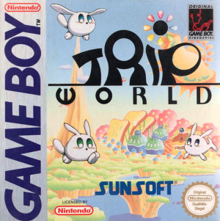
It was with those thoughts in mind that I played Trip World for the Game Boy. It’s a pretty obscure title that I learned about while poking through Sunsoft’s back catalogue. The developer had caught my curiosity after I saw a Hebereke speedrun during Games Done Quick and I vibed completely with the cute “shitpost Sanrio” characters. I never see anyone talk about Sunsoft, so I decided to pursue a whim and check out a few of their original games over the last year.

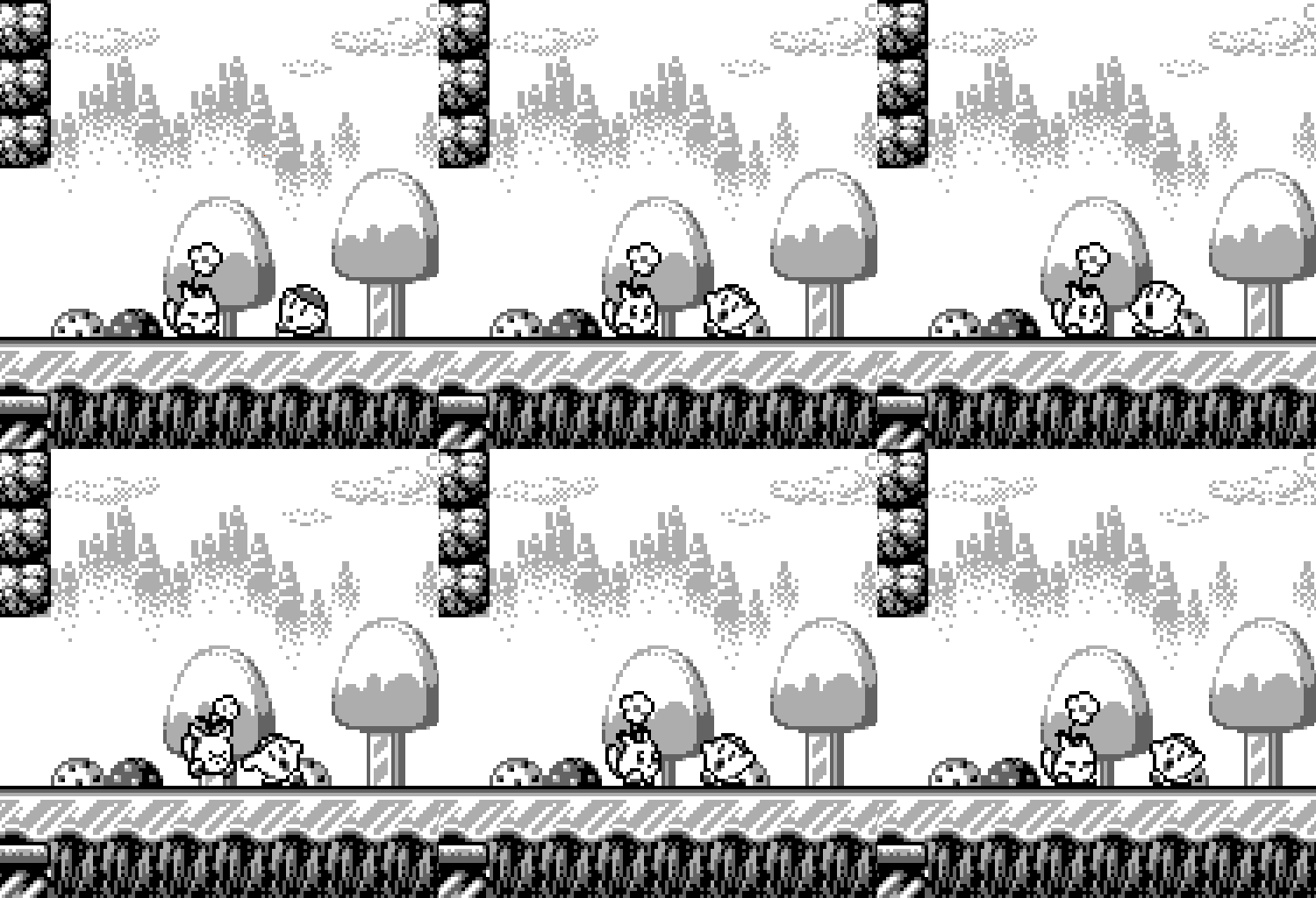
Trip World is a forgotten game, and not without reason. It is a side-scrolling platformer with a cartoon animal mascot character — a crowded genre then and now. What sets it apart are two core concepts: first, that enemies generally do not damage the player, and second, that the player can change forms. Given these concepts and the system it was released on, I assumed that Trip World was chasing after Kirby’s Dream Land, but it turns out that they were released within months of each other. (And besides, Kirby did not have transformations until Kirby’s Adventure on the NES.) Kirby would come to be defined later by its kid-friendly breeziness and many fantastic transformations, but those elements are already set in Trip World. But while Trip World may have come first, the inevitable comparison is not in its favor. They share intentions, but Trip World fumbles its executions.

Platformers generally have enemy characters because they give meaning and consequence to the player’s actions. Without meaningful consequence, there is no drama and no play. Unfortunately Trip World does not have any substitution for the drama afforded by hazardous foes. Critters meander left and right, and collide against the player without any reaction. It is possible to kick them off screen, but there is no real reason to do so. It is also possible, with a power-up, to spit seeds at the critters and cause a small flower to grow on top of their heads. This is surprising and delightful at first blush, but sadly it is also without any consequence. It is a thing you can do, any perhaps that can be enough, if not for the boss fights.

At the end of every level of Trip World there is a shockingly difficult boss battle. While other characters in the world seldom deal any damage, the bosses are brutal and require extremely precise action. It’s not Castlevania hard, but it feels unfair because it is so out of place from what is asked of the player for the other 90% of the game. I am not sure any other game has such a disparate difficulty spike. The challenging bosses put the lackadaisical level designs into question. Either the levels are meaningless because they are not preparing the player for the challenges ahead, or the bosses are meaningless because they halt the chill out vibes of the levels. There is an incompatible miscommunication.

The second conceit, the transformation abilities, do not add up either. The up and down buttons on the d-pad allow the player character to change into a sky form and a fish form. The sky form allows the player to glide, and the fish form allows the player to swim. Each comes with downsides; the glide will stun the player for a period of time when they hit a wall, and the fish can only flop on land. These caveats make the forms only useful in extremely specific scenarios, however those hypothetical scenarios never appear in the game. The base form can travel through water just as well as the fish, only with slower physics, and every jump in the game seems designed to be clearly accomplished with just the base form. There could be speed running benefits to the different forms, but nothing within the game itself asks for nor rewards their use.

This is a pity, because each of the player forms has impressive art and physics. The game has some of the best animation I’ve seen on the GameBoy, and the physics programming feels robust. Outside the form changes I have already mentioned, there are power-ups that turn the player into a bouncy ball, into a miniature version of the character, one that gives a long reaching tail attack, and one even stretches the character’s legs freakishly long. Each of these forms has complete animation sets, and different controls with momentum. It is seriously impressive work for the Game Boy era. My favorite detail was a tumbling animation when sliding down a slope.

The reason this obscure game has stuck in my mind this month is because the shortcomings of the design planning undercut the parts that shine. This is a very harsh thing for me to say, but the poor game design insults the craft of all the other disciplines. Working as a designer, I cannot help but imagine myself on the other side of the screen, squandering the thousands of lines of code and intricately arranged sprite sheets that give the player character life.

That was my dark, nasty thought as I watched the credits start to roll. Then I was greeted by one last surprise: the team was tiny. A couple artists, a couple musicians, and a director who did all the programming. No one called themself a planner. This flipped the narrative in my head. On a bigger team, there is a responsibility to prune and focus so that there is a consistent direction. But if, and I admit this is speculation, this was the work of a programmer’s passionate desire to code a bunch of character experiments, and a posse of artists showing off how good they are at pixel animation, then who am I to say that the fish form needed to be cut? Maybe this game isn’t for me — maybe it’s for the people who made it, the people who added a power-up that makes flowers grow on everyone’s heads, not because it did anything but just because they could. Will I forget this game because of its indulgences, or will I remember it for them? Only time will tell.

It would have been nice if Trip World had better level design. It could take something neat and make it great. Its absence makes my professional anxieties spill out. “Where was the planner?” There wasn’t one. Just a handful of people making something new, and tumbling down beautifully. I hope they had a better time making it than I had playing it.

OTHER STUFF FROM THIS MONTH:

FFVIIR: Intermission (DLC, PS5)

  • FFVIIR’s battle system still leaves me in total awe. Just astonishingly good gameplay. So exciting, so complex, yet before long you can play it without even looking at your opponent. Delicious.
  • Yuffie’s kit is fun! I can’t wait to do battles with her in the ensemble!
  • Does this game want me to think Yuffie just walked out of the bathroom or something and forgot to button her shorts? For the entire game? I am begging you to please change that part of the character design.
  • We borrowed a friend’s PS5 to play this but we messed up and started it in a temporary account that deleted our 3+ hour long save file when we stopped for the night. I think the PS5 is a bad console right now. 60 FPS looks niiiiiiiiiiice tho

Advance Wars (GBA)

  • After the remake of this game was announced at E3 I dove back into the original.
  • This game is legitimately dangerous for me. It is so addicting that it interferes with my life. I finished the campaign within a couple of days and it is taking so much willpower not to start the next one. If I mention Advance Wars again next month I have failed.

Streets of Rage 2 (3DS)

  • The 3DS port of this arcade classic adds stereoscopic 3D and it looks beautiful. I bought a new 3DS last year and tricked it out with faux wood paneling just so I could play these upgraded old games and have the ultimate hipster life. It has been worth it to play this game in the best possible format, IMO. 
  • “2.5D” perspective games like this usually have to do a lot of magic tricks to fake the depth collision and make it feel right. I wonder how much of a nightmare it was to convert that collision calculation to work with “real” depth demanded by the stereoscopic effect. Maybe the original programming was super good and didn’t have to do any trickery so the conversion was seamless! I wonder.

Streets of Fire (Movie)

  • Dude this movie rules??? This movie rules so hard I ordered a collector’s steelbook before the credits finished.
  • I would like someone to write some sort of pithy comparison between Streets of Rage and Streets of Fire but it couldn’t be me.

Dear Brother (Anime)

  • It’s like Mean Girls, if Mean Girls traded all the comedy for gothic dread!
  • The first episode is so intense that I had to stop and take a breath. Nearly every shot is vignetted, like a horror movie. Something menacing is hiding in the shadows. Everyone wears a phony smile. Characters say one thing, and the subtleties of the visuals scream otherwise. I’m still only a few episodes in, but it is clearly the work of masters at the height of their craft.
  • Revolutionary Girl Utena, my favorite show, is clearly in conversation with Dear Brother. Many visual compositions are unmistakable quotes, and the themes of school hierarchies and power structures have many similarities as well. Even mundane shots seem like subconscious recreations. It is as if whenever the animators of RGU closed their eyes to imagine a solution, Dear Brother‘s approach always appeared first. It’s fun to trace back influences and see that in all great and novel things, creativity is often much smaller and more iterative than we might expect.

If you have enjoyed reading this, consider signing up for the Saving Game newsletter! I will always post these on my website, but with the newsletter all future essays can go straight to your inbox.

New Pokémon Snap (May 2021)

A very short catch up this month; I am flying out to visit my parents tomorrow, now that we have all been vaccinated. I have been able to spend more time this month in much needed social company, and I hope you all are able to as well. A funny side effect of this is that I didn’t play too many games this month! Or rather, I didn’t play any too deeply. So this will be a very fast and loose collection of thoughts, perhaps as a karmic consequence of going three times as long in the last letter.

Before I get to this month’s games, the IGDA is doing a peer determined awards show with open nominations in many hyper specific categories, and it makes my heart soar a little. Our industry accolades are dominated by very strange processes, but this is a good chance to vouch for indie titles or specific people who deserve more attention. If you make games fill in a couple that you care about!

New Pokémon Snap (Switch)

I did not grow up with the original Pokémon Snap, but like many I was very happy to see the humble photography amusement ride return. In all the conversation about the game I came across an interesting video that outlines as much behind the scenes information about the original game as they could muster, with some fascinating turbulent history, if it is accurate. Whether it is conjecture or not, the new game is made by completely different staff, in completely different circumstances. The original game is the perfect “Blockbuster rental” game — something that is dabbled in for a weekend while friends are around. That economic model is obviously totally extinct now (to Nintendo’s glee, I am sure). The new online features are cool, and help ease this old game system into a modern context, but beyond nostalgia I am not sure it offers anything special within the wave of photography games that have been innovating the genre like Umurangi Generation, Dear Future, and Beasts of Maravilla Island. Compared to all these other titles, New Pokémon Snap is a very, very expensive production, but I do not think it takes those resources as far.

I still had a great time snapping some pics though, so I can only really beg for one change: The loading screens all show a randomly selected Pokémon silhouette in the corner, I wish it also said “Who’s that Pokémon?” and then unveiled the name as the loading screen transitioned back to the scene. For a single text box and a database query they could make every loading screen a tiny game! (I know why they can’t do this but I waaaaant it!)

Dicey Dungeons (Switch)

I LOVE THIS GAME! It combines a turn-based RPG combat system with the dice sorting of Yahtzee, turning the random number generator into a malleable bidding system. I can’t describe the mechanics because they change constantly — each of the multiple characters has their own unique core gameplay system, and even those have variations across different episodes. It is bursting with mechanical creativity, and always changes up as soon as you get comfortable.

I don’t know if everyone will love it — I admit that it is a game designer’s game. The core challenge is to build a probability engine that manipulates dice rolls into attacks that are guaranteed to land. Cute art only disguises the math of it all so much. But it is mechanically delicious. I played a thief who rolled a chance to steal one of my opponent’s attacks, and that attack let me transform into a bear, and then I was a bear for the rest of the episode, destroying enemies intended to challenge my thief skills. This made some fights very easy, and some incredibly hard. I loved every second.

Final Fantasy VI (SNES with localization patch)

I haven’t gotten very far through this game yet, but it’s cool. There is a character who takes fighting game combo inputs to execute moves. It’s like Dicey Dungeons, but with more talking between the cool mechanics. I suplexed a ghost train though, Dicey Dungeons hasn’t let me do that yet.

Bugsnax (PS5)

You know what, this should belong to that nebulous genre category that Pokémon Snap and Umurangi Generation are in, even though there is no photography in this one. This game would be so much better with Pokémon in it, and Pokémon would be so much better with this game. The makers of Bugsnax clearly know this, I wish Pokémon would too. 

Actually — and I hate to jump back to talking about a multibillion dollar transmedia franchise when this should be an indie team’s time in the sun — isn’t it weird that New Pokémon Snap spends so much effort assuring you that the apples you throw at Pokémon aren’t painful and it’s like being hit with a marshmallow? I know they have been traumatized by PETA campaigns against them, but this is a series founded on Pokémon knocking each other until one faints, and they are so completely adverse to any violence in this fictional world that the contrivances have become comical. Bugsnax has a bite to it (sorry for the pun) that makes the sentient food world more believable. More importantly, it allows it to be more dramatic. The world feels vaster and more alive because there are drops of danger and malice, and it makes the sweet stuff more meaningful by contrast.

Anyways, Bugsnax is better than New Pokémon Snap. Good job team.

Rez Infinite (PS4)

Nice.

If you have enjoyed reading this, consider signing up for the Saving Game newsletter! I will always post these on my website, but with the newsletter all future essays can go straight to your inbox.
Take care and have a pleasant start to your summer!

Looking at the credits

Sometime near the start of April I needed to research some top-down combat implementations on the GameBoy. This initial quest sparked a tangential curiosity, which would consume most of my month. I started by playing the Japanese release only Kaeru no Tame ni Kane wa Naru, or “For Frog The Bell Tolls for the GameBoy. I then followed that up with The Legend of Zelda: Link’s Awakening for the GameBoy and GameBoy Color. After that I dipped my toes in The Legend of Zelda: Oracle of Ages, also for the GameBoy Color. All three games seem to share the same game engine, and their stark differences inspired me to find out more about how they came about, and who made them.

✧༺♥༻✧
Kaeru no Tame ni Kane wa Naru – Hardcore Gaming 101

It’s frankly laughable that I started my research into GameBoy-era combat systems with For Frog The Bell Tolls. While the game could be described as a classic RPG where a pair of princes adventure across distant lands to rescue a princess damsel, the most notable feature of the game is that it is an RPG with no battles at all. 

Well, there are battles, but they are deterministic in outcome. When the player touches an enemy, the two collapse into a cartoon fisticuff dust cloud. As the two combatants exchange unseen blows, their health depletes. The player loses a heart, then the monster loses a heart, then the player loses a heart, etc, until one person dies. There is no input, no action, no dice rolls. As soon as the battle begins, the victor is certain.

To progress through the game, the player has to acquire equipment that improves their fighting ability. For example, the player can find additional health, or they can get a weapon that deals more damage. This is typical RPG fare, but by removing the chance and skill from battles, they have turned the battles into the same “lock and key” sequences that have always existed outside of RPG battle systems. At one point there was an evil tree blocking my way, and I realized that the developers knew definitively that I could not pass through until I had located an additional heart and collected enough money to buy a saw weapon. Every single encounter is transparently part of a grand fetch quest. And I loved it.

Without skill or chance, there is no pressure in any fight. I cannot be good nor bad at the game. Although antithetical to the laws of “good game design,” this was shockingly relaxing to play. All ambiguity and pretense was discarded. Battles lose all drama, sure, but they also pass by in the snap of a second. Fetch quests are often derided because of their tedium, but For Frog The Bell Tolls revealed to me that it is the slow battles that cause that tedium.

As someone who likes to approach studying games by looking at “fun friction,” this approach startled me, and I had to know how it came about. In an interview translated on Shmuplations, programmer Yasuhiko Fuji recounts that the battle system was completely remade three times. He was still in college while working on the game, and was not confident in his design abilities. Ultimately, he decided that the best approach would be to simplify the combat system. What we can learn from this is that the shipped combat system was not what was originally planned. In fact, to my eyes the combat seems “simplified” to the point of being a cut feature. I find this genuinely impressive. Combat systems are the core feature for most RPGs, and most games do not ship with their core feature cut! For Frog The Bell Tolls is a wonderful game, and playing it was unlike anything I have played before. I came to this game looking for combat mechanics, and I left with the lesson that hey, maybe you don’t need them.

✧༺♥༻✧
The Legend of Zelda Link's Awakening DX - GamerBolt

    Except that in my case, I did actually need them. So I moved onto the next game, Link’s Awakening, which I had always heard was the follow-up to For Frog The Bells Toll by the same team. This, it turns out, is not true. If the credits are to be believed, then only the composer worked on both titles. What is true is that both games appear to share the same game engine. The software appears to have the same collision systems and movement, and both utilize a technique for shifting from top-down rooms to side-scrolling rooms. And who were the people utilizing and building on top of the technology from For Frog The Bell Tolls? At the helm was Takashi Tezuka, who wanted to bring his previous title, “A Link To The Past” to handheld.

    I would argue that Link’s Awakening is an improvement from what came before. Perhaps because of the smaller platform and less executive oversight, the narrative has greater personality compared to previous Zeldas. Random weirdness in the narrative coexists harmoniously with deeply considered and elegantly constrained design. The smaller screen forces an economy of level design that leads to the densest gameplay per pixel in a Zelda game. Without the technology for scrolling, each screen has to have something interesting to do in it. For Frog The Bell Tolls also had a quirky story, but its serviceable map layout reveals, by contrast, the skill of the Zelda team’s planners. This game benefits from the team’s experience of making A Link To The Past, but gets to utilize ideas too weird for such a high profile title. Further, its development was likely made possible by constructing atop an existing game engine rather than starting from scratch.

    The people who made that engine weren’t around for Link’s Awakening. Where were they, then? Fuji, the programmer whose interview I referenced earlier, went on to work on Super Metroid instead. In fact, most of the staff did — Yoshio Sakamoto went from scenario writer to director, graphic designer Masahiko Mashimo continued making background art, both character designer Tomoyoshi Yamane and director Toru Osawa shifted to object design. (Don’t worry about Osawa’s downgrade, though, he then directed Ocarina of Time). There are certainly more parallels to be seen between For Frog The Bell Tolls and Link’s Awakening than there is with Super Metroid, but videogames are mysterious like that.

✧༺♥༻✧
The Legend of Zelda: Oracle of Ages (2001) promotional art - MobyGames

    I had so much fun playing Link’s Awakening that I immediately fired up the next handheld Zelda game: Oracle of Ages. This game is one of a pair made by Capcom, the other being Oracle of Seasons. Both of them use Link’s Awakening as a base — not just building off the game engine, but also repurposing many art graphics. Played back to back, these visual similarities really emphasize the differences in level design, and unfortunately the first impression is not favorable.

    The Oracle games utilize enhanced scrolling technology that allows for rooms to be larger than a single screen. While this opens up many possibilities for level design, the feature is not used with much restraint. Rooms are large, open, and empty. While Link’s Awakening has every square tile carefully considered, Oracle of Ages baffled me with blocks and level features scattered around at random. In early dungeons I wasted an hour pushing on objects, searching for secrets, because I could discern no other reason for those objects to be there. The inconsistent utility and larger spaces made it more exhausting to travel from one space to the next. Unlike the previous two games, I did not pick it back up after I put it down. 

    Despite my play experience, I am still fascinated by the result of a new staff. Capcom making an entry in Nintendo’s flagship series was a big deal! While inexperienced with designing the game elements — especially compared to the veterans on Link’s Awakening — giving Capcom’s staff the chance to build this experience would yield incredible future returns. The director, Hidemaro Fujibayashi, would lead Capcom’s The Minish Cap, which is a Zelda game I like quite a bit. He would also go on to direct Breath of the Wild, a game you may have heard of, and that Nintendo seems pretty pleased with. The other planners on the Oracle games would go on to be the lead designers on Devil May Cry 5 and The Last Guardian. That’s pretty incredible!

✧༺♥༻✧

    So what are we supposed to do with all this information? I have strayed very far from my quest to learn more about top-down GameBoy combat systems. But I found something much more interesting. I found deeply divergent design approaches that begged for explanation. All of them were born from circumstance, but specifically the circumstance of the people who made them. For Frog The Bell Tolls was made by young new developers with great technical savvy. Link’s Awakening used that base as a platform for veterans to toy around with their after hours ideas. Oracle of Ages/Seasons was loaned that platform to bring in more new voices, one of whom would become instrumental to Nintendo’s 2017 turnaround. I’ve got a new theory that Takashi Tezuka’s games prioritize density, while Hidemaro Fujibayashi encourages vastness. More than anything, though, I am hungry to learn more about the history of individual contributions on every game I play, to better understand what makes them all so different.

✧༺♥༻✧

    Along this same subject, I came across a documentary called Star Wars Within a Minute. It had been mentioned within a podcast, and thankfully is easily accessible on YouTube and Disney+. This documentary takes a 48 second scene from Revenge of the Sith and goes through every single department that had a hand in it. This means producers, concept artists, previs artists, costume designers, caterers, post production staff, accountants, everything. They interview representatives from each department, but the complete credits are shown as they go through each. The documentary is ostensibly a fluff piece meant to demonstrate how impressive the scale of the film is, but it still manages to humanize the vast amount of work on all films. I do not know the caterer’s life story, but I now know better the kinds of handprints left on any blockbuster.

✧༺♥༻✧

Case Study: David Aja’s Hawkeye

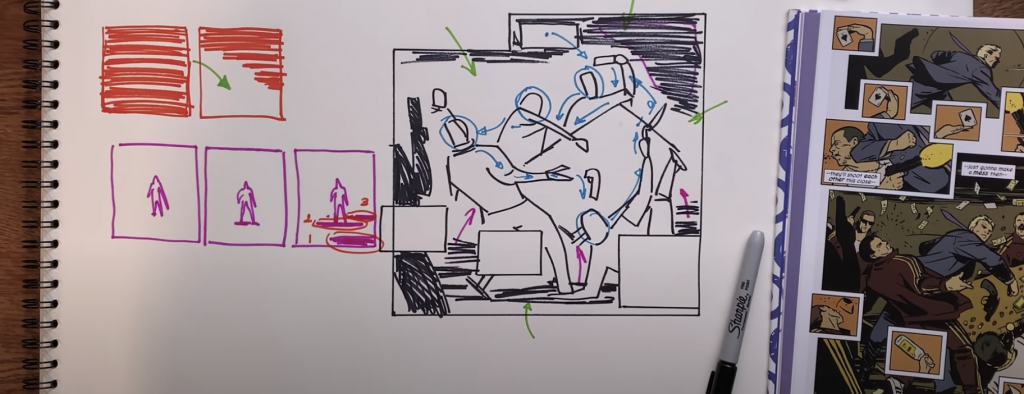
    Films are made by hundreds of people, but even more intimate mediums like comic books can benefit from this kind of documentary work. My absolute favorite new YouTube series has been Elsa Charretier’s comic art case studies. In them, she breaks down the visual language within a single page or panel, and uses her professional expertise to explain step by step how the studied artist arrived at their conclusions. She often redraws panels in order to show how different decisions lead to different effects. Her case studies are valuable lessons in negative space and pacing, but they also serve to highlight what makes these master artists unique. By replicating the thought process of these artists, she demystifies the technical aspects of image making while also showing how there can be several approaches to each problem. Plainly seeing the list of information that must be communicated coupled with the creative solutions makes the contributions of the artist obvious.

    For people outside of comic book circles it may seem strange to need to declare that the artists are important contributors. Unfortunately, the western comics industry can often treat artists as interchangeable assets. Coverage tends to prioritize writers, as series are organized around writers, and artists are often subbed out during on-going stories. Within critical circles, analysis usually focuses on writing as well. Critics are themselves writers, so they are adept at talking about the literary elements. A comic’s plot, character motivations, dialogue, all these are well covered. I’ve seen many artists online bemoan the lack of discussion of their craft. Comics are at least fifty percent art, but when critics are themselves critiqued for having a blindspot when it comes to writing about the craft of image making, the response I see is a sincere plea for examples of how to even critique visuals. In Elsa’s videos I see a perfect lesson.

✧༺♥༻✧

The lineage of Japanese animators, from Animetudes

    Perhaps the most extreme form of this kind of analysis can be found in animation, particularly in anime. It’s colloquially called “sakuga,” and it has come to refer to the practice of accrediting individual shots to their artists. The original scope of the term refers to a cut of animation that is distinctly higher quality than the surrounding cuts, behaving kind of like a solo during a music performance. Those in the know recognize these soloists, and the artists gain some niche celebrity. Because this is the internet age, the scope of “sakuga” quickly exploded, and now any and every cut of animation can be sakuga, leading to a sizable fan community that researches as many individual artists as they can. This research even extends beyond key animators, and includes background artists, compositors, and more.

I am usually adverse to non-professionals making confident assertions about the behind the scenes of any piece of media, but sakuga strikes me as different. For one, the lack of NDAs means that the artists themselves participate in the discussions and can set things straight when cuts are miscredited. Secondly, the goal of these fans is not IP focused. Fan culture usually champions specific IP, but sakuga fans follow the individual creators to whatever shows they take them to, regardless of genre. Their goals are refreshingly non-commercial. They don’t root for a sports team, they chart every player in the league. They just want to learn about the talents and growth of individuals. They want to see how the visual grammar of animation evolves over time, and how it is shaped by human hands.

While sakuga discussions are non-commercial in the sports team sense, they are definitely not apolitical. The goal of sakuga analysis is to expand the spotlight beyond the typical director auteurs. A beloved show is made up from the contributions of so many people, and by highlighting each of them and placing them in a context that is both historical and personal, it gives power to voices that have otherwise been marginalized. But with new attention comes unavoidable realities. When you have a name and a face to the specific, tangible contributions that make up the stuff you love, it empowers their voices when they say “we’re barely scraping by.” Animation is undergoing a crisis. There are more shows being produced than there are resources to make them — human and monetary. The demand is high, and there is a bubble that appears on the cusp of bursting. Thanks to the fan communities that dig into the shows’ credits and honors people for their individual contributions, a complete outsider like me can understand what this ongoing crisis means for the real people suffering under it.

✧༺♥༻✧

Despite witnessing exploitation that would make a games executive blush, I am envious of this moment in comics and anime. There are horrifying injustices in those fields. Yet I look on to these critical analysis and research pieces for the crafts with longing, because games still seem so far from them. Yes, I am envious because I would love for my own work to someday be treated with such scrutiny and respect. (Anyone who says otherwise is lying!) But even more than that, I would love to be able to trace the individual contributions of people as they flitter through the games industry because there is so much to learn from! Were I to take any room in For Frog The Bell Tolls, Link’s Awakening, and Oracle of Ages I would find three dramatically different solutions to some of the same game design problems. Who did the layouts for those rooms? What led them to those conclusions? How did the outcomes of these games inform the next titles they worked on? As someone who works in the field, I can’t help but be transfixed by these questions.

Games are very secretive about how things come together behind the curtain. But I would hope that anyone who has worked on one knows that there is no job in it where the people are completely replaceable. Games are about finding solutions to made up problems, but no two people will land on the same solution. I get a little discouraged when I see fans clamor for sequels to games where the teams have totally dissolved, because the magic that made the originals is not in the IP, but in the chemistry of the team. We all want to know what makes one game click and another flop; or worse, never materialize. I believe we would have a better understanding if we could develop the vocabulary to express the quirks of the individual contributors. I have been inspired by many things this month to look closer at the credits of everything I play, and hopefully I will continue to learn things.


– Esteban

Links:
Shmuplations Interview: https://shmuplations.com/yasuhikofujii/
Elsa Charretier’s Channel: https://www.youtube.com/watch?v=Peu6lw0nido
Star Wars Within A Minute: https://www.youtube.com/watch?v=VgS3pt0yMvs
Animetudes: https://animetudes.com/the-history-of-the-kanada-school/
​Sakuga Blog: https://blog.sakugabooru.com/​

If you have enjoyed reading this, consider signing up for the Saving Game newsletter! I will always post these on my website, but with the newsletter all future essays can go straight to your inbox.

Gnosia (March 2021)

This month I did not play very many games! I finished playing Fire Emblem: Path of Radiance (GC), which I had been streaming with friends a couple times a week, but after the credits rolled I decided to take a break before continuing onto the sequel. This left me without a new major project for March, but it gave me plenty of time to dive back into a pair of hobby projects I have been casually chipping away at for years. One is a stealth action game based on classic swashbuckling thieves of the silver screen, and the other is a mystery game adapting some dynamics of Werewolf and Mafia into a single-player narrative form. It has been very satisfying to reinvest my free time into my own imagination, and even though there is a likely chance that neither will leave my own computer, they have reminded me of how much I love the process of making games. 

One thing I played did collide with my side project in a way I find thought provoking: Gnosia (Switch) is a visual novel that shares an almost identical pitch to my mystery game. I was eager to try it out as soon as it was released to see what I could learn from it, so how about I share what I learned here?

First, a brief description of this very strange game. In Gnosia, you wake up from cryosleep to discover that an alien parasite has infected a crew member, and the ship’s computer protocol requires the crew to vote for a suspect to be resuspended. Should the crew vote incorrectly, the Gnosia infected member will murder someone. As a player you can cast suspicion or defend others before everyone casts their votes. Whether you succeed or fail to catch the imposter each round, the game restarts anew with an expanded cast and new wrinkles, such as additional roles. Eventually, the player has a chance to play as the Gnosia and try to commit murders without being suspected by the non-player characters.

These mechanics should sound familiar to anyone who has played the popular party games Werewolf, Mafia, or its digital sister Among Us. These games are typically defined by their intricate group dynamics, which make the simple rules come alive with personal insight and stakes. Why, then, would anyone want to play a single-player version of this system?

Gnosia’s answer to this question is in its characters. Freed from the confines and baggage of reality, Gnosia stuffs its cast with absurd, colorful crew members with interesting personalities. I enjoy playing the game because it is FUNNY. There is an old school grey alien who appears early on, and who insists he is not the alien. Should you believe him? Mechanically, there is no more reason for him to be Gnosia than anyone else, but everyone insists he is human when he looks like the most stereotypical alien possible! This is the type of farcical drama that is only possible in a videogame.

However, my interest and enthusiasm for the game waned after a few hours. I still highly recommend it, but before too long the stakes dissolve. The evolution of the game’s cast and the introduction of new mechanics seem to come after each game resets, regardless of whether you “won” or not. There are vague currency points gained at the end of each game, which can be spent on RPG stats that invisibly affect your ability to persuade the other crew members to vote one way or another, but the system is so opaque that there is no clear reason to invest in one over another. It feels as if the entire game could be scripted to play out events like a visual novel where the choices made don’t actually affect any system behind the curtain.

This is the strength and failure of Gnosia. It is able to script interesting, even hilarious scenes, but unfortunately, even before I saw them through to their end they lost my engagement. This happens because the memories and continuity of the narrative reset after every game (at least at the point I put down the game), so there is no draw to see what long term conflict can be resolved. In “Rules of Play,” a seminal guide for designing games, Salen and Zimmerman propose a model for understanding player engagement. They posit that when players have a desire to see an outcome matched by a respect for the process to get there, they participate happily. If a player wants to win, but doesn’t respect the process, they become cheaters, and when they lose respect for the win, they become quitters. I felt myself slipping through those steps; first I felt like cheating and reading a spoiler synopsis, then I lost even the will to do that, and quit the game.

As for the mystery game I am working on, which initially I suspected could be very similar to Gnosia, I am pleased to discover that we could not be more different in interpretation of the same source materials. My own project is focused on corroborating alibis to deduce the truth from a procedurally generated web of lies — a mechanical process I yearned for in Gnosia. For better or worse, my work is much less concerned with the squishy drama of how people persuade each other to vote. I think persuading real life friends will always be more interesting than the illusion of persuading a computer, but Gnosia makes a very entertaining effort. Most importantly, it does what I cannot — which is write fun characters. Gnosia may have lost my long term engagement due to unclear mechanical stakes, but without those charismatic characters there is no drive to even start engaging. For that reason alone, Gnosia exists and is cool — while my systems may stay on a spreadsheet, the other half of an incomplete whole, until the day I am able to level up. Thank you for the inspiration and the challenge, Gnosia!

Other stuff I checked out this month:

  • Mother 3 (GBA)
    • Revisiting it with a new appreciation for the brilliant small systems that add real-time action to this turn-based RPG.
  • Wario Ware Gold (3DS)
    • One of the central conflicts to this game is solved with a bidet, which more games should do.
  • Cristales Demo (Switch)
    • This demo is so freaking cool and beautiful. I hope they can maintain the time travel high concept across the full game, the potential scope of it scares me as a developer!
  • Speed (Movie)
    • This movie has exceptional game design, and also my local train station.

If you have enjoyed reading this, consider signing up for the Saving Game newsletter! I will always post these on my website, but with the newletter all future essays can go straight to your inbox.

How much is a coin worth? (February, 2020)

In my books, this month’s biggest release was actually rather small: Bowser’s Fury — a bonus feature packaged with the Switch reissue of Super Mario 3D World, originally for the Wii U. Bowser’s Fury is a stand-alone experience constructed out of the engine and assets used in 3D World, but manages to feel completely fresh thanks to a different camera perspective and unique game structure. I find myself amazed by how effective it manages to be with the frugality of its construction, but since I wrote about a similar topic last month concerning Hitman III I will not retread the same ground here. This month I found myself thinking much more about the game’s incentives and punishments.

Coins are one of Mario’s great gifts to the world. They signal enticing challenges. Their sound effect is the perfect two-note symphony. They make us feel rich. But in games as in life, coins have suffered from inflation and devaluation.

Games were once much more harsh and punishing. Arcade games took more coins than they gave; a necessary consequence of the coin-op business model. When they moved from arcades to the home, games battled trade-ins at used game stores by becoming longer, but kept the full reset Game Overs. Eventually this inaccessible abuse of time lost favor, and games matured beyond the bully who beats up a nerd for their lunch money. What they became is something more nebulous. We have games for more types of people than we ever have in history — but for series that have been around since arcades, there is something of a crisis of identity. How can a game balance incentives without being punitive? Or to put it another way: What is a Mario coin worth these days?

Mario coins are a basic unit. The developers use coins to guide player attention, create acoustic rhythm, and provide extra lives. Coins mean a second chance. It doesn’t hurt to miss them, but it feels great to grab a bunch. However, their fundamental utility has collapsed. Game Overs are too punishing for a wide audience, so the consequences of dying have been pruned with each new game. 35 years later, Mario will still hit a coin block until that counter rewards another life, but now it is hollow. It does not take a savvy player to see that coins can be ignored entirely, and that can leave players to miss some of the most pleasurable challenges and exploration of a game’s level design.

So what is Mario to do?

In Bowser’s Fury the player collects coins. 100 coins rewards a power-up, which is banked in a tiny inventory. There are five power-ups, and the bank can hold five of each. A power-up is lost if the player is hit while equipped with it. The power-ups provide a safety shield at the minimum, so there is always a good reason to have one equipped at all times. The power-ups help overcome challenges, so struggling players will want them. This encourages struggling players to try to collect coins, which often challenge players’ precision. In effect, it recreates one of the original goals of coins: it rewards players who need training wheels by making them practice to keep them, until they are skilled enough to no longer need them.

A talented player will not lose power-ups, so the coins quickly become worthless. This was true of the original 1-Ups as well, so coins in Bowser’s Fury are neither better nor worse for talented players, but they are improved for struggling players. Coins provide an incentive to practice by rewarding various abilities that make the game easier, but can be quickly lost. Coins regain their effectiveness as a carrot by becoming more delectable, while the stick of Game Overs disappears from view.

What becomes of the punitive arm of Mario’s game design? Both talented and struggling players still need some friction to fight against, and here Bowser’s Fury sees a small innovation as well. Previous Mario games have relied on the “bottomless pit” as their primary antagonist. Bowser’s Fury does away with the bottomless pit. Instead, the linear courses are embedded in the overworld. They jutt out of the sea, giving a clear direction to travel (up) and a new, natural punishment for falling off — the player has to swim back to shore and climb back up. This is similar to a normal respawn, but with two crucial differences. First, it takes longer to swim back to the level than it would to respawn. Second, the enemies defeated previously remain defeated. 

The tedious time spent swimming back initially rubbed me the wrong way. It is wasted time, completely worthless. However, I quickly realized it encouraged a new behavior: stepping away from the challenge and trying something else. When the player lands in the sea the friendly dinosaur Plessie appears to ferry you across the water. Plessie makes travelling between the island courses fun and about on par with the increased friction required to retry the last challenge. If a player does swim back and retry, then they will not be confronted with as many enemies. But they might be more likely to step away, try something else, and come back to it later.

I like this approach! I become frustrated when I fail at the same thing over and over again, and often find myself more able to overcome tough challenges after stepping away for a little bit and returning with a cleared head. And by that same token, I did not find Bowser’s Fury particularly challenging, but the threat of having to swim back if I did fall kept my close calls feeling tenser than they would if I could just instantly respawn. 

In short: the game system keeps the play experience embedded in the world without any loading screens, guides players away from behaviors that can increase their frustration, and creates slightly more riveting consequences for failure. This is a classic Mario solution, as creator Shigeru Miyamoto said: “A good idea is something that does not solve just one single problem, but rather can solve multiple problems at once.”
Could this game structure be expanded to a game twice the length or more? I am unsure. Bowser’s Fury is only a few hours long, and the map is small enough to allow players to travel from one end to the next in under a minute. The bigger the map becomes, the more friction emerges during travel. If time is wasted returning to the last challenge and time is ALSO wasted travelling to a different challenge then the system completely falls apart. Yet Breath of the Wild is a game with a similar embedded world, and it manages to captivate some players for hundreds of hours, so I cannot speculate. I am just glad that this game is what it is, and I cannot wait to play it again.

Other games I played:

  • Super Mario 3D World
    • It’s good, I love it.
  • Triangle Strategy (Demo)
    • I am a sucker for everything about this game’s pitch. That said…
    • The voices talk s o s l o w
    • It is so hard to read the sprites and tell what character is which because the post-processing effects are caked on so hard.
    • They use the same ambient particle system in every single scene and it drives me NUTS!
    • I will buy this game regardless
  • 13 Sentinels
    • I think the DESIGN part of the narrative design actually hurts more than it helps. It doesn’t hurt it much, but it doesn’t help it at all.
    • The battles are messy in every single way, but I had fun with them. Not enough to be enthusiastic about the thought of trying Hard mode.
  • Majora’s Mask
    • I am very sad that the character designer retired recently. Takaya Imamura defined the flavor of this game, and we will never see something else quite like it again.
  • Wario Ware Inc.
    • Re-experiencing this game through the eyes of someone who has never played it before was a joyful highlight, and it reinvigorated my love of games like nothing else this month.

If you have enjoyed reading this, consider signing up for the Saving Game newsletter! I will always post these on my website, but with the newletter all future essays can go straight to your inbox.

Skateparks (January, 2021)

Welcome, this is the first installment of Saving Game… Do Not Turn Off The Console, a monthly newsletter recording my life goings ons and the games I am playing along the way.

A new year is an opportunity for new habits! Did you make resolutions for this year? Writing and reflecting at the end of every month is one of mine, but so was returning to personal projects and, well, fate had other plans. My hard drive failed, and while I was able to recover most of my documents I did lose three years worth of personal photos. In terms of recorded memories, it’s a whole era of my life, up in smoke!

I’ve been thinking about impermanence more than usual, as I’m sure many other people are. I’ve had recent deaths hit closer to home than ever before, and last year I had to pack up as much of my belongings as I could under the threat of needing to move overnight. This pandemic has knocked everyone off their expected tracks, so what are we supposed to do?

For my part, I did what I always do: play videogames. Play is an activity done for its own sake, so games can feel good for grounding yourself in the moment. If I lose my belongings, the people around me, and parts of my own past, at least I can have the present — the action of the moment.

Incidentally, the games I researched this month were linked by “playground design patterns,” to steal a term from my friend Kevin Wong. In these games there are many tools or methods for achieving the objectives, allowing play to be at its most freeform and expressive.

TONY HAWK PRO SKATER 1+2 (2020)

When I was a kid we had the demo disk for Tony Hawk Pro Skater (THPS), which contained just the first level; but it was all we needed. The deep, expressive character controls and core gameplay could let you dig into a single location forever. I hadn’t touched the game in years, but I was eager to see what made it tick under a more analytical lens.

I was not disappointed! THPS uses a very elegant and simple system to drive its expressive gameplay. Each trick takes a certain amount of time to execute, and must be completed before the player hits the ground, otherwise the player wipes out. As the player spends time with the game they internalize the timing of each of the actions, and can better execute them within the natural timing windows created whenever they are airborne. This is nearly identical to the gameplay systems in most action games, where players learn how many swings of a sword they can make while an enemy winds up their own attack. The biggest difference is that in THPS, there is no antagonist. The player is responsible for all the timing windows, so you are playing against yourself.

People always talk about how fighting games are like dancing, and wondering how to adapt those systems to a less competitive or violent presentation. After playing this I think a dancing game would be more like THPS than like Street Fighter. And on that subject…

FLOOR KIDS (2017)

I checked out Floor Kids, a breakdancing videogame, to see how it compares. The hand-drawn animation is really incredible, and it is worth checking out for that alone. To my surprise, Floor Kids encourages player expression in a VERY different way, but is no less effective than THPS.

The core mechanic asks players to switch between styles of actions while maintaining button presses on a beat. Each action can flow into any other action, and the scoring system generally rewards everything except for sticking with one type of action for too long. As a result, there are no “wrong” choices besides not making a choice. This would be random and boring if not for the requirement to stick to the relentless beat. There is no time for the player to think about what move to do next, they just have to act. This combination forces the player to express. It feels like dancing — not in the precise and masterful way that THPS does — but in the way that a beat is going on, all eyes are on you and you have to move. No time to think. What do you feel?

HITMAN 1 – 3 (2016 – 2021)

The Hitman games are sometimes called “skateparks of death.” They are freeform like a Tony Hawk game, with simple objectives that can be accomplished in countless ways. Every map has more to discover each time it is explored, and from the beginning every level was designed to support a month of player attention. 

Unlike THPS or Floor Kids, Hitman has tiered levels of player expression. Players can follow “Mission Stories” that spell out every step to reach the goal. These usually take players through the most highly produced set-pieces in the level, but are so prescriptive as to be tedious. These can be disabled or ignored, and instead the player can naturally overhear or discover “Intel” that offers suggestions for wacky ideas. There are “Escalations” that narrow constraints to create more difficult challenges, and demand more creativity to solve. At the furthest end of expression, there are “Contracts” which allow players to create their own user-generated challenges.

The most fascinating part of Hitman III, for me, was after the game ended. The credits for all three games in the trilogy played back to back, and it very starkly illustrated how this latest entry had significantly less resources than either of the preceding titles. Hitman (2016) had a core dev team twice the size of this last one, and several additional departments and development partners. This is to be expected given the studio history: IO Interactive has released the series under a different publisher for every entry, and self-published this last one.

People who do not work in games may not be able to appreciate what a big deal this is. Publishers can offer vast amounts of resources, not limited to the money for expanded staff, but also licenses for development products, relationships to platforms and other studios, and testing specialists. It couldn’t have been a simple task to live up to the quality bar set by the higher budget titles. How did they do it?

IO Interactive were able to release the title thanks to the series’ episodic framework. Each level is self-contained, with their own stories and progression mechanics. This allows players to tackle levels in whatever order they want, and it allows the devs to add in levels following an established format without much risk. It even allows each sequel to import the preceding games’ content, which is rad! Normally people complain about sequels not “innovating” enough, but with Hitman everyone is happy to just have more levels. Thanks to this, the systems and assets developed in the first game do not need to be re-developed. Crowd faces only need to be modeled once, the character controller only needs to be programmed once, the UI system only needs to be designed once, the weapon effects only need to be made once, etc.

However, the episodic format may have also been responsible for some of this game’s problems. The reason the series was developed in a modular style was because the first game was released episodically — a single level at a time. Unfortunately this has been proven time and time again to be a disastrous business move. Journalists will talk about the first episode when it releases, but most players prefer to wait until the entire game is complete before deciding whether it is worth spending money on. Each subsequent episode is talked about less and less, and by the time the last one comes out all the players who were on the fence earlier won’t even hear about it. I am willing to wager that this release style impacted the sales for the first game and played a part in why Square Enix axed the studio. Whether this is true or not, IO Interactive abandoned this release strategy for the second and third game.

There’s no way to know if a different architecture for the game would have saved it from being punted around so many studios, but it undoubtedly allowed this entry to exist. The budget for this game is evidently wounded. Apologies for the bluntness, but Hitman III is the poorest of the lot. The levels are sparser and less intricate. Many of the objectives depend on gimmicks. The new gameplay addition is a camera that can scan codes from afar, but does not change gameplay in the slightest. The final level was clearly cut during production and taped together with whatever assets they could afford. This game was made with fewer resources, and that fact is not invisible.

But I love this game. Without it there would not be a complete Hitman. The series has gone through an entire console generation, three publishers, two business models, and unjustly bled most of the people who created it. It is better to finish this series of games, definitively, while they still can. It could not have been easy to land this plane, and it didn’t land without skids, but it is impressive that they did. I am so happy to have a tidy package with this massive trilogy of excellent games. Well done, IOI.

Other games I played:

  • Fire Emblem: Genealogy of the Holy War (SNES)
    • I cut an entire other essay length piece on this game, to be maybe posted at a later date.
  • Harvest Moon (SNES)
    • Still the best one.
  • Among Us
  • 13 Sentinels
  • Fire Emblem: Gilmore Girls (GBA ROM Hack)
    • I have played hundreds of hours of FE games, but I couldn’t beat this parody game…  I am a fake fan.
  • Super Mario 3D Land (3DS)
  • A Sailor Moon jigsaw puzzle
  • Fire Emblem: Path of Radiance (GC)
    • This game costs like $500 these days but I am not yet sure it justifies the price.

If you have enjoyed reading this, consider signing up for the Saving Game newsletter! I will always post these on my website, but with the newletter all future essays can go straight to your inbox.

2020 Games in Review

At the beginning of the year, I decided to write down every game I played. Turns out, I played a lot of games! Probably more games than I will ever play in a single year again in my life.

I wrote these reflections very quickly, trying to get it under the wire before the new year drops. I’m not sure who these are for, but in the next year I am going to try and write these more regularly, every month, so that my thoughts can have more room to breath and I’m not trying to remember things so far out from playing them. EDIT: If you like this, perhaps you would like to sign up for an email newsletter with similar (smaller) updates during 2021? https://tinyletter.com/efajardo

Anyways, here we go:

JANUARY

  • Fire Emblem 4: Genealogy of the Holy War (SNES)
    • A tactical role-playing game that has the player command a growing army of colorful characters as they navigate political intrigue across an entire continent and multiple generations.
    • This game bookended my year — I started in January and am finishing it up as I write this. This game is special, the scope of the character drama and the realized world manages to stand above the 3D open world games of today. I also read 2451 pages of the manga adaptation in two weeks.
  • Legend of Zelda: A Link To The Past (SNES)
    • The definitive 2D Zelda.
    • Good game, I replay  it every couple of years but I never finish it. Always get bored of the dark world for some reason.
  • Star Wars Battlefront II (PS4)
    • EA’s controversial take on the popular Star Wars Battlefront series had a rocky launch that caused the game to practically 180 direction over years of patches.
    • I like this game, it requires zero brain and I can’t be good at it.
  • Pokémon Mystery Dungeon DX Demo (Switch)
    • The demo for a 3D remake of a GBA/NDS spin-off of Pokémon
    • I looooove the original game, but wasn’t really interested in the remake beyond using the demo to take the personality test with all my friends. Maybe I didn’t play more because I gave it my heart and it gave me Machop.
  • Dark Arms: Beast Buster 1999 (Neo Geo Pocket)
    • Shoot gun and sometime shoot special gun to capture zombies like Pokémon.
    • This game is weird as hell. It rules.
  • Smash Bros. Ultimate (Switch) 
    • The fighting game famous for slamming together franchises now slams together it’s entire history in a single opus.
    • I will never stop playing this game. There is an endless fountain of design lessons in every corner.
  • Tokyo Mirage Sessions FE Encore (Switch)
    • A spin-off of the influential Shin Megami Tensei series. Pop idols fight demons and vague allusions to a couple of Fire Emblem characters appear?
    • I want to like this game and we have so much in common but I think we are just on different wavelengths.
  • Mario 64 co-op mod (N64 hack)
    • NICE.
  • Out Run (Switch/3DS) 
    • The classic arcade game about vibing while driving a car.
    • Out Run is a sublime game that gets better and better the more you play it. I habitually give it a run when I have ten minutes to spare.
  • Final Fantasy Adventure (Game Boy)
    • A Zelda-style top down action game. 
    • The opening to this game gripped me completely. You awaken in a gladiatorial pit fighting monsters, and then flee for freedom. The fast paced adventure, companion system, and hilariously overpowered battle mechanics captivated me and left me with a memorable experience I will carry for a long time.

FEBRUARY

  • Odama (GameCube)
    • Control an army and their giant stone pinball using a microphone.
    • This game is weird. Solid source of two hours of non-stop laughter.
  • Mario Galaxy (Wii)
    • A 3D platformer with twisty gravity.
    • Beautiful art direction, but the cohesion of the levels seems more random than I remembered it being. Still fun, and maybe in the end cohesion doesn’t really matter all that much.
  • Fire Emblem: Three Houses Ashen Wolves DLC (Switch)
    • 2019’s hit “what if chess pieces could kiss” gets some new pieces — the teenage mutant ninja turtles.
    • The new standalone story isn’t very memorable, but the new characters integrate into the main game very well and open up fun new possibilities for New Game+, which is exactly what an obsessive fanboy like me wanted.

MARCH

  • Asuka 120% Burning Fest (Dreamcast?? Saturn??)
    • Goofy school club captains fighting game.
    • Every single attack can be parried and counter parried, making for the most edge of your seat matches. I don’t know the character mechanics very well, but the game is so readable and dramatic that it instantly became one of my favorite fighting games to watch being played.
  • Granblue Versus (PS4)
    • Stylish fighting game based on a transmedia gatcha franchise.
    • I only skimmed the barest surface of this game but it seems neat.
  • Metal Gear: Ghost Babel (GB Color)
    • A largely forgotten 2D stealth game.
    • This game combines the original 2D Metal Gear design with some more modern mechanics from the 3D games, and it made me hungry for more innovations in 2D stealth. The pixel animation is also g.o.r.g.e.o.u.s.
  • Metal Gear AC!D (PSP)
    • Turn based stealth game + card game???
    • This game trades out action for tactics, and in doing so lays bare many interesting mechanics. Each action is a resource, and there is plenty of time to think over the consequences. I only spent a few hours with it but want to study this game further.
  • F-Zero Climax (GBA)
    • High speed sci-fi racing game.
    • This game is pretty okay. A fine portable F-Zero game, except that the original F-Zero can be played portably, and feels better than this one. The draw distance is limited by the hardware, and that makes racing occasionally frustrating.
  • F-Zero Maximum Velocity (GBA)
    • Like F-Zero Climax, but with totally new characters.
    • I have no interest in returning to this game. I can’t remember what disappointed me with this game, but that might be a testament to how unremarkable it was.
  • F-Zero GP Legend (GBA)
    • F-Zero with an involved story and branching missions.
    • I wonder what was in the air during this generation that led to old franchises trading out their arcade roots to experiment with Saturday morning cartoon narrative focuses. It’s a neat direction to take F-Zero, and I was excited to get to know the characters better but the strict mission design quickly frustrated me and I realized I would rather just play pure races.
  • Animal Crossing: New Leaf (Switch)
    • The long awaited community sim arrived on Switch with a greater focus on crafting systems and online play.
    • As much as anything, game design is about controlling the texture of friction across various activities. Overcoming friction can be fun, and when it isn’t fun that friction should be minimized. Animal Crossing has a particular relationship to friction because it is intended to be played slowly over the course of months. This requires lots of friction — the player’s goal must be far away — but it still requires immediate satisfaction, otherwise why come back? I think crafting mechanics are a great answer to this. It feels good to acquire resources, and it is satisfying to pay them off with a produced creation. Additionally, it has never been easier to share those creations with friends. I think this makes for the best Animal Crossing yet. However, the recipe of friction still isn’t perfected. Some goals come too easily, and many people pay off their debts within days, while other goals have too much friction. For example, I could easily add another room to my house, but I do not feel like there is a worthwhile path to decorating it in a way my friends would be excited by. I played intensely for months and wouldn’t trade that time for anything, but the core reward loop would need tweaking for me to intensely get back into it again.

APRIL

  • Final Fantasy VII Remake (PS4)
    • A landmark blockbuster, videogame’s closest equivalent to “Star Wars,” reimagined with modern technology and design sensibilities.
    • I have no experience with the original, but this game made me understand why FFVII is beloved. As soon as I was done with it I wanted to be playing it more, and that feeling stuck with me the rest of the year. Big, ambitious, sentimental, real and fantastic, the parts that shine outweigh all the things that drag. My favorite game of the year.
  • Resident Evil 3 (PS4)
    • Another remake, of a less classic game.
    • Adapting to the pandemic, this was the first game my friends coalesced around to experience together over a stream. Not as engaging as the Resi2 remake.
  • Heart Throb: Custom Date (Google Sheets)
    • My friends converted this 80’s fantasy dating card game into our own custom version, playable online through Google Sheets.
    • I highly recommend creating your own custom version of the highly obscure 80’s card game and playing it with your friends online.

MAY

  • Crisis Core: FFVII (PSP)
    • A prequel to Final Fantasy VII.
    • The blend of turn-based and real-time action that made FFVII Remake so compelling starts to take shape here, but it is slapped with a random slot machine game mechanic that never lets me feel completely in control. Cool to see the years of experimentation that payed off later.
  • Metal Gear Solid: Portable Ops
    • The first attempt at a 3D portable Metal Gear bridges the gap between
    • This game technologically and narratively bridges my two favorite Metal Gear games, Snake Eater and Peace Walker, but suffers from a complicated control scheme and empty levels. Incredible that the MGS3 engine is running on a smaller syster, it has the exact same physics and textural feeling as Snake Eater.

JUNE

  • Advance Wars (GBA)
    • Control cute little soldiers and tanks in a tactics game by the creators of Fire Emblem.
    • This game is so beloved, and the game mechanics and art are incredible, but I was surprised to find myself so repulsed by the cutification of recognizable war.
  • Fire Emblem Heroes (iPhone)
    • It’s Fire Emblem, gatcha’fied!
    • I personally don’t have a problem with gatcha games, but the tactics gameplay is (literally) skippable and the other mechanics were inscrutable to me before it tanked my phone’s battery.
  • Kirby’s Dream Course (SNES)
    • Kirby is a golf ball.
    • This game is wonderful and everyone should play it. Excellent date game, and the Switch version has online play!
  • Mario Kart (SNES)
    • The first Mario Kart used “Mode 7” technology to create the illusion of a 3D racetrack.
    • This game is so crunchy and slippery I love it. I love all Mario Karts.

JULY

  • Puyo Puyo 2 (SNES)
    • Multiplayer Tetris with cute bloby faces!
    • I am bad at Puyo Puyo.
  • Smash Tennis (SNES)
    • It’s tennis!
    • I am bad at Smash Tennis.
  • Panel de Pon (SNES) aka Tetris Attack
    • It’s Puyo Puyo with a Mii Fighter costume in Smash Bros!
    • I am bad at Panel de Pon
  • Star Fox 2 (SNES)
    • A long unreleased sequel to the technologically impressive Star Fox.
    • I had a blast with this game! It is very short, which would have been a hurdle if it was sold standalone, but was perfect for my busy life. Densely packed with excitement — a wonderful evening game.
  • Doom 64 (N64)
    • Doom but with original maps.
    • Fun.
  • Clubhouse Games (Switch)
    • 51 classic games like Chess and Poker given a luxurious digital recreation.
    • Games are part of ancient world culture, and I’ve sometimes dreamed of an anthropologically focused game that preserved and contextualized folk games around the globe. I was surprised to find a sliver of that dream in this. The games are tactile and effective, and playing “Hit and Blow” with my mom made her laugh harder than I have ever seen in my life.
  • City Connection (SNES)
    • A car driving platformer?
    • I do not understand how to play this game.
  • Super Mario Bros. 3 (SNES)
    • Arguably the best Mario game.
    • I have only played the first couple of worlds I’M SORRY I’LL PLAY IT NEXT YEAR.
  • Kirby Air Ride (GameCube)
    • Drive fantastical vehicles from the Kirby world in races and open world competitions.
    • Nothing in games has captured the feeling of Air Ride’s City Trial — a multiplayer open world collectathon. I crave a spiritual sequel to refine and expand on that gameplay.
  • Super Mario Strikers (GameCube)
    • Hockey game turned into a soccer game starring gritty Mario characters.
    • The over the top VO lines in this game are top tier. My favorite Christmas many years ago involved playing this game all day with family and friends.

AUGUST

  • Legend of Zelda: Ocarina of Time (N64)
    • This game invented half of the rulebook for 3D action games.
    • I played Ocarina for the first time in college, so I don’t have nostalgia for it, but experiencing it again I was struck by how gorgeous the art direction is. The beauty of those spaces shakes me emotionally just thinking about them.
  • Man of Medan (PC)
    • An interactive schlocky horror game from the creators of Until Dawn.
    • Tried to play it with friends, but it could not overcome the conversations we would rather be having with each other.
  • Sekiro (PS4)
    • Dark Souls but with katanas
    • Never played a Souls game before, but I tried this one because I like parrying. I am the only person on earth who thinks From Software games look ugly.
  • A Short Hike (Switch)
    • Take Breath of the Wild and Animal Crossing and shrink it down to the purest essence.
    • Best game I played all year. I cried at how perfect it is.
  • Mega Man 7+8+9+10 (SNES)
    • Mega Man.
    • After jumping from the NES to the SNES, Mega Man suddenly had to search for an evolution. The game was once hallmarked by pure simplicity, but the technological leap daunted it out of continuing that path. None of these games seemed to have a definitive answer, as each swerved to wildly different approaches.
  • Mega Man X 1+2+3+4+5+6+7+8 (Various)
    • Mega Man reboot.
    • I can’t remember the distinct games very much, but seeing the series evolve from it’s very pure and simple roots into a totally different wild thing was like seeing the entire history of videogames flash before my eyes. I played each game for an hour or two, but I didn’t realize that still added up to more than 16 hours straight.
  • Mega Man Z 1+2+3+4 (GBA)
    • Mega Man reboot rebooted with a new protagonist and mission structure.
    • After swimming in the confusing miasma of Mega Man X, these games offered a solid identity that I immediately grabbed onto. I spent much more time with these and would have happily finished them if there weren’t more games I wanted to explore.
  • Mega Man ZX 1+2 (DS)
    • Mega Man reboot rebooted.
    • I got bored.
  • Fall Guys (PS4)
    • 100 players push each other off obstacle courses.
    • I cynically bounced off this sensation instantly. I love the game on paper, but I couldn’t feel in control of my character and I didn’t see any way to improve.

SEPTEMBER

  • Mirror’s Edge Catalyst (PS4)
    • A big budget sequel to a first-person platforming experiment.
    • The more this game gets forgotten the more I find myself thinking about it. The bloat of a AAA release breaks the parts that people loved about the original, but I find every creative decision and their ramifications fascinating. 
  • Super Mario 3D Land (3DS)
    • This Mario combines 3D gameplay with 2D level design sensibilities.
    • I always have a good time playing this game, but with some distance I can see that it is less bursting with ideas than the Wii U follow-up, and my memories of this game are fairly uniform.
  • Mega Man 1+2+3+4+5+6 (NES)
    • The original Mega Mans.
    • I beat some classic Mega Mans for the first time and had a great time! My journey is complete, I now feel like I understand Mega Man, and I love it.
  • Metroid Prime (GameCube)
    • The eerie alien exploration game goes 3D.
    • This game holds a treasured place in my memories, but the mystery of exploration can’t be recaptured in a replay, and the combat alternated from boring to frustrating in a way that killed my enthusiasm.
  • PUBG (PS4)
    • The original breakout Battle Royale game.
    • I played this game a ton on my phone last year and was very good at it, and was shocked by how unpleasant the console experience was by comparison. 
  • Kirby Fighters 2 (Switch)
    • A fighting game with Kirby that is not Smash Bros. but does look like Smash Bros.
    • Who would have thought that a fighting game where every character has the same silhouette would have readability issues? Any game that invites comparisons to Smash Bros. will suffer.
  • Hidden Folks (Switch)
    • Where’s Waldo but animated and interactive
    • Cute, good, so easy to make you get angry at yourself for not thinking it yourself.
  • Extreme-G (N64)
    • An F-Zero sort of sci-fi racing game with weapons
    • The mechanics do not click into place.
  • Super Mario 64 (N64)
    • This game wrote the other half of how to do 3D games.
    • What can I say about this game? It’s Mario 64.
  • Mario Party 2 (N64)
    • The second in a long series of party games, this one refines it into a definitive form.
    • I love Mario Party. It isn’t about fairness, it is about being an engine of conversation and drama.
  • The Legend of Zelda: Majora’s Mask (N64)
    • Ocarina of Time’s assets repurposed into a surreal and apocalyptic new game.
    • We didn’t play Majora’s Mask this year, Majora’s Mask played us.
  • After Burner II 3D (3DS)
    • Fighter jet arcade game given a stereoscopic 3D upgrade.
    • I played this game so hard I broke off my 3DS joystick. I love it.
  • Mega Man Legends (PS1)
    • A 3D adventure with new characters.
    • I vibe with this game so hard and I wish I was playing it right now. I will come back to you one day, Mega Man Legends…
  • Sky Kid (NES)
    • Cute side scrolling fighter plane game.
    • I like simple games, and I like flying planes, so I like this game perhaps an unreasonable amount.
  • Trip World (Gameboy)
    • A cute side-scrolling platformer with tiny animals
    • I do not understand the mechanics of this game but it is cute and I like it. I will return to it one day and I will understand it.
  • Pokémon The Card Game (Gameboy Color)
    • The videogame turned card game turned back into a videogame.
    • This game rules. I want a sequel.
  • Pokémon The Card Game 2: Great Rocket (Gameboy Color)
    • The sequel to the videogame turned card game turned back into a videogame.
    • Hell yeah, a sequel!
  • Ufouria (NES) aka Hebereke
    • A “search action” platformer with shitpost-Sanrio characters.
    • I am obsessed with this game and it’s characters. One of the rare games this year that I picked up and played to completion.
  • Sugoi Hebereke (SNES)
    • A top down fighting game! Those never happen!
    • Without a translation I had very little idea what was going on, but my love for the character mascots ensures I am going to play this more.
  • Moon (PS1)
    • An anti-RPG that inspired Undertale.
    • I am sorry Moon I will go back to you and play more next year — you deserve it and I did not give you the time you need.
  • Among Us (iPhone)
    • Multiplayer murder mystery that took the world by storm.
    • I was critical of Among Us at first, but after spending more time with it I take it all back. This game is a gem. Totally deserving of carrying so many social interactions in 2020. Viva Among Us!
  • Fire Emblem 1: Shadow Dragon & The Blade of Light (NES)
    • The original tactics fantasy RPG.
    • I tried to play this game by pointing a phone with google translate at the screen. The joke is on me — a few months later an official english release surprised everyone.
  • Fire Emblem Echoes: Shadow of Valentia (3DS)
    • A remake of the 2nd Fire Emblem game, considered the black sheep of the franchise.
    • I only played a few levels before arbitrarily deciding I would play through these games in release order, and now I look forward to playing it in 2023.
  • Mario Kart World Tour (iPhone)
    • Mario Kart gatcha’fied!
    • I played this to get some promotional pins (which then sold out before I could get them). I love all Mario Karts. I won every single race I played. 
  • Star Wars Jedi: Fallen Order (PS4)
    • Big ol’ single player adventure game.
    • The mixture of game mechanics and influences produce an interesting flavor, but the balance is not quite right. Like many people, I am eager for a sequel. I have no doubt they will nail it with a clearer picture of what the game is.

OCTOBER

  • Tony Hawk Pro Skater 1+2 (PS4)
    • The smash hit skateboarding games of the 00’s get a new coat of paint.
    • I want to spend a lot of time with this game in the new year and really soak up it’s powers.
  • Sensible Soccer (SNES) aka Championship Soccer
    • Soccer, but up and down instead of left and right.
    • The characters are 12 pixels tall. Perfect game 10/10. All about passing and positioning, with clear view of the field and sublime kicking mechanics.
  • Fire Emblem 3: Mystery of the Emblem (SNES)
    • A remake of the first game with improvements and an entire new sequel.
    • After so many stabs at playing more Fire Emblem, this is the one that clicked with me and unlocked how to play all the others. The level design is amazing, each map produces distinct memories. Great game but I screwed up the ending and can’t beat the boss.
  • Nintendoland (Wii U)
    • Party games that take advantage of all the Wii U’s weird features.
    • While all other games jumped to other platforms this one will sink into obscurity with the Wii U, like a captain aboard a sinking ship. A loss for humanity.
  • Badge Arcade (3DS)
    • Crane game for virtual pins on a dead console.
    • I came to this microtransaction machine five years after it stopped updating. It is part of a fleshed out ecosystem that the 3DS has that the Switch lacks, and I am only appreciating in retrospect.
  • 3D Classics Sonic the Hedgehog (3DS)
    • It’s Sonic the Hedgehog in stereoscopic 3D!
    • Wow, it’s Sonic the Hedgehog in stereoscopic 3D!
  • 3D Classics Twinbee (3DS)
    • It’s Twinbee in stereoscopic 3D!
    • Wow, it’s Twinbee in stereoscopic 3D!
  • 3D Classics Excitebike (3DS)
    • It’s Excitebike in stereoscopic 3D!
    • Okay actually this one is a little more interesting, because they made actual 3D geometry for this conversion! 
  • 3D Classics Kid Icarus (3DS)
    • It’s Kid Icarus in stereoscopic 3D!
    • This is the best way to play Kid Icarus. I was delighted, and played the game up to the end where I realized I had screwed up the level system and trapped myself. Read the manual of old games before you play!

NOVEMBER

  • New Super Mario Bros. Minigames (DS)
    • Various small minigames experimenting with the DS touchscreen.
    • Despite playing these only a couple of months ago, I have no particular memory of these.
  • Star Wars Podracer (N64)
    • A sci-fi racing game across the Star Wars galaxy
    • I didn’t have an N64 growing up, but I fondly remember playing this game at friends’ houses. Not as interesting as my memories of it, as there is basically no interaction between the racers.
  • Kid Icarus Uprising (3DS)
    • An on-rails/third-person shooter by the creator of Smash Bros. and Kirby.
    • Masahiro Sakurai is my favorite designer, and it is a joy to see him deeply in his indulgent bullshit. Unfortunately the controls are a pain to engage with for long periods of time — a game too good for the system it is on.
  • Story of Seasons: Friends of Mineral Town (Switch)
    • A 3D remake of the GBA Harvest Moon game.
    • I can talk about Harvest Moon games for hours upon hours. There is no summary I can write that doesn’t risk spilling into a long essay.
  • Fire Emblem 7: The Blazing Blade (GBA)
    • The first Fire Emblem game to release internationally.
    • Some of the best pixel animation ever made. A breezier game than the others, and refreshing respite while playing the complex and demanding Genealogy of the Holy War.
  • Star Wars Squadrons (PS4)
    • Flight sim with classic spaceships.
    • This game did the impossible: it made me want a flight stick and VR headset.
  • Jackbox 7 (PC)
    • A collection of association party games.
    • Somehow, seven iterations in, these things keep getting better.
  • 13 Sentinels (PS4)
    • A mysterious sci-fi visual novel.
    • This is one of those twisty narrative games where I can’t tell if the destination will be worth the journey. It is gorgeous and complicated, but the narrative design mechanics are tedious.
  • Picross 3D Round 2 (3DS)
    • A sudoku-like puzzle game reimagined in 3D.
    • I adore this game! It completely hooked me and rewired my brain. My obsession became, perhaps… unhealthy.

DECEMBER

  • Picross S (Switch)
    • The first Switch iteration of the 2D Picross puzzle games.
    • Compared to the other Picross games, this one is disappointing. It seems very low effort, relatively, and the only unique game mode is a step down from the standard mode. It lacks any sort of grading that encourages or rewards me for playing better.
  • Picross DS (DS)
    • It’s Picross!
    • The UI lacks some notation features that help the later entries, but puzzles are better designed than the Switch version.
  • Devil May Cry (PS2)
    • The first in a long-running and influential action series.
    • Frankly I had a hard time deriving any pleasure out of my brief time with this game, and I plan on jumping straight to later entries.
  • Pokémon Pinball Ruby & Sapphire (GBA)
    • A pinball game with Pokémon!
    • Did you know the Picross S and Picross DS studio made this game? That fact astounds me. This game is a classic and I would love for them to make another.
  • Yakuza 0 (PS4)
    • A crime drama brawler.
    • Played this myself a few years ago, but re-experienced it while watching my friend stream the entire game. The character drama is so juicy and delicious.
  • Garfield Kart Furious Racing (PC)
    • It’s Mario Kart but with Garfield.
    • I watched my friends stream this so I am obligated to mention it. I have no thoughts about this game.
  • Fire Emblem 5: Thracia 776 (SNES)
    • A mid-quel, taking place during a timeskip in the middle of Genealogy of the Holy War.
    • December was when I seriously dove into Genealogy, and when I hit the time skip I was curious about the fate of some characters so I briefly checked out the opening levels to this game. In my quick time I really appreciated seeing the evolution of the game systems and tighter direction, and I hope I can find time to return to it if fatigue doesn’t set in.

And that’s all the games I played in 2020! I made a conscious effort to explore lots of franchises in as much of their entirety as I could, to see the evolution of their design. I internalized too much to fit into a retrospective of this sort, but the surprising discovery I made was that I gravitate much more to games with strong characters. Metal Gear, Fire Emblem, Final Fantasy, what compelled me to get through any of my frustrations with them was my desire to spend time with characters I loved. I used to joke that games only have stories because single player games would make you lonely without them, and I still believe that, but not diminutively. Without the company of people during this year, I found great comfort in the company of dramatic characters.

Unfortunately, as a creator, I don’t know anything about creating characters. My inability to confidently craft narrative design killed my progress on a personal project at the beginning of the year, so with these lessons I have a new field to grow in.

Here’s to the next year of great games~

Pokémon is actually relevant this time you can’t stop us

This episode is 10% game development, 90% Pokémon, and 100% shame. It may seem like this episode is also 200% late, but we’re not talking about the usual turkey holiday, we’re talking about Thanksgiving II, the lesser known second one. We’re right on time for that. Hope everyone enjoys Thanksgiving II!

Our theme music is by Jami Lynne, @cloversealife on twitter! The hosts can be found @foxyredspecs and @estebanthinks, and you can find the show @FreeWifiPodcast ~!